Published: July 2026 | Last updated: May 2026
Disclaimer: Specifications and pricing in this article are drawn from manufacturer and retailer sources current at time of publication. Always verify current pricing before purchasing.
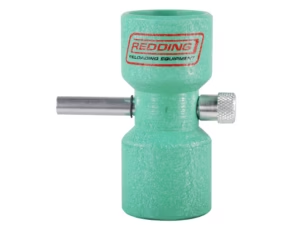
The Redding Model 3 Powder Measure has been in continuous production for decades, and the version with the Universal Metering Chamber is the configuration that most handloaders reach for when they want a single measure to cover everything from pistol flake powders through slow magnum rifle stick powders. The Universal Chamber is a micrometer-adjustable drum designed to handle the full practical range of powder types and charge weights without requiring a chamber swap for most applications. At a street price in the $100-130 range, it is the most affordable entry point into the Redding powder measure line – and Redding’s powder measures occupy the upper tier of the non-competition mechanical measure category for solid reasons.
Redding is one of a handful of American reloading equipment manufacturers that has held a consistent reputation for mechanical quality over multiple generations of handloaders. Their dies, presses, and powder measures are known for tight tolerances and long service lives. The Model 3 reflects that manufacturing philosophy: machined aluminum throughout, a drum-to-housing fit that maintains consistency after years of use, and a design that requires minimal maintenance. It is not a benchrest competition measure – the Redding BR-30 occupies that position in the Redding line – but it is a thoroughly capable general-purpose measure that handles hunting loads, service rifle loads, and moderate precision rifle work with equal competence.
The Model 3 with Universal Chamber is the right choice for the handloader who loads multiple calibers across the full spectrum from pistol to magnum rifle, wants a single measure that does not require chamber swaps for most applications, and is ready to move beyond the budget tier into a tool that will remain in service for a decade or more without performance degradation. It is a long-term purchase, not a starter measure.
Key Specifications
| Feature | Detail |
|---|---|
| Manufacturer | Redding Reloading Equipment |
| Model | Model 3 Powder Measure with Universal Metering Chamber |
| SKU | Not available at time of publication |
| UPC | Not available at time of publication |
| Metering System | Micrometer-adjustable rotating drum |
| Chamber | Universal Metering Chamber – handles pistol through magnum rifle charges |
| Charge Range | Approximately 0.5 to 100 grains (powder-dependent) |
| Adjustment | Micrometer drum with graduated scale; repeatable setting return |
| Construction | Machined aluminum body and drum; hard-anodized interior |
| Baffle | Powder baffle included |
| Mounting | Standard 7/8-14 threaded die body; fits any standard press or stand |
| Additional Chambers | Handgun Chamber available separately (sold as Redding 3 with Handgun Chamber or combined kit) |
| Compatible with Match 3BR Upgrade | Yes – Match 3BR drum is a direct replacement upgrade |
| User Rating | Not available at time of publication |
| MSRP | Approximately $119.99-$129.99 |
| Approx. Street Price | $100-$130 depending on retailer |
The Universal Metering Chamber – Design and What It Covers
The Universal Metering Chamber is the defining component of this configuration. Understanding what it does – and what its limits are – is the starting point for evaluating whether this is the right measure for a given handloader’s needs.
The metering chamber is a machined aluminum drum that rotates inside the measure housing. Its cavity is sized and shaped to accept powders across the full practical reloading range: small, fast pistol powders like Hodgdon Titegroup and Winchester 231 at the low end, slow magnum rifle powders like Hodgdon Retumbo and Alliant Reloder 33 at the high end, and everything between. The micrometer-style adjustment ring controls the effective cavity volume by moving the drum relative to a fixed cavity wall. Turn the ring and the charge weight changes. Return the ring to a previously recorded micrometer setting and the charge weight returns to that value, reproducibly.
That reproducibility is one of the Model 3’s most practically useful features. A handloader who loads 6.5 Creedmoor at one micrometer setting and 308 Winchester at another can record both settings, switch between calibers quickly, and return to each setting without re-verifying charge weight from scratch every session. In practice, the first throw after returning to a recorded setting still gets verified on a scale – powder lot variations and humidity changes affect density slightly – but the starting point is reliably close to the target.
The Universal Chamber’s geometry is a compromise. It is sized to handle both the small charge volumes of fast pistol powders and the large charge volumes of slow rifle powders, which means it is not optimized for either extreme. At the low end – 3 to 5 grain pistol charges – the universal chamber’s relatively large cavity volume means the operator is working at the lower micrometer settings where small adjustments produce proportionally larger charge changes. Redding’s dedicated Handgun Metering Chamber is better calibrated for that range. At the high end – 85 to 100 grain magnum charges – the universal chamber handles the volume adequately, though charge-to-charge consistency with very coarse extruded powders is somewhat better in the longer-cavity Match 3BR drum.
For the middle range – 20 to 70 grain rifle charges that represent the majority of what most precision handloaders actually load – the Universal Chamber performs excellently. This is the sweet spot of the design.
Build Quality and Design
The Redding Model 3 body is machined aluminum throughout. There is no polymer in the structural components. The drum-to-housing interface is fitted to tolerances that maintain consistent cavity volume across thousands of operation cycles. Machined aluminum does not creep, deform, or develop the sloppy fit that develops in polymer measures after extended use. The interior surfaces of the drum cavity are hard-anodized, which provides wear resistance and a surface texture that does not accumulate powder residue as aggressively as bare aluminum.
The micrometer ring is the component that most distinguishes the Model 3 from budget-tier measures. It is a threaded aluminum ring with a graduated scale, machined to provide consistent thread engagement without backlash. Backlash in a micrometer system – where turning the ring back does not immediately change the setting because of thread slop – produces unreliable charge weight returns to recorded settings. The Redding ring has minimal backlash, which is why the setting-return feature works reliably in practice.
The drum operates on a throw arm with a definite stop at each end of the rotation. The stops are metal-to-metal contacts – no plastic bumpers that wear and change position over time. Each throw produces the same drum rotation angle, which is the mechanical foundation for charge-to-charge consistency. The throw arm itself is the standard lever design found on most measures, without the ergonomic handle of some competing products. Over a long session, some operators find a bare lever arm less comfortable than a handled design, but Redding’s throw arm geometry provides adequate mechanical advantage for smooth operation.
The powder baffle is included and fits inside the hopper above the drum. Its function – disrupting the powder column to maintain consistent head pressure on the drum cavity as the hopper empties – is as important in a quality measure as in a budget one. Redding includes it as standard rather than as an afterthought.
The 7/8-14 threaded die body mounts to any standard press die station or powder measure stand. The fit between the Model 3’s die body and a standard die station is tight – the machined die body threads more precisely than a polymer-bodied measure, which reduces the wobble that can develop in polymer measures when mounted to a press.
Setup and Operation
Mount the measure in a press die station or on a dedicated powder measure stand. Tighten hand-firm plus a quarter turn – the metal body can accept more torque than a polymer-bodied measure without cracking, but there is no benefit to overtightening.
Set the micrometer ring to the approximate position for the target charge using the Redding charge table included with the measure. This gives a starting point; actual charge weight depends on powder density, which varies by brand and lot. Throw ten charges into a powder pan, weigh each on a calibrated scale, and record the actual average charge at that micrometer setting. Adjust the ring in small increments until the average thrown charge is within 0.2 grains of the target. Record the final micrometer setting for future reference.
Technique consistency matters. Each throw should be a full, smooth rotation to both stops with a consistent lever speed. A deliberate, unhurried stroke allows the drum cavity to fill completely with extruded powder before the cavity rotates to the drop position. Rushed strokes with extruded powder produce inconsistent fill and higher charge variation. Ball powders are more forgiving of stroke speed variation; Hodgdon Varget, IMR 4064, and Hodgdon H4350 reward consistent, deliberate technique.
The Model 3 with Universal Chamber produces charge-to-charge variation of approximately ±0.2-0.3 grains with ball and short-grain extruded powders under good technique. With long-grain stick powders, variation is typically ±0.3-0.5 grains. For hunting loads and service rifle work, this is entirely adequate. For precision rifle competition where sub-0.2-grain consistency is the target, the Model 3 serves as the primary measure throwing charges near the target weight, with a trickler and scale for final verification – or the handloader upgrades to the Redding Match 3BR drum.
Switching powders requires only emptying the hopper of the current powder, cycling the drum several times to clear residual kernels, and refilling with the new powder. Do not mix powders in the hopper. If switching between very different powder types – ball pistol powder to coarse rifle stick powder – a quick disassembly and wipe of the drum cavity is good practice to prevent contamination.
Where It Fits – Use Cases
General-purpose rifle loading across multiple calibers is the Model 3’s home territory. A handloader who loads 223 Remington with Hodgdon Varget, 308 Winchester with IMR 4064, 6.5 Creedmoor with Hodgdon H4350, and 7mm Remington Magnum with Alliant Reloder 22 does not need to change metering chambers between any of those calibers. Record the micrometer settings, swap hoppers or powder types between sessions, and return to verified settings each time.
Hunting load production where 50-150 rounds per season covers the total output is a natural fit. The Model 3’s mechanical consistency means that once a working load is verified and the micrometer setting recorded, subsequent batches of that load require only a verification throw at the start of the session. The time invested in initial setup is amortized across many loading sessions.
Service rifle and highpower loading – 223 Remington and 308 Winchester for CMP and NRA highpower competition – sits comfortably within the Universal Chamber’s performance range. Competition highpower loads typically use medium extruded powders (Hodgdon Varget, Hodgdon H4895, IMR 4895) where the Model 3’s ±0.3-grain consistency is acceptable, and production volume in the 200-500 rounds per session range is practical with a measure at this price tier.
Pistol loading with the Universal Chamber is functional but not optimal for small fast-powder charges. A dedicated Handgun Metering Chamber or the Redding 3 with Universal and Handgun Chamber kit is the better configuration for a handloader who loads significant volumes of pistol calibers alongside rifle work. The Universal Chamber handles 45 ACP and 357 Magnum adequately; it is less well-suited to 9mm Luger charges of 4-5 grains where the micrometer setting is at the low end of the Universal range.
Precision rifle competition at the highest level – PRS, benchrest, F-Class – is where the Model 3 with Universal Chamber reaches its ceiling. It handles these applications better than any budget-tier measure, but competitive shooters often prefer the tighter drum tolerances of the Redding Match 3BR or the dedicated geometry of the Redding BR-30 for the lowest possible charge variation with extruded powder.
Competitive Analysis
Redding Model 3 vs. Redding Match 3BR with Universal Metering Chamber: The Match 3BR is a direct upgrade over the Model 3, using a drum machined to tighter tolerances with a geometry specifically optimized for extruded stick powder consistency. It costs approximately $40-60 more than the Model 3. The performance improvement is most evident with long-grain extruded powders where the tighter drum-to-housing fit reduces charge variation from ±0.3-0.5 grains to ±0.1-0.3 grains. For a handloader who loads primarily ball powder or medium extruded powders for hunting and service rifle use, the Model 3 is adequate and the price premium for the 3BR is hard to justify. For a handloader building toward precision rifle competition who will use the measure with slow stick powders, the 3BR is worth the premium. Choose the Redding Model 3 if your use case centers on general-purpose rifle and hunting loads. Choose the Redding Match 3BR if precision rifle competition with extruded powder is your primary application.
Redding Model 3 vs. Redding BR-30 Powder Measure: The BR-30 is Redding’s dedicated competition benchrest measure, optimized specifically for extruded stick powder in benchrest charge ranges. Its drum geometry and housing tolerances are the tightest in the Redding line. It costs approximately $150-175. The BR-30 is not a general-purpose measure – its design optimization for extruded powder in a narrow charge range makes it less suited for the full pistol-to-magnum-rifle range the Model 3 covers. The Model 3 is the versatile general-purpose tool; the BR-30 is the dedicated benchrest instrument. Choose the Redding Model 3 for general-purpose multi-caliber use. Choose the Redding BR-30 for dedicated benchrest loading with extruded powder where consistency below ±0.1 grain is the goal.
Redding Model 3 vs. Forster Bench Rest Powder Measure: The Forster Bench Rest Measure is a machined aluminum micrometer-adjustable measure that competes with the Redding Model 3 in the $100-140 price range. Forster’s drum design emphasizes extruded powder consistency through a different geometry approach than Redding’s. Both are quality instruments. Reloaders who are already in the Redding die and press ecosystem have a natural reason to prefer the Model 3; reloaders who use Forster dies and the Co-Ax press find the Forster measure integrates naturally with that setup. Performance between the two is comparable for most applications. Choose the Redding Model 3 if you are in the Redding reloading ecosystem or prefer Redding’s micrometer system. Choose the Forster Bench Rest Powder Measure if you run a Forster Co-Ax press and want matched accessories.
Redding Model 3 vs. Hornady Lock-N-Load Bench Rest Powder Measure: The Hornady Lock-N-Load measure is a micrometer-adjustable unit at approximately $70-85 – meaningfully less expensive than the Redding Model 3. The Hornady measure handles ball and extruded powders adequately and integrates with the Lock-N-Load press bushing system. The machining quality on the Redding is tighter – the drum fit, micrometer thread engagement, and body tolerances are consistently better than the Hornady unit at this price tier. Whether that quality differential is worth $35-50 depends on the handloader’s application and standards. For a casual hunting rifle reloader, the Hornady measure is adequate. For a serious precision reloader who will use the measure for years and loads a variety of calibers, the Redding Model 3’s build quality is a meaningful long-term advantage. Choose the Redding Model 3 if build quality and long-term performance consistency are priorities. Choose the Hornady Lock-N-Load Bench Rest Powder Measure if the Hornady ecosystem fit and price savings are the deciding factors.
Redding Model 3 vs. Lyman Brass Smith Powder Measure: The Lyman Brass Smith is a micrometer-adjustable measure at approximately $60-75, positioned below the Redding in price and build quality. It functions adequately for most rifle and pistol applications. The Redding Model 3’s advantages are tighter tolerances, better long-term consistency, and a drum-to-housing fit that stays consistent longer. Choose the Redding Model 3 if you want the best-performing measure in the non-competition class. Choose the Lyman Brass Smith Powder Measure if the Lyman ecosystem integration and lower price better fit your setup and budget.
Comparison Table
| Feature | Redding Model 3 Universal | Redding Match 3BR Universal | Redding BR-30 | Hornady LNL Bench Rest | Forster Bench Rest |
|---|---|---|---|---|---|
| Adjustment | Micrometer drum | Micrometer drum (tighter tolerance) | Micrometer drum (competition) | Micrometer drum | Micrometer drum |
| Construction | Machined aluminum | Machined aluminum | Machined aluminum | Aluminum | Aluminum |
| Ball Powder Performance | Excellent | Excellent | Good | Good | Good |
| Extruded Powder Performance | Good – ±0.3-0.5 gr | Very good – ±0.1-0.3 gr | Excellent – ±0.1 gr | Good | Good |
| Charge Range | 0.5-100 grains | 0.5-100 grains | Benchrest range | Full range | Full range |
| Universal Chamber Included | Yes | Yes | N/A – single drum | Yes | Yes |
| Handgun Chamber Option | Yes (separate purchase) | Yes (separate purchase) | No | No | No |
| Best Application | General purpose multi-caliber | Precision rifle + general use | Benchrest competition | Hornady ecosystem users | Forster Co-Ax users |
| User Rating | ~4.6/5 | ~4.7/5 | ~4.8/5 | ~4.3/5 | ~4.5/5 |
| Price Range | $100-$130 | $140-$175 | $150-$175 | $70-$85 | $100-$135 |
Troubleshooting
Charge weight varies more than expected between throws with extruded powder. The most common cause is inconsistent lever technique. With long-grain stick powders, the drum cavity must be allowed to fill completely before it rotates to the drop position. A fast, jerky stroke does not allow complete fill. Slow the stroke and ensure full travel to both mechanical stops on every throw. If variation persists with good technique, confirm the powder kernels are not bridging at the hopper-to-drum opening – this can happen with very coarse powders when the hopper is nearly full. Keep the hopper at half capacity or less with coarse powder.
Micrometer ring does not return to previously recorded setting accurately. Check for powder debris in the micrometer thread. Disassemble the drum from the housing, clear any accumulated powder dust from the micrometer threads with a dry brush, and reassemble. If the thread has visible wear, Redding’s service department handles Model 3 repairs and replacement components. Confirm that the recorded setting was made with the same powder and powder lot – density variations between lots affect the charge weight at any given micrometer setting.
Charge weight drifts across a session – first throws are heavier or lighter than later throws. This is baffle-related head pressure variation. Confirm the baffle is correctly seated in the hopper. If the drift is progressive as the hopper empties, the baffle is not fully disrupting the column pressure. Refill the hopper to at least half before drift appears and note at what hopper level the drift begins – this helps identify whether the baffle position needs adjustment.
Powder leaks around the drum-to-housing interface. Fine powder dust emerging from the drum-housing gap is normal at very low levels. If significant powder is escaping, the drum has developed wear or the housing interior has accumulated debris that is preventing full drum seat. Disassemble, clean all contact surfaces with a dry cloth, inspect the drum exterior for raised burrs from contact damage, and reassemble. The Redding Model 3’s machined fit should not allow significant powder leakage under normal use.
Throw arm feels stiff or binds at the end of travel. Check for powder impaction in the drum cavity at the stop positions. A small buildup at the cavity opening edge can cause the drum to bind as it contacts the housing stop. Disassemble and clean the drum cavity and housing contact area. After cleaning, apply a very light coat of dry lubricant to the drum’s exterior cylindrical surface – not to the cavity interior.
Frequently Asked Questions
What is the difference between the Redding Model 3 with Universal Chamber and the Model 3 with Universal and Handgun Chambers? The Redding 3 with Universal and Handgun Metering Chamber is a bundle that includes both chambers. The Universal Chamber handles the full charge range but is less precisely calibrated at the low end for small pistol charges. The Handgun Chamber is a smaller-cavity drum optimized for the 3-15 grain range of most pistol loads, providing better micrometer resolution at those small charge weights. A handloader who loads significant volumes of both pistol and rifle calibers should buy the combined kit rather than purchasing the second chamber later at a higher per-unit cost.
Can I upgrade the Model 3 to a Match 3BR later by purchasing just the drum? Yes. The Redding Match 3BR drum is a direct drop-in replacement for the Model 3’s Universal Chamber. The housing, body, and hardware are identical between the Model 3 and the Match 3BR – the drum is the only difference. A handloader who starts with the Model 3 and later decides they want Match 3BR performance can purchase the replacement drum without buying a new complete measure.
How does the Redding Model 3 perform with Hodgdon H4350 for 6.5 Creedmoor loads? H4350 is a medium extruded powder that meters well through the Universal Chamber. Charge-to-charge variation with H4350 and good technique runs approximately ±0.3 grains in most setups – acceptable for hunting and service rifle loads, adequate for most practical precision rifle applications. A handloader who needs tighter than ±0.2-grain consistency for competition work uses the Model 3 to throw charges close to the target weight and a trickler to bring each charge to exact weight on a scale.
Does the Redding Model 3 work on a Redding T-7 Turret press or Redding Big Boss II? Yes. The Model 3 uses standard 7/8-14 threading and mounts to any die station on any press using that threading, including the Redding T-7 Turret, Redding Big Boss II, and Redding Ultramag. The Redding measure on a Redding press is a natural combination – same brand, coordinated tolerances, and a familiar thread fit.
Is the Model 3 suitable for 300 Win Mag or other large magnum calibers with charges over 80 grains? Yes. The Universal Chamber handles charges into the 90-100 grain range depending on powder density. A 300 Win Mag charge of Hodgdon H1000 at approximately 78-82 grains sits comfortably within the Universal Chamber’s range. Alliant Reloder 33 or Vihtavuori N570 at 85+ grains for belted magnum calibers are at the upper range but workable. Verify actual charge weight on a scale with each new powder combination regardless of micrometer setting.
What maintenance does the Model 3 require? Minimal. After each loading session, cycle the drum several times with the hopper empty to clear residual powder. Wipe the drum exterior and housing interior with a dry cloth if powder dust has accumulated. Annually or after every 2,000-3,000 rounds, disassemble the drum from the housing and clean the drum exterior, housing interior, and micrometer threads with a dry brush. Apply a light coat of dry lubricant to the drum’s exterior cylindrical surface. Avoid liquid lubricants that attract powder residue. The Model 3 does not require other maintenance under normal use.
Conclusion
The Redding Model 3 Powder Measure with Universal Metering Chamber earns its position in the upper tier of non-competition mechanical powder measures on the basis of what it actually delivers: machined aluminum construction that maintains consistent performance over years of use, a micrometer adjustment system that returns to recorded settings reliably, and adequate performance across the full range of powders and calibers that most serious handloaders work with. It is the measure that a handloader buys once and uses for the life of their reloading setup without upgrade pressure, unless competition-level precision rifle loading with extruded powder is the eventual destination.
The price premium over budget-tier measures is real and justified. A Hornady Lock-N-Load measure at $75 is half the cost and does the job adequately for many applications. The Redding Model 3 at $115 has better machining, tighter tolerances, and a micrometer system that returns more accurately to recorded settings – advantages that compound over years of regular use. For the handloader who is building a setup they intend to use for a decade, the Redding’s cost differential is modest.
Choose the Redding Model 3 Powder Measure with Universal Metering Chamber if you load multiple calibers spanning both rifle and pistol applications, want a single micrometer-adjustable measure with reliable setting-return capability and machined aluminum quality that holds up to long-term regular use – particularly if you are in the Redding reloading ecosystem with a Redding T-7 Turret or Redding Big Boss II.
Choose the Redding Match 3BR with Universal Metering Chamber instead if precision rifle competition with extruded powder is your primary application and you want the tightest charge variation available in a manually operated rotating drum measure.
Choose the Redding BR-30 instead if you load dedicated benchrest calibers with extruded powder and want the best-performing single-application measure Redding produces.
Choose the Forster Bench Rest Powder Measure instead if you run a Forster Co-Ax press and want matched accessories throughout your setup, or prefer Forster’s drum geometry for extruded powder.
Choose the Hornady Lock-N-Load Bench Rest Powder Measure instead if you are in the Hornady press ecosystem and the Lock-N-Load bushing integration justifies accepting slightly lower build quality at a meaningfully lower price.
Disclaimer: Specifications and pricing in this article are drawn from manufacturer and retailer sources current at time of publication. Always verify current pricing before purchasing.