Published: 2026 | Last updated: May 2026
Hodgdon H1000 is a slow-burning, single-base extruded powder from the Hodgdon Extreme series – the standard-bearer for temperature-stable magnum performance in North American reloading. It occupies the burn rate position between Hodgdon H4831SC and Hodgdon Retumbo, covering the classic belted magnum territory that defines western North American big game hunting: 7mm Remington Magnum, 300 Winchester Magnum, 338 Lapua Magnum at standard bullet weights, and the full range of comparable large-capacity cartridges.
The powder’s defining property – what the Extreme series designation actually means for H1000 – is measured at approximately 0.21 fps per degree Fahrenheit of velocity variation. That number is the foundation of everything H1000 is known for. It means a load developed at 70°F in an October range session produces essentially the same velocity in January cold or August desert heat. It means drop charts do not need seasonal recalculation. It means the rifle zeroed in September shoots to the same point in November.
The stability comes at a cost: single-base chemistry without nitroglycerin produces less energy per gram than double-base alternatives. Alliant Reloder 22 and Alliant Reloder 26 both produce more velocity in the same cartridges at the same pressure. For shooters who prioritize maximum chronograph numbers and can manage seasonal variation, that double-base velocity premium is real. For hunters and competitors who need consistent point-of-impact year-round, the Extreme stability is worth the velocity trade.
This article is based on published manufacturer specifications, established load data, and documented field reports. Specifications and performance figures can vary between lots, rifles, and conditions. If you have loaded Hodgdon H1000 in practice – leave a comment below: real-world experience from the reloading bench is what separates verified data from manufacturer claims.
Powder Description and Technical Profile
Hodgdon H1000 is a single-base, extruded stick powder. The single-base formulation – nitrocellulose without nitroglycerin – is the chemical foundation of both its primary advantage and its primary limitation.
Without nitroglycerin, the energy release involves one reaction rather than the nitrocellulose-nitroglycerin interaction. This produces three practical consequences. First, lower flame temperature than double-base alternatives at the same burn rate – the bore and throat see less heat per shot, which measurably extends barrel life in 338 Lapua Magnum and 300 Winchester Magnum barrels that see aggressive erosion rates from high charge weights. Second, inherently lower temperature sensitivity because the single reaction’s energy coefficient changes less with temperature than the two-component interaction in double-base powders. Third, the Extreme series additive package builds on this inherent stability to produce the industry-leading 0.21 fps per degree figure.
Bulk density is 0.910 g/cc – moderate for the slow magnum burn rate class, but adequate for the large-capacity cases H1000 serves. In 300 Winchester Magnum and 7mm Remington Magnum at working charge weights, case fill runs 93-98% – the range that produces consistent powder column contact with the primer and supports low standard deviations without compressed loads in most applications.
The grain geometry is traditional extruded stick – longer kernels than short-cut alternatives like IMR 8208 XBR or Alliant AR-Comp. The longer sticks produce more metering variance than short-cut or ball powders. Precision loading with H1000 requires either an auto-dispenser or a hand-weigh/trickle workflow. This is the standard approach for serious magnum loading regardless of powder choice; it is not a H1000-specific limitation.
Strengths:
- 0.21 fps per degree Fahrenheit temperature stability – the established Extreme series benchmark for slow-magnum powders, verified across millions of rounds of field use over decades
- Single-base clean burning produces less carbon residue than double-base alternatives in equivalent applications
- Lower flame temperature than double-base powders at the same burn rate – measurably extends barrel life in 338 Lapua Magnum, 300 Winchester Magnum, and similar high-erosion magnum cartridges
- Deepest published data library among slow-magnum powders in North American manuals
- Consistent lot-to-lot performance from Hodgdon’s manufacturing quality controls
- Reliable magnum primer ignition – the single-base granules initiate cleanly with standard magnum large rifle primers without the brisance requirements of some double-base alternatives
Limitations:
- Lower velocity ceiling than double-base alternatives – Alliant Reloder 26 produces 50-100 fps more in 300 Winchester Magnum at the same pressure. This is the single-base energy trade-off
- Extruded stick geometry produces 0.2-0.4 grain volumetric metering variance – precision dispensing equipment or hand-weighing required for match-grade loads
- Availability gaps during demand cycles – H1000 is among the most popular slow-magnum powders and supplies tighten predictably when demand spikes
- Too slow for standard-capacity cartridges – 308 Winchester, 270 Winchester at standard loads, and similar produce incomplete combustion and poor standard deviations with H1000
Technical Characteristics
| Property | Specification |
|---|---|
| Manufacturer | Hodgdon Powder Company |
| Series | Hodgdon Extreme |
| Type | Single-Base Extruded (Stick) |
| Bulk Density (g/cc) | 0.910 |
| Burn Rate Category | Slow Rifle (Standard Magnum) |
| Temperature Stability | ~0.21 fps / °F |
The 0.21 fps/°F Figure – What It Means in the Field
The 0.21 fps per degree Fahrenheit stability measurement is the single most important specification for H1000 users. Translating it to practical field terms:
A typical North American big game hunting scenario involves shooting temperatures ranging from 85°F on a September scouting day to 15°F on a late-November elk hunt – a 70°F swing.
- H1000 at 0.21 fps/°F: 70°F x 0.21 = 15 fps total variation. At 800 yards with a 300 Winchester Magnum load, 15 fps produces less than 1 inch of vertical deviation. The September zero holds through November without recalculation.
- Alliant Reloder 22 at 1.2 fps/°F: 70°F x 1.2 = 84 fps variation. At 800 yards, 84 fps produces approximately 5-6 inches of vertical deviation – enough to miss a vital zone at extended range.
This is the practical value of the Extreme series designation, not marketing abstraction. At 300 yards on elk, neither powder matters much for seasonal variation. At 600-800 yards on mule deer across a season, the 0.21 fps/°F figure is worth every dollar of the velocity trade-off.
| Powder | Stability | 70°F Swing | At 800 yards |
|---|---|---|---|
| Hodgdon H1000 | 0.21 fps/°F | ~15 fps | <1″ |
| Hodgdon Retumbo | ~0.3 fps/°F | ~21 fps | ~1.5″ |
| Alliant Reloder 26 | ~0.5 fps/°F | ~35 fps | ~2.5″ |
| Alliant Reloder 22 | ~1.2 fps/°F | ~84 fps | ~5-6″ |
| Alliant Reloder 25 | ~1.75 fps/°F | ~123 fps | ~8-9″ |
Burn Rate Comparison and Competing Powders
| Powder | Type | Density (g/cc) | Key Character |
|---|---|---|---|
| Hodgdon H4831SC | Single-Base Extruded | 0.875 | Faster – 270 Win, 30-06, 25-06 |
| IMR 4831 | Single-Base Extruded | 0.870 | Faster – traditional, deep data |
| Alliant Reloder 22 | Double-Base Extruded | 0.930 | Faster – higher velocity, less stable |
| Norma MRP | Single-Base Extruded | 0.910 | Similar – European single-base |
| Hodgdon H1000 | Single-Base Extruded | 0.910 | Reference – Extreme benchmark |
| IMR 7828 SSC | Single-Base Extruded | 0.930 | Similar – short-cut, temperature sensitive |
| Alliant Reloder 26 | Double-Base Extruded | 0.989 | Slightly Slower – EI tech, higher velocity |
| Hodgdon Retumbo | Single-Base Extruded | 0.925 | Slower – Extreme, ultra-overbore focus |
| Accurate MagPro | Double-Base Spherical | 0.950 | Similar – ball metering, less stable |
vs. Hodgdon Retumbo: Within the Extreme series, Retumbo burns slightly slower than H1000 and is specifically optimized for ultra-overbore cases – 300 RUM, 300 PRC, 30-378 Weatherby – where H1000 peaks pressure too early. In 300 Winchester Magnum and 7mm Remington Magnum with standard-to-heavy bullet weights, H1000 is typically the better Extreme series match. The demarcation: H1000 for standard belted magnums, Retumbo for Ultra Magnums and the largest overbore cases.
vs. Alliant Reloder 26: Reloder 26 is double-base with Nitrochemie’s EI impregnation technology and produces 50-100 fps more velocity in 300 Winchester Magnum and 7mm Remington Magnum at the same pressure. Its temperature stability (~0.5 fps per degree) is substantially better than conventional double-base powders but does not match H1000’s Extreme series 0.21 fps. For a hunter who needs maximum velocity and can accept slightly more seasonal variation, Reloder 26 makes the trade. For one who wants set-it-and-forget-it year-round zero consistency, H1000 is the conservative choice.
vs. IMR 7828 SSC: IMR 7828 SSC is a single-base short-cut extruded powder at a comparable burn rate. Its short-cut geometry meters better than H1000’s longer sticks. Its temperature sensitivity (~1.8-2.4 fps per degree) is dramatically worse than H1000’s Extreme series chemistry. For a reloader who prioritizes metering convenience over seasonal stability, IMR 7828 SSC is an option. For one who values year-round consistency as the primary property, H1000 is the appropriate choice.
vs. Alliant Reloder 25: Reloder 25 is a double-base powder at a comparable burn rate with approximately 1.75 fps per degree sensitivity – the highest of any powder compared here. It is a legacy powder that predates modern temperature-stabilized alternatives. For most applications where Reloder 25 has historically been used, Reloder 26 is a more appropriate modern alternative. H1000 remains the correct choice when Extreme series year-round stability is the priority.
vs. Accurate MagPro: Accurate MagPro is a double-base ball powder with the metering advantage that spherical geometry provides. Its temperature sensitivity is moderate-to-high for a double-base powder. For high-volume magnum ammunition production on a progressive press where metering consistency matters more than seasonal stability, MagPro is a practical choice. For single-stage precision loading where year-round consistency is the priority, H1000 is more appropriate.
Recommended Cartridges and Applications
Hodgdon H1000 operates efficiently in large-capacity belted and rebated magnum cases with heavy-for-caliber bullets. Its burn rate is too slow for standard-capacity cartridges and appropriate for the standard belted magnum class – not the ultra-overbore cases that need Retumbo.
| Cartridge | Bullet Weight Range | Notes |
|---|---|---|
| 300 Winchester Magnum | 180-220 gr | Primary application – full weight range |
| 7mm Remington Magnum | 160-195 gr | Standard to heavy hunting and match loads |
| 338 Lapua Magnum | 250-285 gr | Standard ELR competition weights |
| 6.5 PRC | 143-156 gr | Precision hunting – slightly slow end |
| 300 PRC | 200-225 gr | ELR precision hunting |
| 270 Winchester | 150-160 gr | Heavy-bullet only – standard 130 gr use H4831SC |
| 7mm Weatherby Magnum | 154-175 gr | Full-power Weatherby performance |
| 300 Weatherby Magnum | 180-200 gr | Standard to heavy Weatherby loads |
| 338 Winchester Magnum | 225-275 gr | Standard hunting loads |
| 300 WSM | 180-200 gr | Short-action magnum heavy bullets |
The 300 Winchester Magnum with 200-215 grain high-BC bullets is the application where H1000’s combination of properties most clearly outperforms double-base alternatives for year-round precision use. The burn rate is well-matched to the case capacity at these bullet weights, the Extreme stability holds zero across seasons, and the lower flame temperature of single-base chemistry is particularly valuable in a 300 Win Mag barrel that generates aggressive erosion from high-pressure 30-caliber loads.
The 6.5 PRC note: H1000 is documented for 6.5 PRC and produces accurate loads. Its burn rate is at the slower end of what the 6.5 PRC case uses efficiently with 143-156 grain bullets. Hodgdon Retumbo or Alliant Reloder 26 may produce better case fill and efficiency in this cartridge depending on the specific bullet weight. Verify against current Hodgdon data and develop from both if H1000 and Retumbo are available.
Bullets
Hodgdon H1000 is specifically suited to heavy, high-BC projectiles in large magnum bore sizes where the slow, sustained pressure curve provides the most complete acceleration before the bullet exits the muzzle.
| Brand | Model | Weight | Cartridge | Application |
|---|---|---|---|---|
| Berger | Hybrid Target | 195-215 gr | 300 Win Mag / 300 PRC | ELR Competition |
| Berger | LRHT | 195-215 gr | 300 Win Mag / 300 PRC | Long-Range Hunting |
| Hornady | ELD-M | 195-225 gr | 300 Win Mag / 300 PRC | Long-Range Match |
| Hornady | ELD-X | 178-212 gr | 300 Win Mag / 7mm Rem Mag | Long-Range Hunting |
| Sierra | MatchKing | 175-220 gr | 300 Win Mag / 7mm Rem Mag | Competition |
| Sierra | Tipped MatchKing | 175-200 gr | 300 Win Mag / 7mm Rem Mag | Match Accuracy |
| Nosler | AccuBond | 175-210 gr | 7mm Rem Mag / 300 Win Mag | Bonded Hunting |
| Nosler | Partition | 175-200 gr | 7mm Rem Mag / 300 Win Mag | Classic Big Game |
| Lapua | Scenar-L | 250-285 gr | 338 Lapua Magnum | ELR Competition |
| Lapua | Naturalis | 185-230 gr | 300 Win Mag / 7mm Rem Mag | Lead-Free Hunting |
| Barnes | LRX | 168-200 gr | 300 Win Mag / 7mm Rem Mag | Lead-Free Long Range |
| Federal | Trophy Bonded | 165-200 gr | 300 Win Mag | Premium Hunting |
Have you loaded Hodgdon H1000? Your practical data on charge weights, accuracy nodes, temperature behavior, or metering experience helps other reloaders more than any spec sheet. Leave a comment below.
Primers
Hodgdon H1000 as a slow-burning single-base powder in large-capacity cases requires magnum large rifle primers for consistent ignition in all primary applications. Standard large rifle primers produce incomplete ignition events with slow powder columns in large cases, showing as elevated extreme spread and inconsistent velocity. This is not a cold-weather-only recommendation – magnum primers are required for H1000 at all temperatures.
| Primer | Type | Application |
|---|---|---|
| Federal GM215M | Large Rifle Magnum Match | Competition precision – gold standard |
| CCI 250 | Large Rifle Magnum | General magnum applications |
| Winchester WLRM | Large Rifle Magnum | Consistent hunting and match loads |
| Remington 9-1/2M | Large Rifle Magnum | Standard magnum hunting choice |
| Federal 215 | Large Rifle Magnum | Maximum ignition for large cases |
| CCI BR-2 | Large Rifle Benchrest | Competition where magnum brisance is adequate |
| Fiocchi Large Rifle Magnum | Large Rifle Magnum | Consistent European alternative |
| RWS 5337 | Large Rifle Magnum | Premium European precision option |
The Federal GM215M is the most commonly cited competition primer with H1000 in precision 338 Lapua Magnum and 300 Winchester Magnum loading. Primer seating depth consistency matters significantly with slow powder columns in large cases – use a quality bench priming tool and verify seating depth periodically.
Metering and Equipment Compatibility
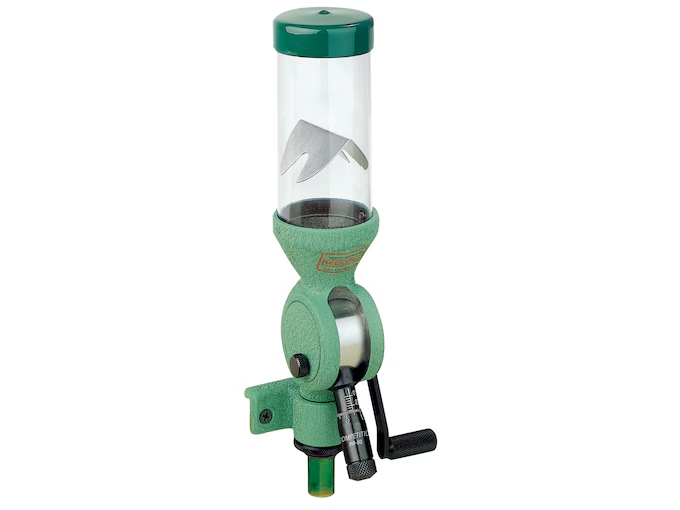
Hodgdon H1000 is an extruded stick powder with longer kernels than short-cut alternatives. Standard volumetric powder measures produce 0.2-0.4 grain charge-to-charge variance – acceptable for hunting loads but not for competition-grade work.
For precision competition and hunting loads, a digital auto-dispenser is the practical tool. The RCBS ChargeMaster Supreme, RCBS MatchMaster, and Hornady Auto-Charge Pro all handle large-grain extruded powders at magnum charge weights reliably. The Frankford Arsenal Powder Trickler with a high-resolution scale – Lyman Gen 6 Compact or Frankford Arsenal Precision Digital Scale – covers the hand-weigh approach for those who prefer it.
For hunting load production where 0.2-0.3 grain variance is acceptable, the Redding Match Grade 3BR with consistent handle cycling delivers adequate results for field ammunition.
At the 90-95% case fill range where H1000 typically operates in its primary applications, a long drop tube helps large kernels settle consistently before bullet seating – an important step for near-maximum loads where inconsistent compression from uneven kernel packing introduces start-pressure variation.
Reloading Safety Notes
All charge weights must come from current published Hodgdon load data for H1000 specifically. Hodgdon publishes free load data online. Do not substitute Alliant Reloder 22, Alliant Reloder 26, or Hodgdon Retumbo charge weights without independent verification. The density and burn rate differences between these powders are large enough that charge weights are not interchangeable.
Start 10% below the listed maximum and work up in 0.3-grain increments. In large magnum cases, pressure can rise steeply near maximum. Stiff bolt lift is the earliest reliable pressure indicator in bolt-action magnum rifles – do not dismiss it.
The single-base Extreme chemistry of H1000 produces its stability across the full -20°F to 125°F range without the non-linear pressure behavior that affects some double-base powders above 85°F (such as the concern documented with Alliant Reloder 26). Loads developed at any temperature in that range should behave predictably at any other temperature within it.
See the overpressure in reloading guide for systematic pressure sign identification.
FAQ
Does H1000 work in 338 Lapua Magnum with 300-grain bullets?
H1000 is documented for 338 Lapua Magnum with 250-285 grain bullets where the burn rate is well-matched. For the heaviest 285-300 grain bullets at maximum ELR velocities in 27-30 inch barrels, Hodgdon Retumbo or Alliant Reloder 33 are typically better matched – slightly slower burn that sustains pressure further through the longer barrel. H1000 in 338 Lapua with 300-grain bullets can work but may not produce the maximum velocity that heavier bullets specifically benefit from. Verify against current Hodgdon published data.
How does H1000 compare to Alliant Reloder 26 for 300 Win Mag?
Alliant Reloder 26 produces 50-100 fps more velocity at the same pressure from its double-base EI chemistry. H1000 produces better year-round seasonal consistency (0.21 fps/°F vs Reloder 26’s ~0.5 fps/°F). H1000 also does not carry the above-85°F elevated pressure concern that Reloder 26 reloaders must manage. For year-round hunting where seasonal consistency is the priority, H1000 is the more conservative choice.
Can H1000 be used in 7mm PRC?
7mm PRC is a purpose-built ELR cartridge with a larger case than 7mm Rem Mag. H1000 is documented for 7mm PRC with appropriate heavy bullet weights. The slightly larger case of the PRC may also suit Retumbo – verify both against Hodgdon’s published data for your specific bullet weight and develop from whichever produces better case fill and lower standard deviation.
Conclusion
Hodgdon H1000 earns its benchmark status through decades of consistent, field-verified performance in the cartridges that define North American magnum big game hunting and long-range precision shooting. The 0.21 fps per degree temperature stability is not a marketing claim – it is a measured, independently verified property that has been confirmed in millions of rounds across extreme seasonal conditions.
The trade-offs are equally real: less velocity than double-base alternatives, extruded geometry that requires precision dispensing, and reliable availability only when supply chains are healthy. All of these are manageable characteristics of a powder that delivers its primary property – year-round zero consistency – without compromise.
Choose Hodgdon H1000 if you load 300 Winchester Magnum, 7mm Remington Magnum, 338 Lapua Magnum, or similar belted magnums and need year-round point-of-impact consistency across seasonal temperature swings without load recalculation. Choose Hodgdon Retumbo if your primary cartridges are Ultra Magnums – 300 RUM, 300 PRC, 30-378 Weatherby – where H1000 is slightly too fast. Choose Alliant Reloder 26 if maximum velocity with acceptable seasonal variation is the priority and you can manage the temperature development protocol. Choose Alliant Reloder 22 if maximum velocity matters most and year-round consistency is secondary to achieving every available fps at a given pressure level.
Editor’s note: Published load data and manufacturer specifications are the starting point – not the final word. Field experience from reloaders who have actually worked with this powder is the most reliable guide to what it does in practice. If you have used Hodgdon H1000, share your results in the comments.