Published: 2026 | Last updated: May 2026
IMR 7828 SSC is a slow-burning, single-base super-short-cut extruded powder that is a direct evolution of the long-standing IMR 7828. “SSC” stands for Super Short Cut – the grain geometry has been significantly shortened compared to the original IMR 7828 to address the primary practical limitation of all long-grain extruded slow powders: metering consistency. The chemical formulation is substantially the same as IMR 7828; the physical grain dimensions are the differentiator.
The powder sits in the slow-burning magnum rifle position between Hodgdon H4831SC (slightly faster) and Hodgdon H1000 (slightly slower). This positions it for the same large-capacity magnum applications as Alliant Reloder 22 and comparable powders: 7mm Remington Magnum, 300 Winchester Magnum, 270 Winchester with heavy bullets, and the range of similar large belted magnum cartridges.
The honest framing: IMR 7828 SSC carries temperature sensitivity of 1.3-1.4 fps per degree Fahrenheit – neither exceptional nor problematic, but meaningfully more sensitive than Hodgdon H1000 (0.21 fps/°F) or IMR 4955 Enduron (<0.5 fps/°F). It is a traditional single-base slow-magnum powder whose primary modern advantage over competitors is the SSC grain geometry’s metering improvement.
This article is based on published manufacturer specifications, established load data, and documented field reports. Specifications and performance figures can vary between lots, rifles, and conditions. If you have loaded IMR 7828 SSC in practice – leave a comment below: real-world experience from the reloading bench is what separates verified data from manufacturer claims.
Powder Description and Technical Profile
IMR 7828 SSC is a single-base, super-short-cut extruded cylindrical powder. The single-base formulation – nitrocellulose without nitroglycerin – produces the clean-burning behavior and moderate temperature stability characteristic of single-base chemistry, without the energy density premium of double-base alternatives.
The super-short-cut grain geometry is the defining engineering improvement. The original IMR 7828 uses traditional long-stick grains that bridge across measure drum apertures, shear during the metering cycle, and produce charge-to-charge variance of 0.4-0.6 grains in standard volumetric measures. The SSC version shortens each kernel significantly, producing grains that are effectively compact cylinders rather than long sticks. The practical result:
- Metering variance drops to approximately ±0.1-0.2 grains on quality equipment – substantially better than the original IMR 7828
- Packing density in the case increases by approximately 4% – the shorter grains settle more uniformly in the case, allowing slightly more charge weight to fit before reaching compression at any given case fill percentage
The 4% packing density improvement is not trivial in large-capacity magnum cases. In 300 Winchester Magnum with 180-grain bullets, a 4% improvement in packing efficiency translates to approximately 3-4 additional grains of charge weight before compression – potentially 30-50 fps more velocity at the density maximum.
Bulk density is approximately 0.945 g/cc (59 lbs/ft³) – high for a single-base extruded slow powder, reflecting the efficient packing of the super-short-cut geometry. For reference: Hodgdon H1000 is 0.910 g/cc, Alliant Reloder 22 is 0.930 g/cc. IMR 7828 SSC’s higher packing density is the physical mechanism behind the case capacity improvement.
The progressive pressure curve of a slow single-base extruded powder builds steadily through the bore, sustaining pressure through 24-26 inch magnum barrels effectively. This sustained push produces the velocity advantage in long-barreled magnums that faster powders cannot achieve at the same pressure.
Strengths:
- Super-short-cut geometry produces ±0.1-0.2 grain metering variance – substantially better than the original IMR 7828 and competitive with quality short-cut alternatives
- 4% case capacity improvement from improved packing density – meaningful additional charge weight before compression compared to long-cut alternatives
- Single-base clean burning – less carbon residue than double-base magnum powders at equivalent pressure
- Single-base temperature stability (1.3-1.4 fps/°F) – better than double-base alternatives like Alliant Reloder 22 (1.6-1.8 fps/°F), though substantially more sensitive than Extreme series or Enduron alternatives
- Sustained progressive pressure curve extracts velocity efficiently from 24-26 inch magnum barrels
- Deep published data library from the long IMR 7828 family history in major North American manuals
Limitations:
- Temperature sensitivity of 1.3-1.4 fps/°F – categorized as “fair/marginal” for extreme long-range precision hunting. Loads developed at 60°F produce elevated pressure at 95°F and lower velocity at 10°F; full temperature protocol required
- Not at Extreme series or Enduron stability levels – Hodgdon H1000 (0.21 fps/°F) and IMR 4955 Enduron (<0.5 fps/°F) are substantially more seasonally consistent
- SSC metering still not at ball powder levels – ±0.1-0.2 grain is good for an extruded powder but does not approach the 0.04-0.07 grain variance of spherical alternatives
- Single-base lower energy density – Alliant Reloder 22 and Alliant Reloder 26 produce higher peak velocities from double-base chemistry
- Too slow for standard-capacity cartridges – 308 Winchester and similar cases produce incomplete combustion and poor standard deviations
Technical Characteristics
| Property | Specification |
|---|---|
| Manufacturer | IMR Powder (Hodgdon Powder Company) |
| Type | Single-Base Super-Short-Cut Extruded |
| Bulk Density (g/cc) | ~0.945 (59 lbs/ft³) |
| Grain Shape | Super Short Cylindrical |
| Burn Rate Category | Slow Rifle (Magnum) |
| Temperature Sensitivity | ~1.3-1.4 fps / °F |
| vs. Original IMR 7828 | Same chemistry, shorter grain cut |
IMR 7828 vs. IMR 7828 SSC – Why SSC Is Almost Always the Better Choice
The original IMR 7828 is still available, and the practical question of which to use is worth addressing directly.
Both powders have essentially the same chemical formulation. The only difference is grain length. The consequences of that difference:
IMR 7828 (long cut): 0.4-0.6 grain metering variance typical. Long sticks bridge in measures, shear at the drum edge, and settle unevenly in cases. For a reloader who hand-weighs every charge on a precision scale, these metering issues disappear – the charge goes to the same weight regardless of what the measure does.
IMR 7828 SSC (super short cut): 0.1-0.2 grain metering variance typical. Better packing in the case produces approximately 4% more charge weight before compression. Essentially identical results at the same charge weight in identical conditions, but more practical for production loading.
The verdict is simple: unless IMR 7828 is specifically available and SSC is not, there is no reason to use the long-cut version. SSC is a direct improvement in practical use without any performance trade-off.
Temperature Sensitivity – Context and Protocol
1.3-1.4 fps per degree Fahrenheit places IMR 7828 SSC in the middle of the magnum powder sensitivity spectrum – significantly better than Alliant Reloder 22 at 1.6-1.8 fps/°F, but substantially more sensitive than Hodgdon H1000 at 0.21 fps/°F.
For a typical western North American hunting scenario with a 300 Winchester Magnum – load development in August at 80°F, hunting in November at 15°F – the 65°F temperature drop produces:
IMR 7828 SSC at 1.35 fps/°F: 65°F x 1.35 = 88 fps velocity reduction in the field versus the development temperature.
At 500 yards with a 180-grain bullet, 88 fps produces approximately 3-4 inches of additional drop compared to the August zero. A hunter who confirmed a 500-yard zero in August and does not account for November cold will be shooting 3-4 inches low.
The management protocol is the same as any temperature-sensitive powder: develop the final maximum charge at the highest temperature you will use the firearm. A load validated at 80°F summer temperature is safe year-round. Verify cold-weather velocity to build a temperature-corrected drop chart.
| Powder | 65°F Winter Swing | At 500 yards |
|---|---|---|
| Hodgdon H1000 | ~14 fps | <0.5″ |
| IMR 4955 Enduron | ~25 fps | ~1″ |
| IMR 7828 SSC | ~88 fps | ~3-4″ |
| Alliant Reloder 22 | ~104-117 fps | ~4-5″ |
Burn Rate Comparison and Competing Powders
| Powder | Type | Density (g/cc) | Key Character |
|---|---|---|---|
| Hodgdon H4831SC | Single-Base Extruded | 0.875 | Slightly Faster – Extreme stability |
| Alliant Reloder 19 | Double-Base Extruded | 0.935 | Faster – 270 Win, 30-06 |
| Alliant Reloder 22 | Double-Base Extruded | 0.930 | Similar – higher velocity, less stable |
| IMR 7828 SSC | Single-Base Short-Cut | 0.945 | Reference |
| IMR 7828 | Single-Base Long-Cut | 0.890 | Same chemistry, worse metering |
| Hodgdon H1000 | Single-Base Extruded | 0.910 | Slightly Slower – Extreme stability |
| IMR 4955 Enduron | Single-Base Short-Cut | 0.920 | Similar – Enduron stability |
| Alliant Reloder 26 | Double-Base Extruded | 0.989 | Slightly Slower – EI technology |
| Norma MRP | Single-Base Extruded | 0.910 | Similar – European single-base |
vs. Hodgdon H4831SC: H4831SC is slightly faster and belongs to the Extreme series with approximately 0.3 fps/°F stability – substantially better than IMR 7828 SSC’s 1.3-1.4 fps/°F. It produces less velocity from its slightly faster burn in large-capacity magnum cases. For year-round hunting where seasonal consistency is the priority, H4831SC is more practical. For maximum velocity in 300 Winchester Magnum and 7mm Remington Magnum from a single-base powder, IMR 7828 SSC provides more fps.
vs. Alliant Reloder 22: Reloder 22 is double-base and produces higher velocity at comparable pressures from its nitroglycerin energy content – the standard double-base vs. single-base velocity difference. It is 1.6-1.8 fps/°F versus IMR 7828 SSC’s 1.3-1.4 fps/°F – IMR 7828 SSC is marginally more stable. For a reloader who wants maximum velocity and will implement the temperature protocol anyway, Reloder 22 produces more fps. For one who wants single-base cleanliness with the same pressure range flexibility, IMR 7828 SSC is the appropriate choice.
vs. Hodgdon H1000: H1000 burns slightly slower, belongs to the Extreme series (0.21 fps/°F), and produces less velocity from single-base chemistry. The comparison is direct: maximum year-round stability goes to H1000; better metering with some velocity advantage and no stability requirement goes to IMR 7828 SSC.
vs. IMR 4955 Enduron: IMR 4955 Enduron is the Enduron-technology version at a comparable burn rate with temperature stability <0.5 fps/°F and integrated decoppering chemistry. It is the more technically capable modern alternative at this burn rate position. For a new load development program where the stability advantage and decoppering benefit justify the premium, IMR 4955 Enduron is the more forward-looking choice. For a reloader with established IMR 7828 SSC loads who is satisfied with the temperature protocol, there is no compelling reason to switch.
Recommended Cartridges and Applications
IMR 7828 SSC operates efficiently in large-capacity belted and standard magnum cases with heavy-for-caliber bullets. The burn rate is too slow for standard-capacity cartridges and appropriate for the large magnum class.
| Cartridge | Bullet Weight Range | Notes |
|---|---|---|
| 7mm Remington Magnum | 154-195 gr | Primary application – full range |
| 300 Winchester Magnum | 165-220 gr | Standard to heavy hunting |
| 270 Winchester | 140-160 gr | Heavy-bullet maximum velocity |
| 270 WSM | 140-160 gr | Short-action magnum |
| 7mm WSM | 154-175 gr | Short-action magnum |
| 300 WSM | 165-200 gr | Short-action magnum |
| 300 Weatherby Magnum | 165-200 gr | Standard Weatherby loads |
| 338 Winchester Magnum | 200-250 gr | Standard hunting loads |
| 6.5-284 Norma | 130-156 gr | Precision long-range loads |
| 25-06 Remington | 100-120 gr | Heavy-bullet applications |
The 7mm Remington Magnum is the historical center of IMR 7828 SSC’s application range – the cartridge where its burn rate is best matched to case capacity across the standard 154-175 grain hunting bullet range and the heavy 175-195 grain precision bullet range. In a 24-26 inch barrel, IMR 7828 SSC produces near the velocity ceiling for this cartridge at appropriate SAAMI pressures.
The 243 Winchester application with 105-115 grain heavy bullets is the counterintuitive entry. The original article mentions this, and the mechanism is the case-volume-to-bore-diameter principle: with very heavy bullets that are long for the bore, effective powder space is reduced, shifting the optimal burn rate toward slower powders. This is a specialized application verified in published IMR data, not a general 243 Winchester recommendation – standard 55-100 grain 243 Winchester loads use faster powders.
Bullets
IMR 7828 SSC produces best results with heavy-for-caliber, high-BC projectiles in its primary magnum bore sizes. The sustained progressive pressure curve provides maximum acceleration of heavy bullets through long magnum barrels.
| Brand | Model | Weight | Cartridge | Application |
|---|---|---|---|---|
| Berger | Hybrid Target | 168-195 gr | 7mm Rem Mag / 300 Win Mag | ELR Competition |
| Hornady | ELD-X | 162-195 gr | 7mm Rem Mag / 300 Win Mag | Long-Range Hunting |
| Hornady | ELD-M | 168-195 gr | 7mm Rem Mag / 300 Win Mag | Long-Range Match |
| Nosler | AccuBond | 160-200 gr | 7mm Rem Mag / 300 Win Mag | Bonded Hunting |
| Nosler | Partition | 160-200 gr | 7mm Rem Mag / 300 Win Mag | Classic Big Game |
| Sierra | MatchKing | 175-220 gr | 7mm Rem Mag / 300 Win Mag | Competition |
| Berger | VLD Hunting | 168-175 gr | 300 Win Mag | Long-Range Hunting |
| Barnes | LRX | 145-175 gr | 7mm Rem Mag / 270 Win | Lead-Free Long Range |
| Barnes | TTSX | 150-180 gr | 300 Win Mag / 7mm Rem Mag | Lead-Free Hunting |
| Federal | Trophy Bonded | 165-200 gr | 300 Win Mag | Premium Hunting |
Have you loaded IMR 7828 SSC? Your practical data on charge weights, accuracy nodes, temperature behavior, or comparison with H1000 and Reloder 22 helps other reloaders more than any spec sheet. Leave a comment below.
Primers
IMR 7828 SSC as a slow single-base powder in large-capacity cases benefits from magnum large rifle primers for consistent ignition. Standard large rifle primers may produce adequate ignition at moderate charge weights, but at maximum charges in the largest cases like 300 Weatherby Magnum and 338 Winchester Magnum, magnum primers provide more reliable and consistent ignition of the slow dense powder column.
| Primer | Type | Application |
|---|---|---|
| CCI 250 | Large Rifle Magnum | General magnum standard |
| Federal GM215M | Large Rifle Magnum Match | Competition precision |
| Winchester WLRM | Large Rifle Magnum | Hunting and match loads |
| Remington 9-1/2M | Large Rifle Magnum | Standard magnum hunting |
| Federal 215 | Large Rifle Magnum | Maximum ignition large cases |
| CCI BR-2 | Large Rifle Benchrest | Competition where adequate brisance confirmed |
| Winchester WLR | Large Rifle Standard | Moderate charges in smaller magnums |
| CCI 200 | Large Rifle Standard | Sub-maximum development starts |
| Fiocchi Large Rifle Magnum | Large Rifle Magnum | Consistent European alternative |
| RWS 5337 | Large Rifle Magnum | Premium European precision option |
When switching from standard to magnum primers in load development, reduce the starting charge by 5% and work back up. Magnum primers add brisance that can push a load at the top of the range with standard primers into elevated pressure territory.
Metering and Equipment Compatibility
The super-short-cut grain geometry is what distinguishes IMR 7828 SSC from IMR 7828 in practical loading use. On quality volumetric equipment, ±0.1-0.2 grain variance is achievable – a meaningful improvement over the 0.4-0.6 grain variance of the original long-cut version.
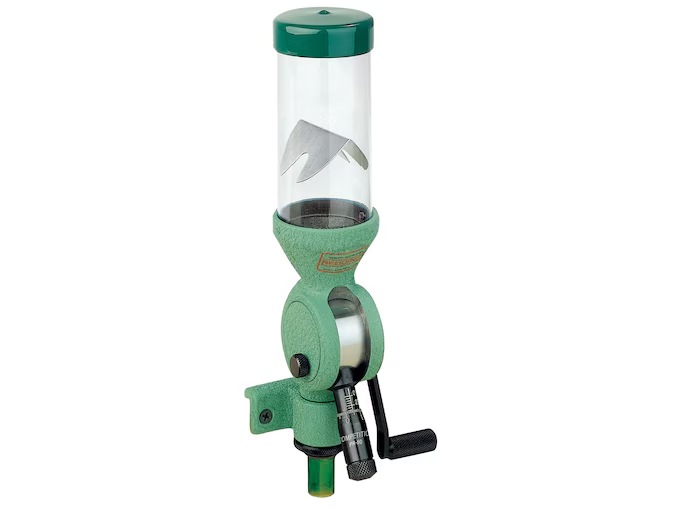
For hunting ammunition production where 0.1-0.2 grain variance is acceptable for the application, the Redding Match Grade 3BR and Forster Bench Rest Powder Measure handle IMR 7828 SSC with the short-cut geometry’s inherent improvement over longer sticks.
For precision match-grade loading where tighter standards apply, digital auto-dispensers are the appropriate tool. The RCBS ChargeMaster Supreme, RCBS MatchMaster, and Hornady Auto-Charge Pro handle large-charge slow powder loads reliably.
The Frankford Arsenal Powder Trickler with a Lyman Gen 6 Compact or Frankford Arsenal Precision Digital Scale covers the hand-trickle approach for individual charge verification at the ±0.02 grain level.
Reloading Safety Notes
All charge weights must come from current published IMR/Hodgdon load data for IMR 7828 SSC specifically. Do not substitute IMR 7828 (long cut), Hodgdon H1000, or Alliant Reloder 22 charge weights without independent verification.
Develop maximum charge at the highest field temperature. At 1.3-1.4 fps/°F, a load at maximum charge developed in winter conditions (40°F) may produce unsafe pressure in summer heat (95°F). The 55°F temperature increase produces approximately 72-77 fps additional velocity – and corresponding pressure increase.
Start 10% below the listed maximum and work up in 0.3-grain increments. Pressure signs in large magnum cases at slow powder burn rates: flattened or cratered primers, stiff bolt lift, ejector marks on case heads. The pressure builds steeply near maximum with slow-burning large charges – do not skip increments.
See the overpressure in reloading guide for systematic pressure sign identification.
FAQ
Should I use IMR 7828 or IMR 7828 SSC?
Almost always IMR 7828 SSC. The SSC version meters better (0.1-0.2 grain vs. 0.4-0.6 grain variance), packs approximately 4% more efficiently in the case, and has no performance trade-offs at the same charge weight. Unless SSC is specifically unavailable and the long-cut version is available, choose SSC. Note that charge weights are not identical between the two – the SSC typically requires slightly different maximum charge weights than the long-cut version for the same cartridge and bullet combination.
How does IMR 7828 SSC compare to H1000 for year-round hunting?
Hodgdon H1000 is 6-7 times more temperature stable (0.21 fps/°F vs 1.35 fps/°F). Over a typical hunting season with a 65°F temperature swing, this produces approximately 14 fps versus 88 fps of velocity variation. For a hunter shooting at 500+ yards across different seasons, H1000 requires no seasonal drop chart adjustment; IMR 7828 SSC produces 3-4 inches of additional drop at 500 yards in cold conditions. If season-to-season zero consistency is the priority, H1000 is the more practical choice.
Is IMR 4955 Enduron a better modern alternative to IMR 7828 SSC?
IMR 4955 Enduron is at a comparable burn rate with Enduron temperature stability (<0.5 fps/°F) and integrated decoppering chemistry – it is a more technically capable modern formulation at this burn rate position. For new load development, IMR 4955 Enduron is worth developing alongside IMR 7828 SSC and making the choice based on which produces better accuracy nodes in your specific barrel. For existing verified IMR 7828 SSC loads, the upgrade to Enduron requires starting fresh load development – a cost worth considering before switching.
Conclusion
IMR 7828 SSC is a well-positioned traditional slow-magnum powder that delivers specific and documented advantages over its long-cut predecessor: substantially better metering and improved packing density. Within the temperature sensitivity limitations of a non-Extreme, non-Enduron single-base formulation, it produces excellent velocity in large-capacity magnum cartridges from its sustained progressive pressure curve.
For hunters and precision shooters who develop loads at field temperatures and build temperature-corrected drop charts, IMR 7828 SSC is a fully capable choice in its application range. For those who need set-it-and-forget-it year-round zero consistency, the Extreme series or Enduron alternatives are more appropriate.
Choose IMR 7828 SSC if you load 7mm Remington Magnum or 300 Winchester Magnum with standard to heavy bullets and want single-base cleanliness with the best metering available in the traditional IMR 7828 family, with the acceptance of the 1.3-1.4 fps/°F temperature protocol. Choose Hodgdon H1000 if Extreme series year-round stability is the priority. Choose IMR 4955 Enduron if the modern Enduron stability and decoppering are worth starting fresh load development. Choose Alliant Reloder 22 if maximum velocity from double-base chemistry is the priority and the temperature protocol is acceptable.
Editor’s note: Published load data and manufacturer specifications are the starting point – not the final word. Field experience from reloaders who have actually worked with this powder is the most reliable guide to what it does in practice. If you have used IMR 7828 SSC, share your results in the comments.