Published: October 2025 | Last updated: June 2026
Introduction
Lapua introduced the Naturalis in 2002, making it one of the earlier commercially available lead-free hunting bullets from a major European manufacturer. The current version is marketed as a third-generation design, reflecting over two decades of refinement to the bullet’s valve tip mechanism, bearing surface geometry, and copper alloy formulation.
The Naturalis exists for two reasons. First, lead-free hunting regulations have expanded significantly in Scandinavia, Germany, and other European countries since the early 2000s, and Lapua needed a hunting bullet that complied with these restrictions while delivering the performance expected from a premium brand. Second, some hunters voluntarily choose lead-free bullets for environmental and food-safety reasons even where lead is still legal, and the Naturalis serves this market.
The Naturalis is a true monolithic copper bullet – no lead core. It is machined from a copper alloy rod rather than being assembled from separate jacket and core components. Lapua’s other bullets – the Lapua Scenar-L, Lapua Mega, Lapua Lock-Base, and Lapua FMJ – all use conventional jacket-and-core construction. The Naturalis is the only Lapua bullet without a lead core. This construction produces near-100% weight retention on impact because there is nothing to separate – the bullet is one piece. The tradeoff is the same as every other monolithic copper design: higher chamber pressure than a lead-core bullet of equal weight (because the harder copper has more bearing surface friction), the need for adequate freebore clearance to avoid pressure spikes, and a somewhat different accuracy node behavior during load development.
The feature that distinguishes the Naturalis from direct competitors like the Barnes TTSX and Hornady GMX is the green polymer valve tip. Barnes uses a standard polymer tip in the TTSX; Hornady uses a polymer tip in the GMX. The Naturalis tip incorporates a valve structure that Lapua claims produces more consistent, symmetric petal expansion than a standard polymer tip by equalizing hydraulic pressure across the expansion petals as the bullet opens. This mechanism is theoretically sound – asymmetric petal opening is a documented failure mode in monolithic expansion – but the practical difference compared to well-executed standard tips is difficult to verify without controlled testing.
The caliber range runs from .224-inch to .366-inch (9.3mm), with weights from 50 to 250 grains. The 9.3mm 250-grain and the 6.5mm 140-grain are the most relevant to the European market the Naturalis primarily serves. The caliber range extends to .338-inch (noted as .339-inch in Lapua’s data, which may reflect European bore measurement conventions) with a 231-grain variant at the exceptional G1 BC of 0.648.
Disclaimer: Reloading is an inherently dangerous activity. Always consult current published load data from reputable sources (Lapua, Hodgdon, Hornady, Lyman) before loading any cartridge. Monolithic copper bullets generate higher chamber pressures than lead-core bullets of the same weight. Always start at the published minimum charge for lead-free bullets specifically – not lead-core data – and work up carefully. Start conservatively and monitor for pressure signs. Never exceed maximum published loads. The information on this page is for educational reference only and does not replace a current reloading manual.
Technical Characteristics
The Naturalis’s construction is pure monolithic copper with a polymer valve tip – a combination that defines both its strengths and its practical constraints for handloaders.
Monolithic copper construction: The bullet is machined from copper alloy rod stock rather than formed from a drawn jacket over a pressed lead core. This eliminates the core-jacket interface entirely – there is no separation possible because there is only one material. On impact through heavy bone at any velocity, the bullet remains intact and penetrates in a predictable straight line. This is the fundamental reliability advantage of monolithic designs over all cup-and-core and bonded lead-core bullets.
Polymer valve tip: The green polymer tip is Lapua’s differentiated feature. The tip seats in a cavity at the bullet’s nose and acts in two ways. First, it initiates expansion by being driven rearward into the cavity on impact, creating a hydraulic shock that begins opening the copper petals. Second, the valve structure channels this hydraulic force symmetrically around the circumference of the cavity, so all four or five expansion petals begin opening simultaneously rather than sequentially. Whether this produces measurably better terminal performance than a standard polymer tip in field conditions is the question that only accumulated hunter reports can answer – the physics are sound but the practical magnitude of the advantage is unverified.
Expansion petals: The Naturalis expands by the front portion peeling back into four or five copper petals that fold outward to a diameter of 1.5x to 2x the original bullet diameter. These petals remain attached to the bullet shank throughout penetration – unlike some bonded designs where jacket pieces can separate. The retained petal structure creates a large frontal surface that transfers energy to tissue while the intact base and shank section continue driving forward for deep penetration.
Expansion threshold: Lapua specifies 1,600 fps as the minimum reliable expansion velocity for the Naturalis. This is the same threshold as the Federal Trophy Bonded and Hornady ELD-X, and lower than most conventional soft-points at 1,800 fps. For close-range forest hunting where impact velocity is high and expansion is not a concern, this threshold is irrelevant. For long-range shots where velocity drops, the 1,600 fps threshold provides meaningful margin.
Boat-tail base: The boat-tail reduces base drag and contributes to the BCs across the lineup. Monolithic bullets typically achieve competitive BCs despite their all-copper construction because the longer, narrower profile required to maintain the same weight as a lead-core bullet can be more aerodynamically efficient. The notable exception in the Naturalis lineup is the 156-grain .284-inch at BC 0.270, which is unusually low for a 7mm bullet at that weight and suggests either a round-nose profile or an older design that was not updated with the boat-tail profile applied to other variants.
Pressure considerations: All monolithic copper bullets generate higher peak chamber pressures than lead-core bullets of the same weight, for a given powder charge. The longer bearing surface of a solid copper bullet creates more friction against the bore, and the harder material does not obturate (seal) the bore as readily as a jacketed lead-core bullet. The practical consequence for handloaders: start at the minimum published charge for comparable lead-free bullets specifically, not lead-core data for the same cartridge, and work up more cautiously than with conventional bullets. The Naturalis is no exception.
Reduced fouling: Lapua claims the Naturalis reduces barrel fouling by 15-20% compared to lead-core bullets. The mechanism is that pure copper does not leave lead deposits in the bore. Copper fouling still occurs, but it is typically easier to remove and does not accumulate in the same way as lead smearing from a jacketed bullet’s core.
Ballistics and Performance
G1 BCs from 0.255 to 0.648 span a wide range that reflects significant variation in profile across the lineup.
The 231-grain .338-inch Naturalis at G1 BC 0.648 and SD 0.289 is the outstanding aerodynamic performer. Note that Lapua lists this as .339-inch diameter, which may reflect European bore measurement conventions for the .338-inch (8.6mm) bore – verify the specific diameter at lapua.com before ordering. BC 0.648 at 231 grains from a 338 Winchester Magnum or 338 Lapua Magnum platform is exceptional for a lead-free hunting bullet and competitive with premium bonded designs in .338-inch. SD 0.289 provides deep penetration through large game at any realistic hunting velocity.
The 140-grain .264-inch Naturalis at G1 BC 0.472 and SD 0.287 covers 6.5 Creedmoor, 6.5 PRC, 260 Remington, and 6.5×55 Swedish Mauser hunters who need a lead-free option. BC 0.472 is slightly below the Barnes TTSX in comparable 6.5mm weights and well behind the premium lead-core designs, but adequate for shots inside 400 yards. SD 0.287 provides genuine elk and moose penetration depth.
The 250-grain .366-inch Naturalis at BC 0.339 and SD 0.268 in 9.3×62 or 9.3x74R is the European hunting bullet that this diameter line most directly serves. SD 0.268 is somewhat modest for a 9.3mm moose bullet – the Lapua Mega 285-grain at SD 0.300 provides notably deeper penetration for the same bore – but the Naturalis’s 100% weight retention compensates for the lower SD in practical terms, because every grain of the retained weight is working toward penetration rather than being shed during expansion.
The 170-grain .308-inch Naturalis at BC 0.319 and SD 0.256 covers 308 Winchester, 30-06 Springfield, and 300 Winchester Magnum hunters in lead-free zones. BC 0.319 is modest and limits effective hunting range to inside 300 yards before wind drift and drop become challenging to manage.
The 156-grain .284-inch at BC 0.270 is the curiosity in the lineup. BC 0.270 is very low for a 7mm bullet at that weight – this figure suggests a round-nose or semi-round-nose profile rather than the spitzer boat-tail profile of other Naturalis variants. Verify the specific profile at lapua.com before building load data, and note that this variant has a more limited effective range than the BC figure for other 7mm hunting bullets would suggest.
Accuracy of 0.5 to 0.8 MOA is realistic in well-developed loads. Note that monolithic copper bullets typically require more load development iterations than lead-core bullets to find the optimal seating depth and charge combination, because the sharper pressure curve and different fouling behavior create more pronounced accuracy nodes that reward systematic testing rather than quick-development approaches.
Expert Ballistics Table – Lapua Naturalis Variants
Data from Lapua specifications. BCs are G1 values. Note: the 231-grain variant is listed at .339-inch which may reflect European bore measurement for .338-inch. Verify current figures at lapua.com before load development.
| Diameter (inches) | Weight (grains) | BC (G1) | Sectional Density | Application |
|---|---|---|---|---|
| .224 | 50 | 0.255 | 0.142 | Varmints in 223 Remington – lead-free compliance |
| .243 | 90 | 0.434 | 0.218 | Deer, antelope in 243 Winchester |
| .264 | 140 | 0.472 | 0.287 | Elk, moose in 6.5 Creedmoor and 6.5×55 Swedish Mauser |
| .284 | 156 | 0.270 | 0.277 | Deer, elk in 7mm – likely round-nose; verify profile |
| .308 | 170 | 0.319 | 0.256 | Elk in 308 Winchester and 30-06 Springfield – inside 300 yards |
| .323 | 180 | 0.357 | 0.246 | Elk, large game in 8mm Mauser cartridges |
| .338/.339 | 231 | 0.648 | 0.289 | Large game in 338 Winchester Magnum – highest BC in lineup |
| .366 | 250 | 0.339 | 0.268 | Moose in 9.3×62 and 9.3x74R |
Comparison Bullets
The Naturalis competes in the lead-free monolithic hunting bullet category alongside Barnes, Hornady, and Nosler designs. The comparison here is entirely within lead-free hunting bullets – if lead-free compliance is not required and conventional lead-core hunting bullets are permissible, the relevant comparison shifts to bonded designs like the Nosler AccuBond or Federal Trophy Bonded.
The Barnes TTSX is the most direct and most established competitor. Barnes pioneered the modern monolithic hunting bullet in North America, and the TTSX is their premium tipped monolithic design. Construction is similar – all-copper with polymer tip – but Barnes uses a grooved shank design (three rings machined into the bearing surface) that reduces bearing surface contact to manage pressure. Both bullets achieve near-100% weight retention. BCs for comparable TTSX weights (0.295-0.586) are generally competitive with the Naturalis across the lineup, with the Naturalis’s 231-grain .338-inch at BC 0.648 being notably higher than most TTSX equivalents. The TTSX has a longer North American field record and a wider caliber range. The Naturalis has the valve tip mechanism for symmetric expansion and Lapua’s manufacturing reputation. For hunters who can find both, accuracy testing in the specific barrel is the definitive selection criterion.
The Barnes TSX is the non-tipped version of the TTSX. Without the polymer tip, BCs are slightly lower than the TTSX at comparable weights, and expansion initiation is somewhat less consistent at lower impact velocities. The TSX is less expensive than both the TTSX and the Naturalis. For lead-free compliance where cost is a consideration, the TSX provides the Barnes monolithic reliability at lower price.
The Hornady GMX uses a gilding metal alloy (not pure copper) with a polymer tip. BCs (0.245-0.540) are generally behind the Naturalis across comparable weights. The GMX is available in a wide range of calibers and weights and is widely distributed in North America. Hornady publishes comprehensive GMX-specific load data, which simplifies load development compared to the Naturalis where data availability may be more limited for North American cartridges.
The Nosler E-Tip uses a lead-free alloy core (not pure copper) with a polymer tip. BCs (0.300-0.523) are competitive at lighter weights. The E-Tip’s alloy construction produces somewhat different pressure behavior than pure copper designs, and Nosler publishes E-Tip-specific data comprehensively. For hunters in lead-free zones who are already in the Nosler ecosystem, the E-Tip is a natural choice.
The Federal Trophy Copper is Federal’s lead-free monolithic option, using a copper alloy with a polymer tip and grooved shank. It is primarily available through Federal’s factory ammunition rather than as a handloading component, which limits its relevance for handloaders.
Comparison Table – Lead-Free Monolithic Hunting Bullets
| Bullet | Diameter Range | Weight Range | BC Range | Tip Design | Pressure vs Lead-Core | Relative Cost |
|---|---|---|---|---|---|---|
| Lapua Naturalis | .224-.366 | 50-250 gr | 0.255-0.648 | Polymer valve tip | Higher | Premium |
| Barnes TTSX | .224-.338 | 50-225 gr | 0.295-0.586 | Polymer tip | Higher | Premium |
| Barnes TSX | .224-.375 | 50-300 gr | 0.265-0.550 | Open tip | Higher | Premium |
| Hornady GMX | .224-.338 | 70-200 gr | 0.245-0.540 | Polymer tip | Moderate | Premium |
| Nosler E-Tip | .243-.338 | 90-200 gr | 0.300-0.523 | Polymer tip | Moderate | Premium |
| Federal Trophy Copper | .243-.375 | 85-280 gr | 0.350-0.550 | Polymer tip | Moderate | Premium |
Applications and Practical Aspects
The Naturalis application range is defined by lead-free compliance requirements or the hunter’s personal preference for lead-free construction, combined with the same game-species and distance considerations that apply to any hunting bullet.
Varmints and small game (.224-inch, 50 grains): The 50-grain .224-inch Naturalis at BC 0.255 and SD 0.142 in 223 Remington is a compliance bullet for lead-free varminting where 223 Remington is used. At SD 0.142 and only 50 grains, this bullet has limited penetration depth – it is designed for varmint rapid-expansion applications rather than big game. BC 0.255 limits it to close range. Hodgdon Varget, Hodgdon CFE 223, and Hodgdon H335 are appropriate for 223 Remington with this weight.
Deer, antelope (.243-inch, 90 grains): The 90-grain Naturalis at BC 0.434 and SD 0.218 in 243 Winchester or 6mm Creedmoor is a lead-free deer and antelope bullet. BC 0.434 is competitive with comparable lead-core hunting bullets in this caliber and weight. SD 0.218 is adequate for deer but not heavy enough for elk. Hodgdon Varget and Hodgdon H4350 work well with this weight.
Elk, moose (6.5mm, 140 grains): The 140-grain Naturalis in 6.5 Creedmoor, 6.5 PRC, 260 Remington, or 6.5×55 Swedish Mauser is the Naturalis’s primary European application for elk and moose in lead-free zones. SD 0.287 provides elk-level penetration depth, and the near-100% weight retention means every grain of that bullet reaches the vitals. Hodgdon H4350 and Alliant Reloder 16 are primary powder choices for 6.5 Creedmoor; Vihtavuori N150 and Vihtavuori N160 are natural companions for the 6.5×55 Swedish Mauser in Scandinavia.
Elk, deer (.308-inch, 170 grains): The 170-grain Naturalis in 308 Winchester, 30-06 Springfield, or 300 Winchester Magnum is a lead-free elk and large deer load. BC 0.319 limits this bullet to inside 300 yards before trajectory management becomes challenging – it is a close-to-moderate range hunting bullet despite being a monolithic construction. Hodgdon Varget, Hodgdon H4895, Alliant Reloder 15, and Vihtavuori N540 work well for 308 Winchester loads with this weight. For 30-06 Springfield, Hodgdon H4350, IMR 4350, Alliant Reloder 19, and IMR 4064 are appropriate.
Large game (.338/.339-inch, 231 grains): The 231-grain Naturalis at BC 0.648 in 338 Winchester Magnum or 338 Lapua Magnum is the Naturalis lineup’s aerodynamic standout. BC 0.648 from a lead-free monolithic bullet is exceptional and gives this combination genuine long-range hunting capability while maintaining 100% weight retention on impact. Hodgdon H4831SC, Alliant Reloder 22, and Alliant Reloder 25 are appropriate for 338 Winchester Magnum with this weight.
Moose (.366-inch, 250 grains): The 250-grain 9.3mm Naturalis in 9.3×62 or 9.3x74R serves Scandinavian and European moose hunters in lead-free areas. The complete weight retention compensates for the modest SD 0.268 compared to the heavier lead-core Lapua Mega 285-grain. Vihtavuori N160 and Vihtavuori N165 are the primary powder choices for the 9.3×62.
Reloading
Reloading the Naturalis requires specific attention to the pressure considerations of monolithic copper construction that differ from lead-core bullet loading.
Load data source – critical: Do not use lead-core load data as a starting point for Naturalis loads. Monolithic copper bullets generate higher chamber pressures than jacketed lead-core bullets of the same weight in the same cartridge because of longer bearing surface and harder construction. Use Lapua’s own Naturalis-specific data at lapua.com as the primary source. For cartridges where Lapua data does not cover the Naturalis, use published data specifically for other monolithic copper bullets (Barnes TSX, Barnes TTSX) of the same diameter and weight as a reference, beginning 5% below even those starting charges and working up very conservatively.
Freebore clearance: Monolithic bullets require more freebore clearance than lead-core bullets to allow the bullet to begin moving before the full bearing surface engages the rifling under full pressure. This is the primary seating depth consideration unique to all-copper bullets. Start at 0.050 to 0.100 inches off the lands – significantly more jump than the 0.020 to 0.040 inches typical for lead-core bullets – and test systematically. The Naturalis’s accuracy node under these conditions may be at 0.060 to 0.080 inches off the lands rather than the closer jump typical for lead-core match bullets.
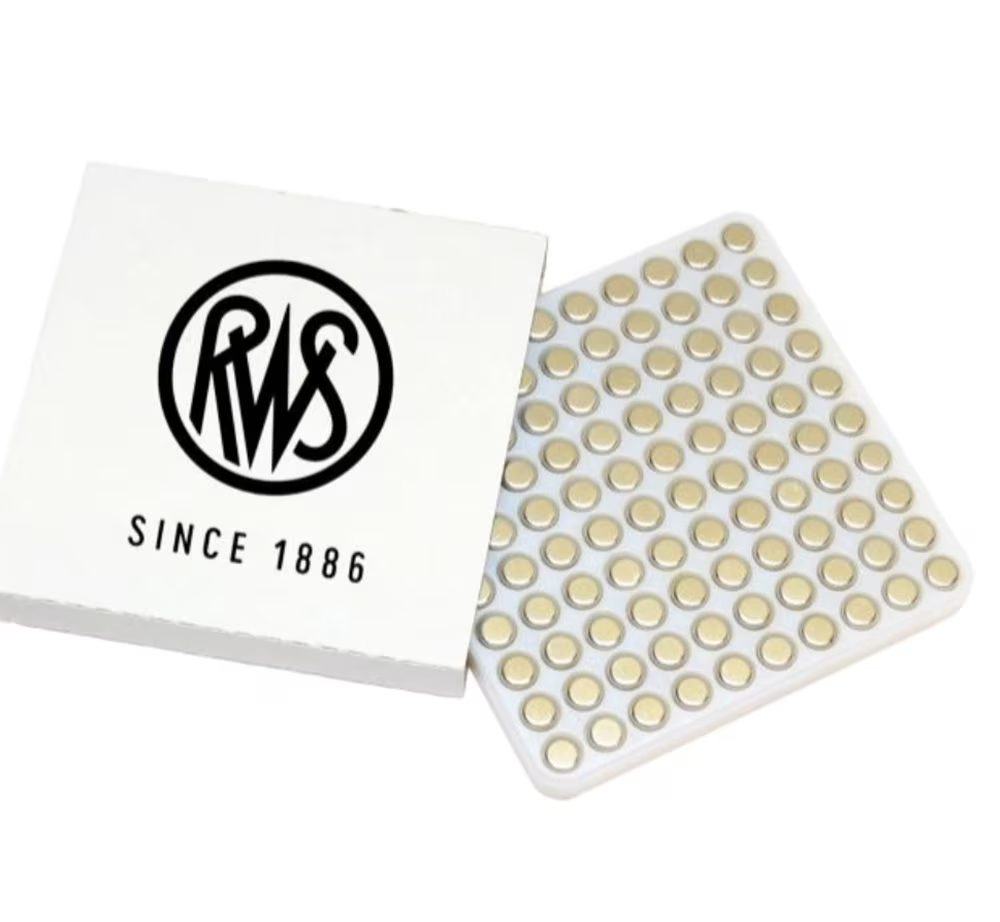
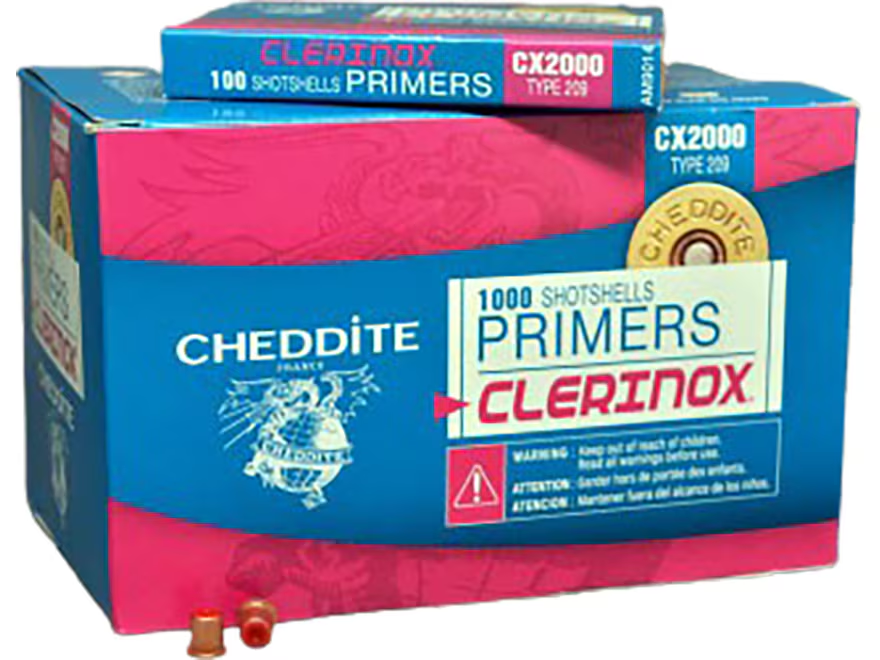
Primers: Standard large rifle primers are adequate for most Naturalis applications. CCI 200, Federal 210, Winchester WLR, and Remington 9-1/2 cover the standard rifle cartridges. For magnum applications – 300 Winchester Magnum, 338 Winchester Magnum, 338 Lapua Magnum – magnum primers CCI 250, Federal 215, or Remington 9-1/2M are appropriate for consistent ignition of slow powders.
Cases: Lapua brass is the natural pairing for Lapua bullets. For the 6.5 Creedmoor, 308 Winchester, 338 Lapua Magnum, and 9.3×62 applications, Lapua cases are widely available and provide the best dimensional consistency for precision loads. Anneal cases periodically – the higher pressures of monolithic loads accelerate case neck work-hardening.
Crimp: A light roll crimp at the cannelure is appropriate for semi-automatic platforms and high-recoiling magnum applications. For bolt-action rifles, proper neck tension is sufficient.
Barrel twist: The Naturalis variants generally require faster twist than lead-core bullets of similar weight because the all-copper bullet is longer and less dense, requiring more spin for stabilization. Lapua’s specifications at lapua.com provide twist rate recommendations. As a guideline: the 140-grain .264-inch requires 1:8 minimum, the 231-grain .338-inch likely requires 1:10 minimum. Verify before ordering.
Powder Selection by Application:
| Application | Caliber | Bullet Weight | Recommended Powders |
|---|---|---|---|
| Varmints | 223 Rem | 50 gr | Hodgdon Varget, Hodgdon CFE 223, Hodgdon H335 |
| Deer | 243 Win | 90 gr | Hodgdon Varget, Hodgdon H4350, IMR 4064 |
| Elk/moose | 6.5 Creedmoor | 140 gr | Hodgdon H4350, Alliant Reloder 16, Alliant Reloder 23 |
| Elk/moose | 6.5×55 Swedish | 140 gr | Vihtavuori N150, Vihtavuori N160, Hodgdon H4350 |
| Elk | 308 Win | 170 gr | Hodgdon Varget, Hodgdon H4895, Alliant Reloder 15 |
| Elk | 30-06 Sprg | 170 gr | Hodgdon H4350, IMR 4350, Alliant Reloder 19 |
| Large game | 338 Win Mag | 231 gr | Hodgdon H4831SC, Alliant Reloder 22, Alliant Reloder 25 |
| Moose | 9.3×62 Mauser | 250 gr | Vihtavuori N160, Vihtavuori N165, Hodgdon H4831SC |
Reloading Parameters Summary:
| Parameter | Guideline |
|---|---|
| Neck tension | 0.002-0.004 inch interference |
| Seating depth | Start 0.050-0.100 inch off lands – more than lead-core bullets |
| Crimp | Light roll crimp for magnums and semi-auto |
| Minimum expansion velocity | 1,600 fps at target distance |
| Load data source | Lapua lapua.com (primary); monolithic-specific data only |
| Starting charge | 5% below published minimum for comparable monolithic bullets |
| Extreme spread target | Under 15 fps for hunting accuracy |
Load data warning: Never use lead-core load data as a starting point for the Naturalis or any monolithic copper bullet. Higher chamber pressure from longer bearing surface is a real hazard. Always use published data for monolithic copper bullets specifically and start conservatively. Work up in 0.5-grain increments with careful pressure sign monitoring.
Conclusion
The Lapua Naturalis is a well-engineered lead-free monolithic hunting bullet with a specific market position: European and North American hunters who require lead-free compliance, want Lapua’s manufacturing quality, and need calibers the Naturalis lineup covers – particularly 6.5mm for Scandinavian elk and moose hunting, and 9.3mm for traditional European hunting cartridges.
The polymer valve tip is a genuine design differentiator from competing lead-free bullets. The 231-grain .338-inch at BC 0.648 is the lineup’s strongest aerodynamic performer and has no direct equivalent in other lead-free designs at that BC level. Near-100% weight retention is the fundamental performance advantage of all monolithic designs, and the Naturalis delivers it reliably.
Choose the Naturalis if: lead-free compliance is required in your hunting area; you hunt in Scandinavia or Europe with 6.5×55, 9.3×62, or .338-inch cartridges and want a Lapua bullet; you want to pair Lapua bullets with Lapua brass in your hunting loads; or you specifically want the polymer valve tip’s symmetric expansion mechanism over competing monolithic designs.
Choose something else if: lead-free is not required – conventional lead-core hunting bullets like the Lapua Mega, Nosler AccuBond, or Federal Trophy Bonded provide comparable or better terminal performance in most hunting scenarios at lower pressure and with more widely available load data. If lead-free is required but maximum North American caliber range is the priority, Barnes TTSX covers more diameters and weights with a longer North American field record. If maximum long-range BC from a lead-free design in .338-inch is the specific goal, the Naturalis 231-grain is the strongest available option.
Disclaimer: Reloading involves inherent risks. Monolithic copper bullets generate higher chamber pressures than lead-core bullets of the same weight. Never use lead-core load data for the Naturalis. Use published data for monolithic copper bullets specifically, start below minimum charges, and work up carefully while monitoring for pressure signs at every increment. Wear eye protection at all times. The author and myreloading.com are not responsible for injuries or property damage resulting from reloading or shooting handloaded ammunition.
Have you hunted with the Lapua Naturalis? Leave a comment with the details: weight, cartridge, game, range, and shot angle. Did the petal expansion work as designed? Did you recover the bullet and how much weight did it retain? How did load development with the Naturalis compare to your experience with lead-core bullets in the same cartridge – more difficulty finding the accuracy node, or similar? Accounts from Finnish, Swedish, or Norwegian hunters using the 9.3mm or 6.5×55 variants on elk and moose are particularly rare in English-language resources.