Published: October 2025 | Last updated: June 2026
Introduction
Lapua introduced the TRX in 2025, making it the newest commercial hunting bullet in the lead-free monolithic category and the most recently released product in Lapua’s entire hunting bullet lineup. The TRX joins the Lapua Naturalis as Lapua’s second lead-free hunting option, sitting alongside the Lapua Mega conventional soft-point, the Lapua Scenar-L match bullet, the Lapua MaxRange Target, and the Lapua Scenar in Lapua’s current product portfolio.
Where the Lapua Naturalis has been refined through three design generations since 2002 and is supported by over two decades of European field experience on elk, moose, and large deer, the TRX is new enough that its real-world terminal performance record is still accumulating. The Naturalis uses a green polymer valve tip with a patented symmetric expansion mechanism; the TRX uses a blue polymer tip – visually distinct from the green Naturalis, making them easy to tell apart in the loading room. Both are lead-free monolithic copper hunting bullets with 100% weight retention and expansion thresholds near 1,600 fps.
The TRX covers three variants: 120-grain .264-inch, 150-grain .308-inch, and 165-grain .308-inch. This is the narrowest caliber range of any Lapua hunting bullet, but it concentrates exactly on the two most active hunting cartridge families for European and North American hunters who require lead-free compliance: 6.5mm (predominantly 6.5 Creedmoor, 6.5 PRC, and 6.5×55 Swedish Mauser) and 30-caliber (308 Winchester, 30-06 Springfield, and 300 Winchester Magnum). For hunters who only need these calibers and want a current-production Lapua lead-free bullet with the TRX’s specific design, the narrow lineup is not a limitation. For hunters who use 9.3mm, 6mm, or .338-inch calibers, the Lapua Naturalis covers those applications.
G1 BCs from 0.418 to 0.428 form an unusually tight cluster across three very different bullet weights. This suggests that the TRX’s aerodynamic profile has been optimized to achieve consistent performance across the weight range rather than maximizing BC for any individual variant.
Disclaimer: Reloading is an inherently dangerous activity. Always consult current published load data from reputable sources (Lapua, Hodgdon, Hornady, Lyman) before loading any cartridge. Monolithic copper bullets generate higher chamber pressures than lead-core bullets of the same weight due to longer bearing surface. Never use lead-core load data for the TRX – use published data for monolithic copper bullets specifically, starting conservatively. Start at the minimum published charge for comparable monolithic bullets and work up carefully. Never exceed maximum published loads. The TRX was introduced in 2025 and third-party manual data may be limited – check lapua.com as the primary source.
Technical Characteristics
The TRX’s construction is monolithic copper with a blue polymer tip – the same fundamental category as the Lapua Naturalis, Barnes TTSX, and Hornady GMX. The differences within this category are in the tip mechanism, groove design, and specific copper alloy formulation.
Monolithic copper construction: The TRX is machined from copper alloy rod stock with no lead core. Near-100% weight retention is achieved through the structural integrity of the solid copper bullet rather than through bonding chemistry. On impact at any velocity within the operating range, the bullet remains essentially intact as it penetrates tissue.
Blue polymer tip: The blue polymer tip – distinct from the Naturalis’s green valve tip – seats in a hollow-point cavity and initiates expansion on impact by being driven rearward into the cavity. Lapua states that the TRX’s blue tip and hollow-point geometry are specifically designed to produce reliable, consistent petal expansion at velocities as low as 1,640 fps. This threshold is slightly higher than the Naturalis’s 1,600 fps but lower than the 1,800 fps of most conventional lead-core soft-points. For practical hunting purposes, the 40 fps difference between 1,600 and 1,640 fps represents approximately 5-10 additional yards of reliable expansion range – operationally negligible for most hunting scenarios.
The specific expansion mechanism of the TRX tip differs from the Naturalis’s patented valve design. Where the Naturalis claims symmetric force distribution across expansion petals through the valve structure, the TRX uses a more conventional approach of tip-driven hydraulic initiation. Both are designed to produce controlled petal expansion to 1.5x to 2x original bullet diameter.
Grooved bearing surface: The TRX’s bearing surface incorporates pressure-relief grooves similar to the design used in Barnes TTSX bullets. These grooves serve two functions. First, they reduce the bearing surface contact area between the bullet and the bore, which reduces peak chamber pressure for a given powder charge compared to a smooth-shank copper bullet. This partially addresses the pressure elevation that is inherent to monolithic copper construction. Second, reduced contact area produces less copper fouling per shot than a smooth shank. Lapua claims 15-20% less fouling than lead-core bullets – a figure similar to the claim made for the Naturalis. The practical benefit is longer intervals between cleaning and somewhat easier copper removal when cleaning is needed.
Boat-tail base: The boat-tail contributes to the TRX’s G1 BCs of 0.418 to 0.428. The narrow spread of BC across three different weights (120, 150, and 165 grains) suggests that the heavier, longer bullets’ aerodynamic advantage over the lighter bullet is being balanced by slightly different profile geometries in the design – or that these are independently optimized profiles rather than a single silhouette scaled by weight.
Cannelure: The cannelure allows crimp application for semi-automatic rifles or high-recoil applications where bullet setback is a concern, and provides a consistent seating depth reference for volume loading.
Ballistics and Performance
Three variants with G1 BCs clustering tightly between 0.418 and 0.428 produce a lineup with very similar aerodynamic behavior.
The 120-grain .264-inch TRX at G1 BC 0.428 and SD 0.246 is the lighter of the two 6.5mm options Lapua offers in lead-free construction – the Lapua Naturalis 140-grain at BC 0.472 provides more mass and SD for heavier applications. At 120 grains in 6.5 Creedmoor at approximately 3,000 fps, BC 0.428 retains approximately 2,390 fps at 300 yards – above the 1,640 fps expansion threshold by a large margin. SD 0.246 is adequate for deer and lighter elk on broadside shots. For moose and heavy game where penetration depth is the primary concern, the higher-SD Lapua Naturalis 140-grain at SD 0.287 is a more conservative choice.
The 150-grain .308-inch TRX at G1 BC 0.418 and SD 0.226 is the standard deer weight in 308 Winchester and 30-06 Springfield. BC 0.418 is competitive for a monolithic 150-grain .308-inch – the Barnes TTSX achieves approximately 0.400 to 0.450 in comparable .308-inch weights. SD 0.226 is standard for the 150-grain weight and adequate for deer at any angle and lighter elk on broadside shots.
The 165-grain .308-inch TRX at G1 BC 0.428 and SD 0.248 is the more useful of the two .308-inch options for hunters who pursue larger game. SD 0.248 provides meaningful penetration depth through elk and large bear muscle and bone at moderate hunting ranges. BC 0.428 at 165 grains is slightly higher than the 150-grain at 0.418 – the heavier bullet achieves a better BC despite its greater weight, which suggests a longer, more aerodynamically optimized profile at 165 grains. From 308 Winchester at 2,600 fps, BC 0.428 retains approximately 2,100 fps at 400 yards – above the expansion threshold with a meaningful margin.
Accuracy of 0.7 to 1.0 MOA is achievable in well-developed loads – slightly behind the best lead-core hunting bullets (0.5-0.8 MOA) but adequate for ethical hunting shots at the distances the TRX is designed for. The accuracy note reflects the characteristic of all monolithic bullets: load development requires more iterations to find the seating depth and charge combination that produces the best results, and the accuracy node when found tends to be narrower than for lead-core bullets.
Expert Ballistics Table – Lapua TRX Variants
Data from Lapua specifications. BCs are G1 values. As a 2025 introduction, verify all specifications and load data at lapua.com before load development.
| Diameter (inches) | Weight (grains) | BC (G1) | Sectional Density | Application |
|---|---|---|---|---|
| .264 | 120 | 0.428 | 0.246 | Deer, lighter elk in 6.5 Creedmoor and 6.5×55 Swedish Mauser |
| .308 | 150 | 0.418 | 0.226 | Deer in 308 Winchester and 30-06 Springfield |
| .308 | 165 | 0.428 | 0.248 | Elk, bear in 308 Winchester and 30-06 Springfield |
Comparison Bullets
The TRX occupies the same lead-free monolithic hunting segment as the Naturalis, Barnes TTSX, Hornady GMX, and Nosler E-Tip. Within this category, the key comparisons are against both external competitors and the Naturalis within Lapua’s own lineup.
TRX versus Lapua Naturalis: The most direct comparison for any Lapua-ecosystem hunter. The Lapua Naturalis has a 23-year production history and three design generations of field validation. The TRX is new in 2025 with no independent field record yet. The Naturalis covers .224-inch through .366-inch (9.3mm) with eight variants; the TRX covers .264-inch and .308-inch with three. For the overlapping calibers and weights, the practical differences are the blue versus green tip and the Naturalis’s proprietary valve mechanism versus the TRX’s standard tip-driven expansion. The Naturalis 140-grain 6.5mm at BC 0.472 outperforms the TRX 120-grain at BC 0.428 aerodynamically and provides more penetration depth via SD 0.287 versus SD 0.246. For hunters who specifically need the TRX’s 120-grain lighter 6.5mm option, it covers a gap the Naturalis doesn’t fill at that weight.
TRX versus Barnes TTSX: The Barnes TTSX covers a wider range (.224-inch to .338-inch) with longer field validation in North America. Barnes uses a similar grooved shank design to reduce pressure. BCs for comparable TTSX weights are competitive with or slightly below the TRX’s 0.418-0.428 range at most comparable weights, though the TTSX extends to higher weights with higher BCs. For North American hunters, the TTSX’s longer domestic field record gives it a practical edge in validated load data availability.
TRX versus Hornady GMX: The Hornady GMX uses a gilding-metal alloy rather than pure copper. BCs (0.245-0.540) span a wider range than the TRX and Hornady publishes comprehensive GMX load data. For hunters who prioritize data availability for a new cartridge or unusual combination, the GMX’s comprehensive Hornady manual coverage is a practical advantage over the TRX’s limited 2025 data availability.
TRX versus Nosler E-Tip: The Nosler E-Tip uses a lead-free alloy core rather than pure copper. BCs are competitive. Nosler publishes E-Tip-specific data comprehensively. The E-Tip covers .243-inch to .338-inch, offering broader caliber coverage than the TRX.
Comparison Table – Lead-Free Hunting Bullets in .264 and .308-inch
| Bullet | Weight Options | BC at 120-165 gr | Core Type | Pressure vs Lead | Data Availability | Relative Cost |
|---|---|---|---|---|---|---|
| Lapua TRX | 120, 150, 165 gr | 0.418-0.428 | Pure copper | Higher | Limited (2025) | Premium |
| Lapua Naturalis | 140 gr (6.5mm), 170 gr (.308) | 0.319-0.472 | Pure copper | Higher | Good (since 2002) | Premium |
| Barnes TTSX | 110-165 gr range | 0.395-0.550 | Pure copper | Higher | Extensive | Premium |
| Hornady GMX | 110-165 gr range | 0.370-0.520 | Gilding metal | Moderate | Extensive | Premium |
| Nosler E-Tip | 120-165 gr range | 0.360-0.510 | Lead-free alloy | Moderate | Extensive | Premium |
| Federal Trophy Copper | 140-165 gr range | 0.390-0.480 | Copper alloy | Moderate | Limited | Premium |
Applications and Practical Aspects
The TRX’s three variants cover deer and elk hunting in the two dominant hunting caliber families for European and North American hunters who require lead-free compliance.
Deer, lighter elk (6.5mm, 120 grains): The 120-grain TRX in 6.5 Creedmoor, 6.5 PRC, 260 Remington, or 6.5×55 Swedish Mauser is a lead-free deer and lighter elk option. At SD 0.246, penetration on deer from any angle is reliable. For moose and heavy bull elk, the TRX’s 120-grain with SD 0.246 is more appropriate for broadside shots than quartering angles – the Lapua Naturalis 140-grain at SD 0.287 provides more penetration depth for heavy game. Hodgdon H4350 and Alliant Reloder 16 are primary powder choices for 6.5 Creedmoor. Vihtavuori N150 and Vihtavuori N160 are Finnish powder companions for 6.5×55 Swedish Mauser loads.
Deer (30-cal, 150 grains): The 150-grain TRX in 308 Winchester or 30-06 Springfield is a lead-free deer load. SD 0.226 and BC 0.418 are standard for the 150-grain weight class. This is a well-understood hunting combination in terms of trajectory and terminal behavior for deer-sized game. Hodgdon Varget, Hodgdon H4895, IMR 4895, and Alliant Reloder 15 are appropriate for 308 Winchester.
Elk, bear (30-cal, 165 grains): The 165-grain TRX in 308 Winchester, 30-06 Springfield, or 300 Winchester Magnum is the TRX variant with the strongest argument for big game use. SD 0.248 at 165 grains is adequate for elk on broadside and slightly quartering shots, and the near-100% weight retention of monolithic construction ensures all that sectional density is working through the full penetration path. Hodgdon Varget, Alliant Reloder 15, and IMR 4064 work for 308 Winchester. For 30-06 Springfield, Hodgdon H4350, IMR 4350, and Alliant Reloder 19 are appropriate. For 300 Winchester Magnum, Hodgdon H4831SC and Alliant Reloder 22 are appropriate choices.
Reloading
Reloading the TRX requires the same careful approach as any monolithic copper bullet, with additional attention given the 2025 introduction and limited published data availability.
Load data source – critical: The TRX is a 2025 introduction and third-party manual data may not yet be available from Hodgdon, Hornady, Sierra, or Lyman. Lapua’s own data at lapua.com is the primary and most current source. For cartridges where Lapua-specific TRX data is not yet available, use published data for comparable monolithic copper bullets (Barnes TTSX or Barnes TSX) of the same diameter and weight as an approximate starting reference, beginning 5% below even those minimum charges and working up very conservatively.
Never use lead-core data: Monolithic copper bullets generate higher peak chamber pressure than jacketed lead-core bullets. The TRX is no exception. Do not use Lapua Mega load data or any other lead-core .308-inch or 6.5mm data as the starting point for TRX loads.
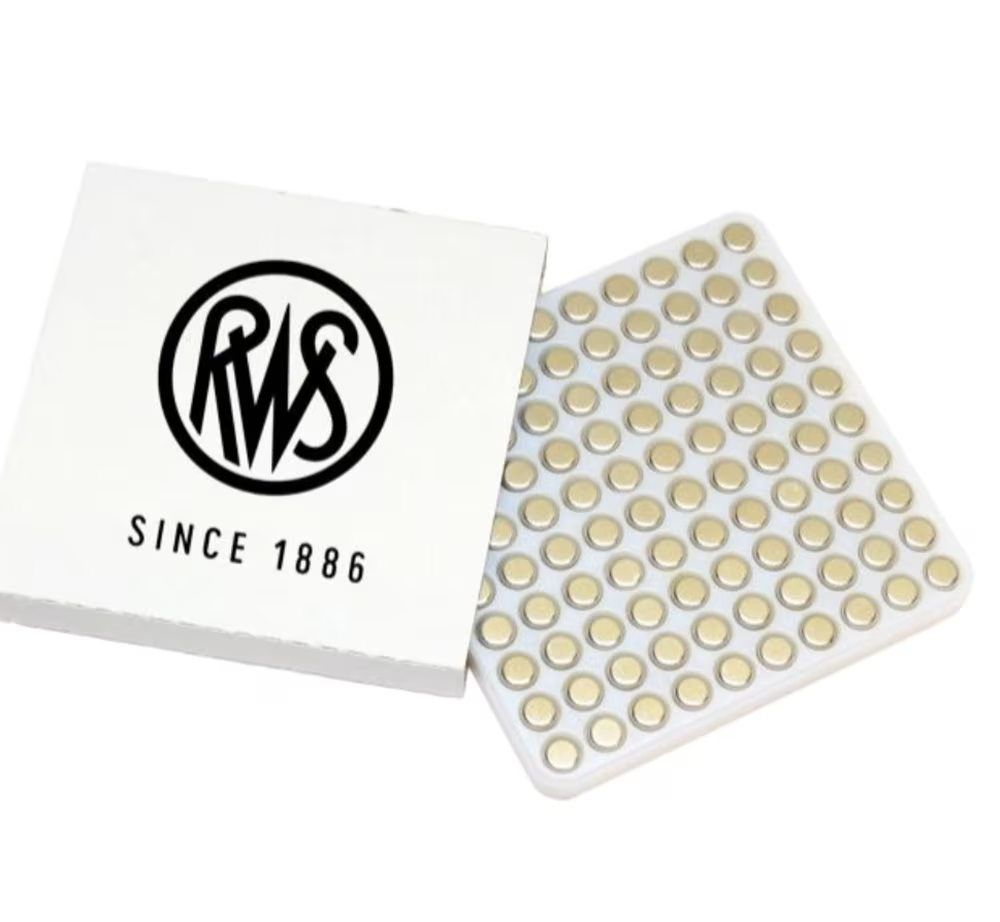
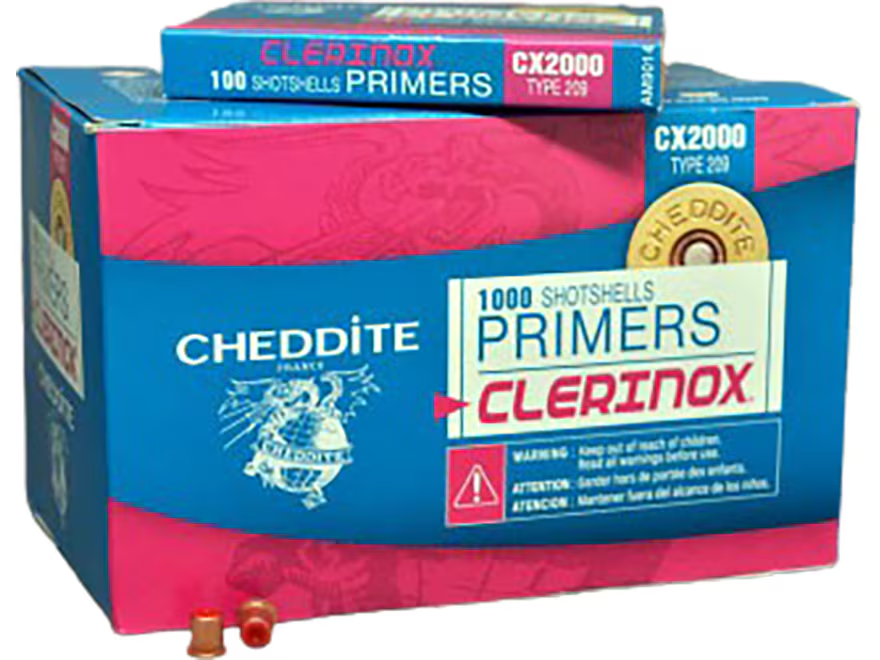
Primers: Standard large rifle primers are appropriate for all TRX applications. CCI 200, Federal 210, Federal GM210M, Winchester WLR, and Remington 9-1/2 are reliable for 308 Winchester, 30-06 Springfield, and 6.5 Creedmoor applications. CCI 250, Federal 215, or Remington 9-1/2M magnum primers are appropriate for 6.5 PRC and 300 Winchester Magnum with slow-burning powders.
For hunters developing precision loads with the TRX, match-grade primers like Federal GM210M and CCI BR-2 can help reduce ES when other variables have been optimized. For Scandinavian hunters using 6.5×55 Swedish Mauser, Vihtavuori N160 is a natural Finnish companion to Lapua’s Finnish-manufactured bullets. The Federal Trophy Copper is another lead-free alternative primarily available through factory ammunition rather than as a handloading component.
Cases: Lapua brass is the natural and recommended pairing for all Lapua bullets. For 6.5 Creedmoor and 308 Winchester, Lapua cases are widely available and provide the best dimensional consistency. For 6.5×55 Swedish Mauser, Lapua and Norma brass are both appropriate. Anneal cases periodically when loading monolithic bullets – the higher pressures accelerate case neck work-hardening.
Seating depth: Start at 0.050 to 0.100 inches off the lands – significantly more jump than lead-core bullets. The grooved shank design partially addresses pressure elevation compared to smooth-shank monolithics, but adequate freebore clearance is still required. Work systematically in 0.010-inch increments once you have established a safe pressure baseline. Expect to spend more time on seating depth optimization than with lead-core bullets.
Crimp: Light roll crimp at the cannelure for semi-automatic platforms or heavy-recoiling magnums. Bolt-action hunting rifles do not require a crimp.
Barrel twist: 1:8 minimum for the 120-grain .264-inch TRX. The 150-grain and 165-grain .308-inch variants are accommodated by the standard 1:10 twist of 308 Winchester and 30-06 Springfield factory barrels.
Powder Selection by Application:
| Application | Caliber | Bullet Weight | Recommended Powders |
|---|---|---|---|
| Deer/elk | 6.5 Creedmoor | 120 gr | Hodgdon H4350, Alliant Reloder 16, Vihtavuori N550 |
| Elk/moose | 6.5×55 Swedish | 120 gr | Vihtavuori N150, Vihtavuori N160, Hodgdon H4350 |
| Deer (6.5 PRC) | 6.5 PRC | 120 gr | Alliant Reloder 23, Hodgdon H4831SC, Alliant Reloder 26 |
| Deer | 308 Win | 150 gr | Hodgdon Varget, Hodgdon H4895, Vihtavuori N540 |
| Elk/bear | 308 Win | 165 gr | Hodgdon Varget, IMR 4895, Alliant Reloder 15 |
| Elk/bear | 300 Win Mag | 165 gr | Hodgdon H4831SC, Alliant Reloder 22, Alliant Reloder 25 |
| Deer/elk | 30-06 Sprg | 150-165 gr | Hodgdon H4350, IMR 4350, Alliant Reloder 19 |
Reloading Parameters Summary:
| Parameter | Guideline |
|---|---|
| Neck tension | 0.002-0.004 inch interference |
| Seating depth | Start 0.050-0.100 inch off lands |
| Crimp | Light roll crimp for semi-auto and magnums; optional for bolt-action |
| Minimum expansion velocity | 1,640 fps at target distance |
| Starting charge | 5% below minimum published for comparable monolithic bullets |
| Load data source | lapua.com (primary); Barnes TTSX data as reference |
| Extreme spread target | Under 15 fps for hunting accuracy |
Critical load data warning: Never use lead-core load data for the TRX. The TRX is a 2025 introduction – always verify current Lapua data at lapua.com before load development. Third-party manual coverage may not yet include the TRX. Starting conservatively below minimum charges and working up carefully while watching every pressure sign is essential.
Frequently Asked Questions
Q: What is the difference between the Lapua TRX and the Lapua Naturalis?
A: Both are lead-free monolithic copper hunting bullets from Lapua, but they differ in tip design, caliber coverage, and production history. The Lapua Naturalis uses a green polymer valve tip with a patented symmetric expansion mechanism and has been in production since 2002 through three design generations. It covers .224-inch to .366-inch (9.3mm) in eight variants. The TRX uses a blue polymer tip with a conventional tip-driven expansion mechanism, was introduced in 2025, and currently covers .264-inch and .308-inch in three variants. The Naturalis has over 20 years of European field validation; the TRX has none yet. The TRX’s 120-grain 6.5mm option fills a weight gap the Naturalis doesn’t cover in that caliber. For hunters who need 9.3mm or other calibers outside the TRX’s range, the Naturalis is the only option.
Q: Why is the BC range so narrow (0.418-0.428) across all three TRX variants?
A: The BC of a bullet reflects the ratio of its sectional density to its form factor (aerodynamic drag coefficient). A heavier bullet at the same diameter normally has a higher BC because its greater mass-to-frontal-area ratio gives it more momentum per unit of drag. The TRX’s unusually tight BC cluster across 120, 150, and 165 grains suggests that the three variants use different profile geometries rather than a single shape scaled by weight. The lighter 120-grain 6.5mm and heavier 165-grain .308-inch both achieve BC 0.428 because the heavier bullet’s mass advantage is offset by a slightly less aerodynamic profile – or vice versa for the lighter bullet. In practical hunting terms, the tight BC cluster means all three variants behave very similarly at distance in terms of wind drift and drop, which simplifies trajectory calculations when switching between them.
Q: Do the grooves on the TRX actually reduce pressure?
A: Yes – the grooves reduce the bearing surface contact area between the bullet and the rifling. Less contact area means less friction during bullet travel down the bore, which reduces the pressure required to push the bullet at a given velocity. The Barnes TTSX uses a similar grooved design specifically to address the higher pressure inherent to monolithic copper bullets. Lapua claims 15-20% less barrel fouling as the most visible benefit, but the pressure management function is equally important for handloaders – the grooves make it somewhat easier to develop safe loads than it would be with a smooth-shank copper bullet of the same weight. Note that the TRX still generates higher pressure than a lead-core bullet of the same weight – the grooves moderate but do not eliminate that difference.
Q: Can I use TRX data from 6.5 Creedmoor for 6.5 PRC loads?
A: No. Load data is specific to the cartridge case, not just the bullet. 6.5 PRC has a larger case capacity than 6.5 Creedmoor and uses slower-burning powders at higher charges. Using 6.5 Creedmoor charges in a 6.5 PRC case would produce underloaded, potentially erratic rounds. For 6.5 PRC, use PRC-specific data from Lapua’s website or data from comparable monolithic bullets in 6.5 PRC from Barnes TTSX or Hornady GMX as a starting reference. The same principle applies for 300 Winchester Magnum versus 308 Winchester data – the two are not interchangeable.
Q: Is it safe to use the TRX in a rifle whose bore has lead fouling from previous loads?
A: Yes, but clean the bore before switching to monolithic bullets for the first time. Lead deposits from jacketed lead-core bullets can reduce bore diameter slightly and cause a monolithic bullet – which is harder and does not obturate the bore – to experience elevated pressure as it engages the tighter, fouled bore. Run a thorough bore cleaning with solvent designed to remove both copper and lead fouling, follow with a patch through to confirm the bore is clean, and then develop TRX loads from scratch in the clean bore.
Q: How does the TRX’s 1,640 fps expansion threshold compare to other lead-free options?
A: The threshold is competitive within the lead-free category. The Lapua Naturalis is specified at 1,600 fps; the Hornady GMX and Barnes TTSX are typically specified at 1,800 fps; the Nosler E-Tip at approximately 1,800 fps. The TRX’s 1,640 fps is lower than Barnes and Hornady alternatives, meaning it retains reliable expansion capability at greater hunting distances before the bullet slows below the expansion threshold. In terms of extended range hunting, the 160 fps advantage over the 1,800 fps alternatives translates to approximately 30-50 additional yards of reliable expansion range depending on the specific cartridge.
Conclusion
The Lapua TRX is a technically well-conceived lead-free hunting bullet with grooved-shank pressure management, a blue polymer tip, and BCs clustered near 0.428 across three variants that cover the two most active hunting cartridge families. The 2025 introduction date is the honest limitation: it is too new for independent field validation, third-party load data coverage is minimal, and the comparison to the Lapua Naturalis‘s two decades of European field experience cannot yet be made on equal terms.
For hunters who specifically want the TRX’s 120-grain 6.5mm option – lighter than the Naturalis’s 140-grain – it fills a genuine weight gap in Lapua’s lead-free lineup. For hunters who need lead-free compliance and want the most field-validated Lapua option, the Lapua Naturalis is the conservative choice until the TRX accumulates its own record.
Choose the TRX if: you need lead-free compliance in 6.5 Creedmoor, 6.5×55 Swedish Mauser, 308 Winchester, or 30-06 Springfield; you specifically want the 120-grain lighter 6.5mm weight that the Naturalis doesn’t offer; you want to stay within the Lapua bullet ecosystem; or you are an early adopter willing to invest the extra load development effort that a 2025 introduction requires.
Choose something else if: you want maximum field validation for a lead-free bullet – the Lapua Naturalis (since 2002) or Barnes TTSX have substantially more documented field performance. If you need calibers outside 6.5mm and .308-inch – such as 243 Winchester, 7mm-08 Remington, or 9.3mm – the Lapua Naturalis or Barnes TSX cover a wider range. If third-party load data availability from major manuals is important for your specific cartridge, Hornady GMX or Nosler E-Tip have more comprehensive published data. If lead-free is not required, the Nosler AccuBond, Sierra Tipped GameKing, or Hornady ELD-X offer better BCs and more load data at lower cost.
Disclaimer: Reloading involves inherent risks. Monolithic copper bullets generate higher chamber pressures than lead-core bullets. Never use lead-core load data for the TRX. The TRX is a 2025 introduction – data availability is limited. Verify all specifications and load data at lapua.com before load development. Start well below minimum charges for comparable monolithic bullets and increase very gradually. Wear eye protection at all times. The author and myreloading.com are not responsible for injuries or property damage resulting from reloading or shooting handloaded ammunition.
Have you hunted with the Lapua TRX? Leave a comment with the details: weight, cartridge, game, range, shot angle, and what you observed on impact. As a 2025 introduction, any firsthand field account is valuable – there is very little published hunter experience with this bullet in any language yet. Your data helps other hunters make better decisions about whether to adopt the TRX or stay with more established lead-free options.