Published: November 2025 | Last updated: March 2026
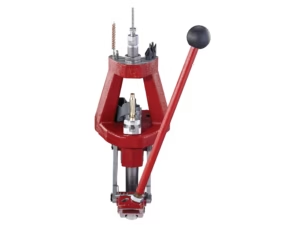
The Redding Big Boss II is the press Redding built for reloaders who push single-stage work to its limits. Large case openings, a long ram stroke, cast-iron frame, and Redding’s reputation for tight manufacturing tolerances combine into a press that handles everything from standard pistol calibers to 50 BMG without complaint. It is not the cheapest single-stage on the market and it is not the most compact. It is built for reloaders who know what they need and are willing to pay for it.

What makes the Big Boss II interesting is that it occupies a specific position even within Redding’s own lineup – above the Big Boss in frame mass and opening size, but below the Ultramag in sheer leverage capacity. That positioning matters when choosing between presses. This review covers where the Big Boss II earns its price, where other single-stages close the gap, and what it is like to actually use day to day.
What’s in the Box
The Redding Big Boss II ships with a complete working set of components:
- Redding Big Boss II press with 7/8″-14 die threads
- Steel operating handle with ball knob
- Smart primer arm for both large and small primers
- Spent-primer catcher with tube
- Printed instructions and warranty information
Not included: bench mounting hardware, shell holders, dies, or case lube. Redding shell holders are the natural match and cover most common calibers. Any standard 7/8″-14 die set from Redding, RCBS, Hornady, Lee, Forster, or Whidden threads directly in. If you plan to use oversize 1-1/4″-12 dies for 50 BMG or similar cartridges, Redding sells a threaded bushing adapter for the Big Boss II die station.
The Smart primer arm included with the press is a genuine convenience over the simple shuttle arms found on competing presses. It holds a small supply of primers in a tube, feeds them individually, and switches between large and small by changing the arm insert. It works, though most reloaders handling precision rifle ammunition prefer separate hand priming for the tactile feedback – more on that below.
Build and Materials
Redding’s reputation in the reloading industry rests heavily on manufacturing quality, and the Big Boss II reflects that. It is not a press with a long list of innovative features. It is a press where the basic components – frame, ram, linkage – are made to closer tolerances and heavier specifications than you find at lower price points.
Frame – Cast iron with powder-coat finish. The frame is heavy in the literal sense; the Big Boss II is one of the heavier single-stage presses in its class. That mass is structural – it damps vibration during heavy sizing strokes and resists the flex that can affect ram alignment under load. Powder coat is durable against solvent exposure and the chemical environment of a reloading bench.
Ram – Large-diameter steel, hollow through the center for spent-primer evacuation. The diameter is larger than standard 1-inch rams and provides more bearing surface, which reduces the tendency toward lateral deflection under off-axis loading. The smooth fit between ram and frame bore is a Redding quality point – the travel feels controlled rather than loose throughout the stroke.
Linkage – Steel throughout. The compound linkage geometry provides increasing mechanical advantage as the ram approaches the top of the stroke, which is where sizing force peaks. The result is a press that completes a difficult sizing stroke with less perceived effort than the numbers might suggest, and that provides good tactile feedback for operations like bullet seating where feel matters.
Frame opening – The Big Boss II‘s opening is among the largest available on a single-stage press, at approximately 4.5 inches of clearance. This is the dimension that determines which cartridges the press can handle without workarounds. Large belted magnums, long single-shot cartridges, and the extended overall lengths of some hunting bullets all fit without fighting the press. For 50 BMG and similarly extreme cartridges, the opening accommodates them where smaller C-frame and O-frame presses cannot.
Handle – Steel with a ball knob. Positioned ergonomically for a natural pull arc. The handle positioning is adjustable on some configurations and the leverage geometry is well matched to the frame mass.
Warranty – Redding’s warranty on the Big Boss II is one year against defects. This is shorter than the lifetime coverage offered by RCBS, Dillon, and Lee on comparable presses, and it is worth noting. Redding’s customer service reputation is good, and the Big Boss II is built to a standard where warranty claims for normal use are uncommon. But the one-year term is a factual difference from the competition.
Key Specs and Compatibility
| Specification | Detail |
|---|---|
| Press type | Single-stage, C-frame |
| Die thread standard | 7/8″-14; 1-1/4″-12 adapter available |
| Shell holder system | Standard slot; accepts Redding, RCBS, Lee, Hornady |
| Ram diameter | Large diameter steel |
| Stroke | Approximately 3.8 inches |
| Frame opening | Approximately 4.5 inches |
| Maximum cartridge | 50 BMG with adapter |
| On-press priming | Yes, Smart primer arm (large and small) |
| Spent-primer management | Through-ram to catcher tube |
| Mounting | 3-hole base |
| Frame material | Cast iron |
| Country of manufacture | USA |
| Warranty | 1 year against defects |
The 3.8-inch stroke and 4.5-inch opening are the two specifications that define what the Big Boss II can do that smaller single-stages cannot. Common references for comparison: a 338 Lapua Magnum loaded round measures approximately 3.68 inches overall; 30-06 Springfield measures up to 3.34 inches; 308 Winchester up to 2.81 inches. The Big Boss II handles all of them without modification, and the large opening means insertion and extraction of long cases is smooth rather than a careful maneuver.
The C-Frame Design – Honest Assessment
The Big Boss II is a C-frame press – the ram travels in an open-sided frame rather than through a closed loop. C-frame designs are lighter and provide easier case access than O-frame designs, and they are the standard for single-stage presses at every price point. The trade-off is that C-frames are more susceptible to deflection under very heavy lateral loads than a true O-frame like the RCBS Rebel.
In practice, this distinction matters at the extreme end of sizing loads – case forming, very large belted magnums, and any operation where the sizing force is highest. For standard rifle calibers including 338 Lapua Magnum, the Big Boss II‘s cast-iron C-frame is rigid enough that deflection does not produce measurable differences in case dimensions. The frame mass compensates for the open-side geometry in a way that lighter C-frame designs cannot.
Redding’s manufacturing tolerances on the ram-to-bore fit reduce the effect of any frame flex by keeping the ram on a tighter path through the stroke. This is where the Big Boss II‘s price premium shows up most directly – not in any single dramatic feature, but in the tightness of fit that keeps everything aligned under load.
Where the Big Boss II Excels
Precision rifle loading is the Redding Big Boss II‘s primary application. Loading 308 Winchester, 6.5 Creedmoor, 300 Winchester Magnum, or 338 Lapua Magnum ammunition where dimensional consistency matters, the tight ram-to-frame fit and heavy cast-iron construction produce repeatable results that a less rigid press cannot match as reliably. Paired with Redding’s own micrometer seating dies – designed specifically to work with this press’s precision geometry – the Big Boss II is a genuine precision loading tool rather than just a press with premium branding.
Case forming and reforming benefits from the frame mass and long stroke. Forming brass to a new caliber – necking down, blowing out, fire-forming – involves some of the highest sizing pressures in any reloading operation. The Big Boss II handles these without the operator wondering whether the press is keeping up with the task.
Large magnum and oversize caliber work is where the large opening and long stroke provide practical advantages over competing single-stages. Reloaders working with 338 Lapua Magnum, 338 Winchester Magnum, or 50 BMG have fewer press options that accommodate the case dimensions without compromises. The Big Boss II is one of the cleaner solutions at its price point.
Dedicated sizing station use in a multi-press setup is another strong application. Many reloaders who run a turret or progressive for priming, charging, and seating dedicate a single-stage to full-length sizing where rigidity matters most. The Big Boss II‘s precision and frame mass make it well suited to that role alongside a Lee Classic Turret or Dillon XL 750 handling the remaining operations.
Realistic Limitations
Price is the starting point. The Redding Big Boss II costs more than the RCBS Rock Chucker Supreme, more than the RCBS Rebel, and considerably more than any Lee single-stage. For a reloader whose work does not benefit from the tighter tolerances and larger opening – standard rifle calibers at hunting-load precision, or any pistol application – the price premium does not translate into meaningfully better ammunition.
One-year warranty is shorter than what competitors offer. RCBS covers the Rock Chucker Supreme and Rebel for life. Lee covers the Classic Cast for life. Hornady covers the Lock-N-Load Classic for life. Redding’s one-year term is the exception in a market where lifetime coverage has become the expectation. The Big Boss II is built well enough that warranty claims are uncommon, but the asymmetry in coverage terms is a real comparison point.
C-frame design under the most extreme forming loads produces more deflection than a true O-frame. The RCBS Rebel‘s O-frame handles peak sizing forces with less frame deformation. For most single-stage reloading applications this does not produce a measurable difference in results. For the very heaviest case forming operations, it is a technical disadvantage.
No automation path is inherent to single-stage design rather than a Big Boss II specific limitation, but it is worth stating. A reloader who eventually wants progressive speed will need a different press. The Big Boss II is a precision tool that does one thing at a time, deliberately.
Size and weight mean a dedicated, permanent mounting position. It is not a press for portable setups or shared bench space.
Setup and Mounting
Bench – The Big Boss II belongs on a solid, permanent bench. A 2-inch hardwood top or equivalent steel surface is the minimum. Given the press’s mass, the bench itself will not be the limiting factor on flex – but a bench that moves or rocks under a heavy sizing stroke introduces inconsistency that the press’s precision cannot compensate for.
Bolts – Three-hole base pattern, 3/8″-16 Grade 8 bolts with large fender washers on the underside. Thread all three before tightening any, then snug evenly. Torque consistently across all three bolts to prevent any tilt in the press mounting that could introduce systematic runout.

Position – Mount far enough from the bench edge that the handle completes its full arc without obstruction, close enough that you are not reaching forward at full extension. The handle arc on the Big Boss II is comfortable without excessive reach; most reloaders find a position 8 to 12 inches from the bench face appropriate.
Smart primer arm – Load the primer tube with the appropriate large or small inserts, seat the arm in the ram recess, and run several dry cycles before loading live primers. The arm feeds primers smoothly when the tube is loaded correctly and the spring tension is set properly. Check that primers seat square in the arm before each session.
Lubrication – Light machine oil on the ram and main pivot points. Keep lubricants entirely away from the primer arm and primer tube area. Even a small amount of oil contamination on primer anvils causes misfires that are difficult to diagnose without pulling the primers.
Die installation – Thread dies to finger-tight in the die station, then adjust depth with the ram at full stroke. For sizing dies, set to cam-over – a slight additional resistance at the top of the stroke confirms full sizing. Use a quality lock ring that will not shift under the vibration of repeated heavy strokes. Redding’s own lock rings with their broad bearing surface are worth using on a press at this precision level. Verify with a concentricity gauge after setting up a new caliber.
Competitors
Redding Big Boss II vs. RCBS Rock Chucker Supreme
The RCBS Rock Chucker Supreme is the press most often compared to the Big Boss II – a cast-iron single-stage with decades of proven use, a reliable on-press priming system, and RCBS’s lifetime warranty. It costs significantly less than the Big Boss II and is the most recommended single-stage press in general online reloading discussion.
The Rock Chucker Supreme’s frame opening and stroke are smaller than the Big Boss II‘s. For reloaders working within standard rifle and pistol calibers, this is not a constraint that shows up in practice. For the specific use cases where the Big Boss II‘s extra opening and stroke matter – very long cartridges, 50 BMG, extreme case forming – the Rock Chucker Supreme reaches its limits while the Big Boss II continues without modification.
The Rock Chucker Supreme’s on-press priming system is more refined and reliable than most competitors at its price point. The Big Boss II‘s Smart primer arm works but is not the reason to choose it over the Rock Chucker.
Redding’s tighter manufacturing tolerances on the Big Boss II produce a measurably tighter ram-to-bore fit than the Rock Chucker Supreme. In practical loading at hunting and field precision levels, this difference does not affect results. At the precision end – benchrest or tight long-range load development – it is a real distinction.
Choose the Rock Chucker Supreme if: lifetime warranty is important, your calibers fit within its opening and stroke limits, you want proven on-press priming, and the price difference is meaningful.
Choose the Big Boss II if: you regularly work with very long or large cartridges, tighter manufacturing tolerances matter to your precision requirements, or you want Redding’s fit and finish at the premium single-stage level.
Redding Big Boss II vs. RCBS Rebel
The RCBS Rebel is an O-frame single-stage press – a closed-loop design that is inherently more resistant to deflection under heavy lateral loads than any C-frame. It costs less than the Big Boss II and covers a similar caliber range including large magnums.
The O-frame advantage shows most clearly under peak sizing forces. Full-length sizing of very large belted magnums or case forming operations that push the press to its mechanical limits benefit from the O-frame’s resistance to flex. The Big Boss II‘s cast-iron C-frame handles these loads well but deflects fractionally more under the same forces.
Where the Big Boss II surpasses the Rebel is in manufacturing precision. Redding’s tighter tolerances on the ram fit and frame dimensions produce more consistent case dimensions at the precision end of the quality range. The Rebel is built for heavy-duty durability; the Big Boss II is built for heavy-duty precision. The distinction matters at benchrest and long-range precision levels and is largely irrelevant for hunting loads.
Choose the Rebel if: O-frame rigidity under peak forming loads is the primary requirement, lifetime warranty is important, or the cost difference is a real factor.
Choose the Big Boss II if: manufacturing precision and tight tolerances are the priority, you want Redding’s fit quality for match-grade loading, or the large frame opening for very long cartridges is needed.
Redding Big Boss II vs. Forster Co-Ax
The Forster Co-Ax is the precision benchmark for single-stage presses – a floating alignment design that self-centers cases under the die and achieves runout numbers that conventional thread-in presses cannot consistently match. It is the press that benchrest competitors and extreme-precision long-range reloaders reach for when minimum runout is the primary goal.
The Co-Ax’s jaw-style die gripping system does not thread dies in – dies seat in a jaw that holds them by the cannelure groove, eliminating thread-in alignment variables entirely. Shell holders are not required; the press grips the case head directly. The result is that every case runs through exactly the same alignment path every time, which is why Co-Ax users consistently report the lowest runout measurements of any press design.
The Big Boss II cannot match the Co-Ax on minimum runout as a design principle. It is a conventional thread-in press with a standard shell holder system. What the Big Boss II offers that the Co-Ax does not is the capacity for very large cartridges – the Co-Ax’s frame opening does not accommodate 50 BMG and some extreme forming operations – and the ability to apply more force through the compound linkage on difficult cases.
Choose the Forster Co-Ax if: minimum runout is the primary goal, you are loading for benchrest or extreme long-range precision, and your calibers fit within its frame opening.
Choose the Big Boss II if: you need to handle very large or long cartridges, heavy case forming requires the extra leverage and opening, or the Co-Ax’s price is not justified by your precision requirements.
Redding Big Boss II vs. Lee Classic Cast
The Lee Classic Cast is Lee’s top single-stage offering – a cast-iron press at a price that is a fraction of the Big Boss II. It covers standard rifle and pistol calibers reliably and carries Lee’s lifetime warranty.
The Classic Cast’s frame opening and stroke are smaller than the Big Boss II‘s, which limits its practical range with the longest and largest cartridges. Its manufacturing tolerances are wider than Redding’s. For hunting loads, practice ammunition, and general reloading across standard calibers, the Classic Cast produces excellent results that most shooters cannot distinguish from Big Boss II output at the target.
The comparison is direct: the Classic Cast is the budget-conscious single-stage for a reloader whose calibers fit within its range and whose precision requirements do not require the tightest possible tolerances. The Big Boss II is the precision tool for a reloader who needs more opening, more stroke, or Redding’s manufacturing quality, and is willing to pay for it.
Choose the Lee Classic Cast if: your calibers are standard rifle and pistol, lifetime warranty is important, and the significant cost difference is a deciding factor.
Choose the Big Boss II if: you need the larger opening and longer stroke, manufacturing precision matters to your loads, or the Big Boss II is the press you plan to use for the next 20 years without reconsidering.
Comparison Table
| Feature | Redding Big Boss II | RCBS Rock Chucker Supreme | RCBS Rebel | Forster Co-Ax | Lee Classic Cast |
|---|---|---|---|---|---|
| Press type | Single-stage C-frame | Single-stage C-frame | Single-stage O-frame | Single-stage floating | Single-stage C-frame |
| Frame material | Cast iron | Cast iron | Cast iron | Steel | Cast iron |
| Ram diameter | Large | 1-1/8 inch | 1-1/8 inch | Floating | 1 inch |
| Stroke | ~3.8 inches | ~3.625 inches | 4 inches | 4 inches | ~4 inches |
| Frame opening | ~4.5 inches | 4.25 inches | 4.1 inches | 4.0 inches | ~3.9 inches |
| 50 BMG capable | Yes (adapter) | Adapter | Adapter | No | No |
| On-press priming | Yes (Smart arm) | Yes | No | No | Yes |
| Die alignment system | Thread-in, tight tolerances | Thread-in | Thread-in | Floating jaw | Thread-in |
| Warranty | 1 year | Lifetime | Lifetime | Lifetime | Lifetime |
| Relative price | $$$ | $$ | $$ | $$$$ | $ |
| Best application | Precision rifle, large calibers, case forming | All-around, proven long-term use | Heavy forming, O-frame rigidity | Minimum runout, benchrest | Budget precision, standard calibers |
Pros and Cons
Pros

- Largest frame opening in its class accommodates very long cartridges, large belted magnums, and 50 BMG with adapter – no workarounds required
- Cast-iron frame with Redding’s tight manufacturing tolerances provides rigidity and precision alignment that lighter frames or looser fits cannot match
- Long ram stroke handles the full range of practical reloading cartridges including the longest hunting bullet overall lengths
- Smart primer arm is more convenient than a basic shuttle, feeding primers individually from a tube and switching large/small without swapping the entire arm
- Through-ram spent-primer disposal to a catcher tube keeps the bench clean during long sessions
- Compound linkage geometry delivers mechanical advantage where it is needed most – at the top of the stroke where sizing force peaks
- Compatible with all standard 7/8″-14 dies; no proprietary system required
Cons
- One-year warranty is significantly shorter than the lifetime coverage offered by RCBS, Lee, Hornady, and Dillon on comparable presses – the most notable competitive disadvantage
- C-frame design deflects slightly more than an O-frame under the most extreme forming loads, though this matters primarily at the edge of the caliber and forming range
- Price premium over competing single-stages is meaningful; the quality difference is real but does not translate into better field ammunition for most applications
- No on-press priming feedback matches a dedicated hand primer tool for reloaders who need to feel every primer seat
- Size and weight require a permanent, dedicated bench position
What to Buy with It
Shell holders – Redding shell holders are the natural match and are sold by caliber. Standard RCBS-style shell holders from most brands also fit the Big Boss II‘s ram slot without modification.
Die sets – Redding’s own die sets are designed to the same manufacturing standards as the press and pair naturally with it. The Redding Deluxe Rifle Die Set with a micrometer seating die is the full expression of what the Big Boss II‘s precision is capable of. For reloaders whose die sets are already from RCBS, Hornady, or other manufacturers, those work equally well – the 7/8″-14 standard is universal.
Hand priming tool – The Smart primer arm works, but most reloaders loading precision rifle ammunition prefer the tactile feedback of a dedicated hand priming tool. The RCBS Universal Hand Priming Tool or RCBS Automatic Bench Priming Tool are the standard companions for single-stage precision loading.
Case lube – Required for rifle sizing without exception. RCBS Case Lube, Hornady One Shot, or Redding Sizing Wax. Stuck cases in a precision sizing die are a significant inconvenience; case lube prevents the problem entirely.
Concentricity gauge – The appropriate companion for any precision single-stage press. Verifying runout after setting up dies and at the start of each caliber session is the practice that makes tight tolerances meaningful. A basic gauge from Hornady or RCBS is sufficient.
Large die adapter – If 50 BMG or other 1-1/4″-12 die calibers are in your plan, buy the Redding adapter at the same time as the press. It threads into the die station and provides the large die thread without requiring any modification to the press.
Frequently Asked Questions
Is the Redding Big Boss II worth the price over the RCBS Rock Chucker Supreme?
For most reloaders, no – and that is not a criticism of the Big Boss II. The Rock Chucker Supreme handles standard rifle and pistol calibers at hunting and practical precision levels, carries a lifetime warranty, and costs meaningfully less. The Big Boss II‘s advantages – larger opening, longer stroke, Redding’s tighter tolerances – show up specifically at the precision end and with the largest cartridges. If your loading is 308 Winchester hunting rounds or 45 ACP target loads, the Rock Chucker Supreme produces equivalent results. If you are loading 338 Lapua Magnum match ammunition or doing serious case forming work, the Big Boss II‘s specifications become genuinely relevant.
What does Redding’s “tighter tolerances” actually mean in practice?
The ram-to-frame bore fit on the Big Boss II is closer than on most competing presses. This means the ram travels in a more precisely constrained path throughout the stroke, which keeps the die and case in better alignment under load. In measurable terms, it shows up as lower runout on finished rounds when using a concentricity gauge. For hunting loads where a few thousandths of runout does not affect point of impact at field ranges, the advantage is theoretical. For long-range precision shooting where runout correlates to dispersion at distance, the tighter fit produces measurably more consistent ammunition.
Why does the Big Boss II only have a one-year warranty when competitors offer lifetime coverage?
Redding has not publicly explained the reasoning. The one-year warranty is a consistent policy across Redding’s product line rather than a limitation specific to the Big Boss II. In practice, the press is built to a standard where manufacturing defects are rare, and the one-year window covers the period when any defect would typically appear. It is still a factual disadvantage compared to RCBS and Dillon’s policies, and it is worth knowing before purchasing.
Can it handle 50 BMG?
Yes, with the 1-1/4″-12 threaded bushing adapter and appropriately rated 50 BMG dies. The Big Boss II‘s frame opening and stroke accommodate 50 BMG case dimensions, which is not true of all single-stage presses. Verify that your die set is rated for 50 BMG before use.
Is the Smart primer arm better than a standard shuttle?
More convenient, not necessarily more precise. The Smart arm’s tube feed means you reload primers less frequently during a session than with a basic shuttle tray. The arm switches between large and small primers by changing the insert rather than the entire arm. For volume loading of a single primer size, the practical difference is minor. For a reloader switching between large and small primers across calibers in the same session, the arm swap versus full shuttle swap is a real time saving. For precision rifle loading, most experienced reloaders use a separate hand priming tool regardless of what on-press system is available.
How does it compare to the Redding Ultramag?
The Redding Ultramag is Redding’s top single-stage press – an O-frame design with even more leverage capacity than the Big Boss II for extreme case forming and the largest cartridges. The Ultramag costs more and is the choice when you need more force than the Big Boss II‘s C-frame geometry provides. For the vast majority of reloading applications including 338 Lapua Magnum and standard case forming work, the Big Boss II is sufficient and the Ultramag is more press than the task requires.
Conclusion
The Redding Big Boss II is a serious single-stage press for reloaders who are serious about what they load. The large frame opening and long stroke handle calibers that challenge or exceed competing presses. Redding’s manufacturing tolerances on the ram fit and frame geometry produce precision that shows up in runout measurements and load consistency at the precision end of the quality range. The compound linkage handles heavy forming loads with a controlled, smooth feel that gives good feedback for seating and forming operations.
The one-year warranty is the honest weak point and worth weighing against lifetime coverage from RCBS, Lee, and Hornady. The C-frame design deflects fractionally more than an O-frame under extreme loads. And the price premium is real – whether it is justified depends entirely on what you load and how precisely you need to load it.
For a hunter loading 300 Winchester Magnum or 338 Winchester Magnum rounds for field use, a less expensive press produces equivalent results. For a precision long-range shooter developing tight loads in 6.5 Creedmoor or 308 Winchester where every thousandth of runout matters, the Big Boss II earns its place and its price. That distinction – knowing which category your loading falls into – is the decision.