Published: October 2025 | Last updated: June 2026
Disclaimer: All load data referenced in this article is drawn from published manufacturer sources. Always consult a current reloading manual before developing any load. Start below published minimums and watch for pressure signs.
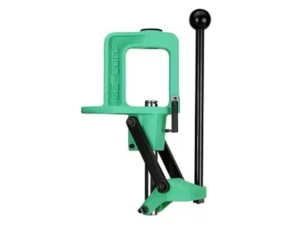
The Hornady Lock-N-Load Iron is Hornady’s heavy-duty single-stage press, and it occupies a specific position in the single-stage press market that no direct competitor fully replicates. Its 26-pound cast-iron O-frame provides the rigidity that heavy magnum sizing and case forming require. Its spring-assisted ram reduces the physical effort per stroke in a way that no other standard single-stage press does. And its Lock-N-Load bushing system – the same quick-change interface found in the Hornady Lock-N-Load AP progressive press and the Hornady Lock-N-Load Classic single-stage – allows pre-set dies to swap in and out in under a minute without re-adjusting seating depth or sizing position.

For a reloader who already owns a Hornady Lock-N-Load AP and uses Lock-N-Load die bushings throughout their die collection, the Iron is the natural single-stage companion. Dies pre-set in Lock-N-Load bushings for the progressive transfer directly to the Iron – seating depth, sizing position, and die adjustment all carry over without re-dialing. This cross-press compatibility is the Lock-N-Load Iron’s most practically useful feature for reloaders already in the Hornady ecosystem.
For reloaders outside the Hornady ecosystem, the Iron’s 26-pound frame, spring-assisted ram, and accessory deck are the differentiators to evaluate against the RCBS Rock Chucker Supreme and Redding Big Boss II on their own merits.
What’s in the Box
The Hornady Lock-N-Load Iron ships in press-only and kit configurations. The base press includes:
- Lock-N-Load Iron press with 7/8-14 die threads
- Ambidextrous operating handle with ball knob
- Spring-assisted ram with compound steel linkage
- Lock-N-Load bushing for quick die installation
- Printed instructions and warranty information
What’s not included with the bare press: shellholders, dies, the auto-prime system (available separately or in kits), or bench mounting hardware. The kit version adds automatic priming, a digital scale, powder measure, and case prep tools. For a reloader starting from scratch, the kit provides a complete loading setup. For a reloader adding the Iron to an existing bench, the bare press is the practical choice.
The priming shroud – a safety enclosure around the primer feed area that contains any detonation event at the primer station – is a Hornady-specific design feature available with the optional auto-prime system. For reloaders who prime on the press rather than with a dedicated hand tool, the shroud is a passive safety addition worth having.
The Lock-N-Load Bushing System on a Single-Stage
The Lock-N-Load bushing system is worth understanding in detail because it’s what makes the Iron different from every other heavy-duty single-stage press at this weight and price tier.
Standard single-stage presses – the RCBS Rock Chucker Supreme, Redding Big Boss II, Redding Ultramag – use standard 7/8-14 threaded die installation. A die threads into the press head, you set the adjustment position with a lock ring, and the die stays there until you thread it out for the next caliber. Changing dies means threading each one out, threading the next one in, and re-dialing position if the lock ring position wasn’t recorded precisely.
The Lock-N-Load bushing system changes this: dies thread into individual bushings that stay on the die permanently. The bushing – with the die pre-adjusted inside it – snaps into the press head with a quarter-turn twist and locks with a small retaining system. To swap dies, you press the bushing release and pull out the current die bushing, then install the next pre-set bushing. Under a minute for a complete die change, and the die returns to its pre-set adjustment position without re-dialing.
For a reloader who loads four or five calibers on a single-stage press – or who regularly switches between a sizing die and a neck-sizing die for the same caliber depending on application – this time reduction per die change is real. Across a loading year with dozens of die changes, it accumulates to meaningful time savings.
The ecosystem advantage: if you run a Hornady Lock-N-Load AP for pistol production and the Lock-N-Load Iron for rifle precision work, the same die bushings work in both presses. 223 Remington dies pre-set for the AP go directly into the Iron at the same position, and vice versa. The LNL bushing format is not compatible with other press brands’ quick-change systems – it’s specific to Hornady’s bushing interface – but within the Hornady ecosystem it provides seamless cross-press die compatibility.
The Spring-Assisted Ram: What It Actually Does
The Lock-N-Load Iron’s spring-assisted ram is the feature most distinctive among heavy-duty single-stage presses. Understanding what it does requires understanding the standard operating cycle of a single-stage press.
On a standard single-stage press, the downstroke lowers the ram as you pull the handle down – the handle’s compound leverage provides the mechanical advantage for this force-intensive direction. When the operation is complete, the upstroke returns the ram to the ready position for the next case. On a standard press, this upstroke requires lifting the ram – plus any die resistance – against gravity. Over 200 strokes for a typical precision rifle batch, that upstroke effort accumulates into measurable arm fatigue, particularly when working with tight seating dies that require more force to release the case from the die on the upstroke.
The spring-assisted ram on the Lock-N-Load Iron provides a mechanical return force for the upstroke. When the downstroke is complete and the handle is released, the spring mechanism assists the ram’s return to the ready position. The operator’s arm isn’t lifting the ram’s weight against gravity – the spring is doing part of that work. The result is a noticeably lighter upstroke that reduces per-stroke effort and session fatigue over extended loading sessions.
For a reloader who loads 100-200 rifle cases per session regularly – 308 Winchester hunting batches, 6.5 Creedmoor competition prep, 300 Winchester Magnum for a Western elk hunt – the spring assist is a comfort feature that makes those sessions easier. For a reloader loading 20-30 cases occasionally, it’s a convenience. It’s not a trivial engineering feature, and no other standard single-stage press in this weight class includes it.
Build and Materials
The Lock-N-Load Iron frame is heavy-duty cast iron with Hornady’s powder-coat finish – the same material and finish philosophy as the RCBS Rock Chucker Supreme, Lee Classic Cast, and Redding Big Boss II in the heavy-duty single-stage category. At 26 pounds, it’s among the heavier single-stage presses in the standard market, providing the frame mass that resists deflection under heavy magnum sizing loads.
The O-frame geometry is the correct choice for any press expected to work with large-capacity magnum cases. The closed O-frame loop keeps the ram and the die head on the same rigid loop so the force path during sizing runs through the frame without opening any gap. The heavy-duty O-frame provides the combination of geometry and mass that serious case forming and magnum loading requires.
The 1-1/8-inch ram diameter is in line with other heavy-duty single-stage presses in this category. The ram is solid steel rather than hollow – which provides greater mass and rigidity at the ram itself. Through-ram primer disposal (where spent primers fall through the hollow ram into a catcher) is available on some competing presses; the Lock-N-Load Iron’s primer management is handled through the separate spent-primer catch system.
The compound steel linkage provides high mechanical advantage through the handle stroke. The linkage geometry is optimized for the bottom of the downstroke where sizing force peaks – the point in the travel where mechanical advantage is most needed.
The accessory deck is an integrated bench feature unique to the Lock-N-Load Iron in this press category. It provides organized storage for commonly-used bench tools – calipers, deburring tools, primer pocket brushes, case lube – at the press without requiring a separate bench organizer. For a reloader who works through a multi-step case prep and loading sequence, the accessory deck keeps the workflow organized and reduces the time spent reaching across the bench for the next tool.
Key Specs and Compatibility
| Feature | Specification |
|---|---|
| Frame Type | O-frame, cast iron |
| Frame Weight | 26 pounds |
| Ram Diameter | 1-1/8 inches, solid steel |
| Ram Assist | Spring-assisted return |
| Die Thread | Standard 7/8-14 |
| Quick-Change System | Lock-N-Load bushing |
| Window Opening | 3-9/16 inches |
| Handle | Ambidextrous |
| Priming System | Optional (auto-prime with shroud) |
| Spent Primer | Catch system/tray |
| Mounting | Three-hole base |
| Caliber Range | 9mm Luger through Ultra Mags |
| Warranty | Lifetime limited against defects under normal use |
| Origin | Hornady Manufacturing, USA |
The lifetime limited warranty covers defects in materials and workmanship under normal use. Confirm specific warranty terms and current policy directly with Hornady Manufacturing with proof of purchase. Hornady’s customer service reputation is generally positive for equipment issues.
The 3-9/16-inch window accommodates 223 Remington, 308 Winchester, 6.5 Creedmoor, 30-06 Springfield, 300 Winchester Magnum, 338 Lapua Magnum, and the Ultra Mag series that Hornady specifically lists in the press specifications.

The Lock-N-Load bushing compatibility with all Hornady LNL dies means reloaders who own the Hornady Custom Rifle Die Set, Hornady Custom Pistol Die Set, Hornady Match Die Set, or Hornady Bushing Die Set with pre-installed Lock-N-Load bushings can use all of those dies in the Iron without any additional hardware or adjustment.
Where the Lock-N-Load Iron Excels
Heavy-duty magnum rifle loading with Hornady ecosystem integration. 300 Winchester Magnum with Hodgdon H1000 for long-range hunting, 338 Lapua Magnum with Alliant Reloder 26, 7mm Remington Magnum for big-game hunting – the Lock-N-Load Iron handles these with the cast-iron O-frame rigidity that large case sizing requires. The spring-assisted ram makes sustained sessions with heavy magnum brass noticeably more comfortable. Paired with Federal GM210M large rifle match primers or CCI BR-2 for precision work, and charged with the Hornady Lock-N-Load Bench Rest Powder Measure for the most consistent volumetric charging Hornady offers.
Precision rifle loading with quick caliber changes. For a bench that runs 6.5 Creedmoor competition loads with Hodgdon H4350 one session and 308 Winchester hunting loads with Hodgdon Varget or IMR 4064 the next, Lock-N-Load bushing swaps make the caliber change practical within a session. The Hornady Match Die Set provides micrometer-controlled seating depth for competition-grade OAL consistency. For 6.5 Creedmoor match loads with Federal GM210M or CCI BR-4 small rifle primers, the Lock-N-Load Iron delivers the rigidity that consistent sizing requires.
Complementary single-stage to an LNL AP progressive bench. For a reloader running a Hornady Lock-N-Load AP for pistol production, the Lock-N-Load Iron handles the single-stage precision rifle work and case forming that the progressive isn’t optimized for – without requiring a second set of die adjustments, since the same bushings work in both presses.
Wildcat development and case forming. The 26-pound cast-iron O-frame and compound leverage handle the high-force operations of forming cases to wildcat dimensions – necking down large cases, fire-forming to new shoulder dimensions, reforming parent brass for derived cartridges. The spring-assist adds comfort to the sustained cycles that case forming requires.
Pistol loading with quick die changes. 9mm Luger with Hodgdon Titegroup and 45 ACP with Winchester 231 are well within the Lock-N-Load Iron’s capability. The Lock-N-Load bushing swap between pistol and rifle dies makes multi-caliber sessions in a single bench session practical. The press is overbuilt for routine pistol loading, but its capability doesn’t hurt – it simply means the frame never approaches its limits during light pistol work.
Realistic Limitations
Weight limits portability. At 26 pounds, the Lock-N-Load Iron is a permanent bench installation. Moving it between locations or storing it between sessions is more practical than with lighter presses, but it’s not a press you carry to the range or set up and break down regularly. For reloaders who need a portable single-stage, the lighter alternatives in this category are more practical.
Optional priming system adds cost for on-press priming. The auto-prime system is not included with the bare press. Reloaders who want on-press priming need to budget for the separate purchase. The priming shroud safety enclosure is part of that optional system, not a feature of the base press. For reloaders who prime off-press with a hand tool – which gives better tactile feedback anyway – this isn’t a practical limitation. The Hornady Hand Priming Tool, RCBS Universal Hand Priming Tool, or Hornady Versa-Prime Bench Priming Tool are natural companions.
Lock-N-Load bushing compatibility is Hornady-specific. The quick-change advantage of the bushing system applies specifically to Hornady Lock-N-Load dies and third-party dies equipped with Hornady-compatible bushings. Non-Hornady dies thread into the press on the standard 7/8-14 thread without bushing quick-change capability. For a reloader who uses Redding, RCBS, or Forster dies primarily, the quick-change advantage is partially reduced – you’d need to purchase Lock-N-Load bushings separately for those dies.
Single-stage throughput. One case operation per handle stroke is inherent to single-stage design. For high-volume pistol production, a progressive press is the right tool. The Lock-N-Load Iron’s strength is precision rifle loading and heavy-duty case work, not production volume.
Setup and Mounting
Bench requirements. 2-inch or thicker hardwood, Grade 8 bolts through all three base mounting holes with large washers. Position the press so the handle has full arc without obstruction and the spent-primer catch system has clearance to collect primers without the tray contacting the bench surface.
Lock-N-Load bushing installation. Thread the die into the Lock-N-Load bushing off the press first. Set the die adjustment position – sizing die per the how to tune a sizing die guide, seating die per the seating die tuning guide – and lock the die in the bushing at that position with the Sure-Loc ring or equivalent. When the bushing is installed in the press, the die returns to the pre-set position without additional adjustment. Check die position verification per the how to tune a single-stage press guide for systematic setup.

Spring assist verification. After mounting, cycle the press handle through its full travel several times without a case to verify smooth operation. The spring assist should provide noticeable return assistance on the upstroke without causing the handle to return sharply or with excessive speed. Adjust the spring if needed per Hornady’s instructions until the return motion is controlled and smooth.
Die selection for the Hornady ecosystem. The Hornady Custom Rifle Die Set and Hornady Match Die Set come with Lock-N-Load bushings pre-installed – natural choices for the Iron. The Hornady Bushing Die Set is the Hornady neck sizing companion. For reloaders who prefer Redding dies for precision work, the Redding Deluxe Rifle Die Set with a separately purchased Lock-N-Load bushing for each die preserves the quick-change advantage while using Redding’s precision die engineering.
Primer system choice. For priming separate from the press, the Hornady Hand Priming Tool uses the same Lock-N-Load bushing interface as the press – shellholder bushings swap quickly for different calibers. The RCBS Universal Hand Priming Tool is the non-Hornady alternative that eliminates shellholder swaps entirely. For precision rifle applications where seating depth is a tracked variable, off-press hand priming gives better tactile feedback than any on-press system.
Case lube. Mandatory for all bottleneck rifle cases – 223 Remington, 308 Winchester, 300 Winchester Magnum, 338 Lapua Magnum. Apply consistently before each sizing stroke. The case prep essentials guide covers the complete brass preparation workflow.
Competitors – Four Direct Comparisons
RCBS Rock Chucker Supreme
The RCBS Rock Chucker Supreme is the direct competitor in the heavy-duty cast-iron O-frame single-stage category. The Rock Chucker has excellent priming feel through its on-press priming arm, a 3.75-inch stroke, and RCBS’s lifetime limited warranty. It doesn’t have the Lock-N-Load bushing quick-change system or the spring-assisted ram. For a reloader outside the Hornady ecosystem who wants cast-iron heavy-duty single-stage performance, the Rock Chucker is the reference standard. For a reloader in the Hornady ecosystem who values Lock-N-Load bushing cross-compatibility with their LNL AP dies, the Iron’s quick-change advantage is the specific differentiator that justifies the choice.
Choose the Lock-N-Load Iron if: you run a Hornady Lock-N-Load AP and want single-stage die bushings to transfer between presses, or the spring-assisted ram is specifically valued for extended session comfort. Choose the Rock Chucker Supreme if: you’re outside the Hornady ecosystem, prefer RCBS’s on-press priming feel and service reputation, or don’t need the Lock-N-Load quick-change advantage.
Redding Big Boss II
The Redding Big Boss II is Redding’s precision machined-steel single-stage press – tighter tolerances than any cast-iron alternative, including the Lock-N-Load Iron. The Big Boss II typically achieves lower runout on sized and seated cases through machining precision rather than through the coaxial floating die design of the Forster Co-Ax. It doesn’t have a spring-assisted ram or a quick-change bushing system. It costs more than the Lock-N-Load Iron. For a benchrest or extreme precision reloader who wants the best machined-steel fixed-die press precision, the Big Boss II is the choice. For a reloader who values the Lock-N-Load ecosystem integration and spring assist at a lower price point, the Iron is the alternative.
Choose the Lock-N-Load Iron if: Hornady ecosystem integration, the Lock-N-Load quick-change system, and spring-assisted ram comfort are the priorities, at a lower price than the Big Boss II. Choose the Big Boss II if: maximum machined-steel precision for benchrest-level dimensional consistency is the priority and the higher cost is justified.
Lee Classic Cast
The Lee Classic Cast is the budget heavy-duty cast-iron single-stage press with the longest stroke in class (4 inches), a fully adjustable handle, and Breech Lock quick-change compatibility. It costs significantly less than the Lock-N-Load Iron. The Lee’s Breech Lock bushings are not compatible with Hornady’s Lock-N-Load system. For a reloader who wants cast-iron heavy-duty capability at the lowest possible price and isn’t in the Hornady ecosystem, the Lee Classic Cast is the value choice. For a reloader who specifically needs Lock-N-Load bushing compatibility or the spring-assisted ram, the Iron justifies its premium.
Choose the Lock-N-Load Iron if: the Lock-N-Load bushing system and spring-assisted ram justify the cost premium over the Classic Cast, particularly for Hornady ecosystem users. Choose the Classic Cast if: budget is the priority, you need the longest stroke for extreme cases, or Breech Lock die compatibility with other Lee equipment is the advantage.
Forster Co-Ax
The Forster Co-Ax represents the alternative engineering philosophy for a precision reloader choosing a heavy-duty single-stage: floating die self-centering that produces 0.001-inch runout rather than fixed-die machining precision. The Co-Ax has a unique jaw system instead of shellholders, a top-mounted priming device, and the lowest runout from any single-stage press design. It doesn’t have a spring-assisted ram, Lock-N-Load compatibility, or an accessory deck. The comparison between the Iron and the Co-Ax is a comparison between precision approaches: the Iron achieves precision through cast-iron rigidity and Lock-N-Load consistency; the Co-Ax achieves it through the floating die’s self-centering mechanism. For a precision rifle reloader whose primary goal is minimum runout, the Co-Ax has the engineering advantage. For a reloader who values Hornady ecosystem integration and spring-assisted operation alongside precision, the Iron is the choice.
Choose the Lock-N-Load Iron if: Hornady ecosystem integration, Lock-N-Load quick-change, and spring-assisted ram are the priority, and conventional fixed-die precision meets your accuracy goals. Choose the Forster Co-Ax if: minimum runout through the floating die design is the primary precision goal, and single-stage workflow without quick-change bushing compatibility serves your application.
Comparison Table
| Feature | Hornady LNL Iron | RCBS Rock Chucker Supreme | Redding Big Boss II | Lee Classic Cast | Forster Co-Ax |
|---|---|---|---|---|---|
| Frame | Cast iron O-frame | Cast iron O-frame | Machined steel O-frame | Cast iron O-frame | Cast alloy, floating die |
| Weight | 26 lbs | ~17 lbs | ~22 lbs | ~15 lbs | ~12 lbs |
| Quick-Change | Lock-N-Load bushing | None | None | Breech Lock | Snap-in jaws |
| Spring Assist | Yes | No | No | No | No |
| Ram Diameter | 1-1/8 in. | 1-1/4 in. | 1-1/4 in. | 1-1/8 in. | 1 in. |
| Accessory Deck | Yes | No | No | No | No |
| Priming System | Optional (with shroud) | On-press arm | On-press arm | On-press arm | Top-mounted |
| Typical Runout | 0.002-0.003 in. | 0.002-0.003 in. | 0.001-0.002 in. | 0.003-0.005 in. | 0.001 in. |
| Ecosystem | Hornady LNL | RCBS | Redding | Lee Breech Lock | Forster |
| Warranty | Lifetime limited | Lifetime limited | 1-year limited | Lifetime limited | Lifetime limited |
| Price Range | $$ | $$ | $$$ | $ | $$$ |
| Best For | Hornady ecosystem + spring assist | General heavy-duty | Steel precision | Budget heavy-duty | Min runout |
Troubleshooting
Lock-N-Load bushing releasing during a stroke. The bushing must be fully seated and locked before running a case. Verify the retention mechanism is engaged after installation – a bushing that’s seated but not locked can release during the stroke. Check the retention mechanism for wear or debris that might prevent full locking engagement. Hornady replacement retention mechanisms are available through their customer service.
Spring assist feeling rough or binding. Check the spring mechanism for debris accumulation – primer residue and metal shavings can work their way into the spring housing during extended use. Clean with compressed air and solvent. If the spring itself shows any deformation or the mechanism has developed a rough spot, contact Hornady – the spring assist is a precision component that needs to work smoothly for the comfort benefit to be felt.
Sizing inconsistency across a batch. First check the Lock-N-Load bushing seating – a bushing with any play in the press head can shift position between strokes. Verify the retention mechanism is fully engaged. Second check the die lock ring position within the bushing – a ring that isn’t tightened against the bushing body can allow the die to shift. Third verify case lube coverage is consistent – dry spots or heavy spots change the sizing resistance and can affect how consistently the case enters the die.
Case sticking in the sizing die. Insufficient case lube for bottleneck rifle cases. Apply before every stroke for large magnum cases in particular. For 300 Winchester Magnum and 338 Lapua Magnum, consistent lube coverage on the full case body and neck prevents the stuck-case scenario that heavy magnum sizing can produce with insufficient lubrication.
Priming arm (optional system) inconsistent seating. For the optional auto-prime system, primer compound residue in the primer slide path causes inconsistency. Clean the primer path before each session. Verify the correct primer size arm is installed for your primer type. Check that cases are fully seated in the shellholder before the priming stroke. For better tactile primer seating feedback, consider using the RCBS Universal Hand Priming Tool as a separate priming step.
What to Buy with It
Lock-N-Load die sets. The Hornady Custom Rifle Die Set with pre-installed Lock-N-Load bushings is the natural primary die choice. The Hornady Match Die Set with micrometer-adjustable seating die for precision rifle loading. The Hornady Bushing Die Set for neck-only sizing of precision rifle brass. The Hornady Custom Pistol Die Set for pistol calibers. All come with Lock-N-Load bushings pre-installed.
Additional Lock-N-Load bushings for non-Hornady dies. If you use Redding Deluxe Rifle Die Sets or RCBS Competition Die Sets, purchase Hornady Lock-N-Load bushings separately for each die to enable the quick-change functionality on those dies in the Iron.
Primer tool. The Hornady Hand Priming Tool uses Lock-N-Load shellholder bushings and integrates with the Hornady ecosystem. The RCBS Universal Hand Priming Tool eliminates shellholder swaps for multi-caliber priming. The Hornady Versa-Prime Bench Priming Tool is Hornady’s bench-mounted priming option.
Powder measure. The Hornady Lock-N-Load Bench Rest Powder Measure is Hornady’s precision measure for caliber-specific rifle charging on the Lock-N-Load Iron. The Redding Competition PR-50 is a compatible high-precision alternative on a separate bench stand.
Powder scale. The RCBS Rangemaster 2000 or Frankford Arsenal Platinum Series Digital Scale for charge weight verification at the start of every session.
Case lube. Hornady One-Shot or RCBS Case Lube for standard bottleneck rifle cases. For 300 Winchester Magnum and 338 Lapua Magnum, apply with extra attention to full case body coverage.
Optional auto-prime system with priming shroud. If you prefer on-press priming over a hand tool, the Hornady auto-prime system for the Lock-N-Load Iron adds the safety shroud that the bare press doesn’t include.
FAQ
How does the Lock-N-Load bushing work with dies I already own from other brands? Standard 7/8-14 dies from RCBS, Redding, Lee, and Forster thread into the press on the standard thread without bushings. To enable the Lock-N-Load quick-change feature on a non-Hornady die, purchase a separate Lock-N-Load bushing, thread the die into it, set your adjustment, and lock the die in the bushing with a Sure-Loc ring. From that point, the die and bushing behave as a single unit that snaps in and out of the Iron’s press head quickly.
Is the spring-assisted ram noticeably different from a standard single-stage? Yes. Reloaders who switch from a conventional single-stage to the Lock-N-Load Iron consistently report the upstroke feels lighter. In extended sessions – 100+ rifle cases – the accumulated reduction in arm effort is perceptible. The effect is most apparent when working with tight seating dies or sizing dies that provide significant case hold-through die on the upstroke.
Can dies from the Hornady Lock-N-Load AP progressive press work in the Iron without adjustment? Yes, with the same bushing. A die pre-set for the Hornady Lock-N-Load AP in a Lock-N-Load bushing installs in the Iron at the same position – no re-adjustment needed. The bushing records the die’s position and maintains it whether installed in the progressive or the single-stage. This cross-press compatibility is one of the most practically useful features of the Hornady Lock-N-Load ecosystem.
Is the 26-pound weight an advantage or a limitation? Both, depending on application. The weight is a deliberate design feature – the 26 pounds of cast iron provides the frame mass that resists deflection under heavy magnum sizing and case forming loads. For a reloader who loads 338 Lapua Magnum or does case forming work, the weight is an advantage. For a reloader who needs to move the press regularly or has limited bench space for a heavy object, the weight is a practical constraint.
How does it compare to the Hornady Lock-N-Load Classic? The Hornady Lock-N-Load Classic is Hornady’s lighter-duty single-stage press – not cast iron, and without the spring-assisted ram. The Classic uses the same Lock-N-Load bushing system for die compatibility, but it’s designed for lighter duty than the Iron. For standard rifle and pistol loading without heavy magnum or case forming work, the Classic is adequate at a lower price. For heavy-duty magnum work, the Iron’s cast-iron frame and spring assist are the meaningful upgrades.
What primers work best in the optional auto-prime system? CCI 500 and Winchester WSP for small pistol, CCI 300 and Winchester WLP for large pistol, CCI 400 and Federal 205 for small rifle, CCI 200 and Federal 210 for large rifle. Dimensionally consistent primers reduce feed issues in any on-press primer system.
Conclusion
The Hornady Lock-N-Load Iron occupies a specific and defensible position in the heavy-duty single-stage press market: cast-iron O-frame rigidity in the same class as the RCBS Rock Chucker Supreme and Lee Classic Cast, with two features that no other heavy-duty single-stage provides simultaneously – the Lock-N-Load bushing system for quick die changes and cross-press compatibility with the LNL AP progressive, and the spring-assisted ram for reduced upstroke effort over extended sessions.
For a reloader already in the Hornady ecosystem with a Lock-N-Load AP for pistol production, the Iron is the natural completion of a two-press bench. Dies pre-set for the progressive transfer to the Iron without adjustment. The spring-assisted ram makes extended rifle loading sessions more comfortable. The accessory deck keeps the workspace organized. All under a lifetime limited warranty from Hornady.
For reloaders outside the Hornady ecosystem, the Iron’s advantages over the Rock Chucker Supreme come down to the spring-assisted ram and the Lock-N-Load bushing system – both real features, but whether they justify the alternative to RCBS’s proven service reputation depends on individual priorities.
Choose the Lock-N-Load Iron if you run a Hornady Lock-N-Load AP and want cross-press die bushing compatibility, value the spring-assisted ram for extended session comfort during magnum and case forming work, and want an accessory deck as part of the press’s integrated design.
Choose the RCBS Rock Chucker Supreme instead if you’re outside the Hornady ecosystem, value RCBS’s on-press priming feel, or prefer RCBS’s well-established service network for long-term press ownership.
Choose the Redding Big Boss II instead if machined-steel precision for the tightest achievable dimensional consistency is the priority and the higher cost is justified.
Choose the Lee Classic Cast instead if budget is the priority, you need the longest stroke available in class, or Lee’s Breech Lock ecosystem suits your existing tooling.
Choose the Forster Co-Ax instead if 0.001-inch runout through the floating die design is the primary precision goal for precision rifle and benchrest applications.