Published: July 2026 | Last updated: May 2026
Disclaimer: Specifications and pricing in this article are drawn from manufacturer and retailer sources current at time of publication. Always verify current pricing before purchasing.
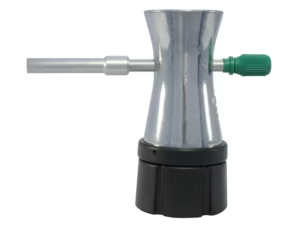
The CED Ultimate Pro Powder Trickler is a motorized electric trickler – it uses a small electric motor to drive the auger mechanism rather than requiring manual knob rotation. This positions it between the manual worm-gear tricklers reviewed in this series and the fully automated scale-and-dispenser systems: the operator still monitors the scale and controls when the trickler stops, but the auger turns continuously at a motor-controlled rate rather than requiring the operator’s hand on a knob throughout the trickle cycle. The result is a hands-free trickle workflow where both the operator’s hands are free to monitor the scale, handle the powder pan, or prepare the next case while the CED trickles toward the target weight.
CED (Competitive Edge Dynamics) is a company whose product line centers on competitive shooting equipment – shot timers, scoring systems, and precision loading accessories used by serious IPSC, USPSA, and precision rifle competitors. The Ultimate Pro Powder Trickler reflects that competitive orientation: it is aimed at the serious handloader who loads significant volumes of precision ammunition and wants a trickler that reduces the physical demands of the trickle cycle without committing to the full investment of an automated dispenser system.
At a street price around $80-120, the CED Ultimate Pro is meaningfully more expensive than manual tricklers from Frankford Arsenal, Lyman, and Redding, and considerably less expensive than fully automated scale-and-dispenser systems like the RCBS ChargeMaster Supreme or Frankford Arsenal Intellidropper 2.0. It occupies a distinct middle tier: motorized trickler capability at a fraction of automated dispenser cost, with the operator maintaining active scale monitoring and stopping the trickler manually when the target weight is reached.
Key Specifications
| Feature | Detail |
|---|---|
| Manufacturer | CED (Competitive Edge Dynamics) |
| Model | Ultimate Pro Powder Trickler |
| SKU | Not available at time of publication |
| UPC | Not available at time of publication |
| Mechanism | Motorized electric auger |
| Motor | DC electric motor (battery or AC adapter powered) |
| Speed Control | Variable motor speed control |
| Output Tube | Adjustable height |
| Base | Weighted stable base |
| Powder Types | Ball, flake, and extruded stick powders |
| Power | Battery and/or AC adapter |
| Manual Fallback | No – motor-dependent operation |
| User Rating | Not available at time of publication |
| MSRP | Approximately $99.99-$119.99 |
| Approx. Street Price | $80-$120 depending on retailer |
Motorized Trickler Operation – What Changes and What Doesn’t
A motorized trickler automates the physical rotation of the auger without automating the measurement or stopping decision. The operator sets the motor speed – governing the kernel delivery rate – and turns the motor on when ready to trickle. The auger rotates at the set speed, advancing kernels to the output tip at a controlled rate. The operator watches the scale and turns the motor off when the target weight is reached. The physical knob rotation that manual tricklers require throughout the cycle is replaced by a speed setting and an on/off decision.
This workflow change has two practical consequences. First, both operator hands are free during trickling. With a manual trickler, one hand holds the knob and one hand hovers near the scale pan or holds a note of the target weight. With the CED motorized trickler, both hands are free to monitor the scale unobstructed, hold the case steady, or prepare the next loading step. This reduces multitasking demand during the final approach to the target weight.
Second, the delivery rate is consistent at a given speed setting rather than varying with the operator’s hand speed. Manual trickler users develop a practiced cadence, but the rate still varies slightly with attention and fatigue across a long loading session. The motor’s consistent rotation speed produces a consistent kernel delivery rate as long as the speed setting is unchanged – removing one source of session-to-session variation in the trickle workflow.
What does not change: the operator still monitors the scale and decides when to stop. The CED Ultimate Pro is not an automated system. It does not weigh powder electronically or stop itself at the target weight. The operator’s attention to the scale reading remains the critical element. What changes is the physical demand of that monitoring – the operator watches and stops, rather than watches, modulates knob speed, and stops.
The variable speed control is the operator interface for the two-speed approach that experienced trickler users develop naturally: higher speed for the bulk approach from several tenths of a grain below the target, lower speed for the final 0.1-0.2 grains. With the CED, the operator sets a high speed, runs the motor until approaching within 0.3 grains of target, switches to low speed, and cuts the motor at the target reading. The speed dial replaces the knob rotation speed modulation of manual tricklers.
Build Quality and Design
The CED Ultimate Pro is a dedicated precision loading tool, and its construction reflects that positioning. The motor housing, auger mechanism, and base are more robustly constructed than the plastic-bodied manual tricklers in the budget-to-mid tier. The motorized auger is machined or precision-formed to maintain consistent thread geometry under continuous motor-driven operation – motor-driven augers accumulate a different wear pattern than hand-turned augers, as the continuous rotation and motor torque demand consistent material properties at the thread crests.
The variable speed control is a dial or rotary control that governs motor speed. The range covers delivery rates from approximately one kernel per second at minimum to a stream of kernels at maximum. The speed settings are repeatable – returning to a previously used position produces the same delivery rate – which allows operators to record effective settings for different powder types and use them consistently across sessions.
The adjustable output tube positions the trickler tip above the scale pan at the correct height. The height range covers standard scale pan heights from major reloading scale manufacturers. The base provides stable positioning during motor operation – motor vibration transmitted to the bench requires a heavier or better-isolated base than manual tricklers need.
Power options vary by production version: some versions operate on batteries only, others include an AC adapter option. Battery operation allows bench use without a nearby outlet; AC operation eliminates battery management. Confirm the specific power options for the current production version before purchase.
Setup and Operation
Position the CED Ultimate Pro adjacent to the scale, with the output tube tip 1-2mm above the scale pan. Connect power. Set the motor speed to minimum.
Fill the auger tube with the intended powder. Set the high approach speed for the bulk trickle phase. Throw a powder measure charge set 0.5 grains below the target weight onto the scale pan. Activate the motor. As the scale approaches within 0.3 grains of the target, switch to the low speed setting. Cut the motor when the scale reads the target weight. Allow 2-3 seconds for the scale reading to stabilize before confirming the final weight.
Trickler and scale isolation is important with a motorized unit. The motor generates vibration that transmits through the bench surface to the scale pan, affecting scale reading stability during operation. Position the CED trickler on a separate surface from the scale – a small anti-vibration mat, a folded cloth, or a separate small board on the bench – to break the vibration transmission path. Some operators run the scale pan on an extended arm or cable over the scale rather than directly on the bench adjacent to the motor.
Ball and flake powders – Winchester 231, Hodgdon Titegroup, Hodgdon HP-38, Alliant Bullseye – advance freely through the motor-driven auger at all speed settings. Medium extruded rifle powders – Hodgdon Varget, Hodgdon H4350, IMR 4064, Alliant Reloder 17, Vihtavuori N550 – are the primary application for a precision trickler at this price tier, and the motor-driven auger handles them consistently. Very coarse long-grain powders – Hodgdon H1000, Alliant Reloder 33, Vihtavuori N570 – require attention to speed setting to maintain single-kernel or low-count delivery at the approach phase.
Where It Fits – Use Cases
High-volume precision rifle loading where the physical fatigue of manual knob rotation over 100+ rounds per session is a real factor. A handloader loading 150 rounds of 6.5 Creedmoor, 308 Winchester, or 6mm Dasher in a session with a manual trickler rotates the knob 150 times through the final precision approach. The CED motor eliminates that physical demand, reducing hand fatigue across the session.
Competitive precision rifle shooters who load significant volumes of practice and match ammunition and want workflow efficiency improvements that do not require committing to the full cost of an automated dispenser. The CED’s price is accessible to serious competitors; its motorized workflow reduces session time and fatigue compared to manual tricklers.
Handloaders who find multitasking between knob modulation and scale reading cognitively demanding during the final precision approach. Freeing both hands from the trickler during scale monitoring simplifies the final approach step.
Setups with a bench outlet – the CED Ultimate Pro requires power, and bench outlet availability is the practical prerequisite for AC-powered operation. Battery operation extends placement flexibility, but battery management adds overhead.
Manual trickler users considering an upgrade who are not ready to invest in a full automated dispenser. The CED occupies the middle ground: motor-assisted manual trickler workflow at a price below automated dispenser territory.
The CED is not appropriate as a replacement for a fully automated dispenser when the handloader’s primary need is eliminating the scale monitoring step entirely. The CED still requires the operator to watch the scale and stop the motor. For hands-off automated charging, the RCBS ChargeMaster Supreme, Frankford Arsenal Intellidropper 2.0, or Lyman Gen 6 Dispenser are the appropriate category.
Competitive Analysis
CED Ultimate Pro vs. Frankford Arsenal Powder Trickler (manual): The Frankford Arsenal trickler is a manual plastic worm-gear unit at $20-30 – roughly one-quarter the CED’s price. The core functional difference is the CED’s motorized operation freeing both hands during the trickle cycle. For a handloader at moderate loading volume – 50 rounds per month – the manual trickler’s lower cost is hard to justify replacing. For a handloader at high volume – 150+ rounds per session regularly – the CED’s hands-free operation and reduced fatigue have practical session-quality value. Choose the CED Ultimate Pro for high-volume loading where motorized hands-free operation reduces fatigue. Choose the Frankford Arsenal Trickler for low-to-moderate volume where manual operation is adequate.
CED Ultimate Pro vs. Lyman Brass Smith Powder Trickler (manual): Same category comparison as Frankford Arsenal. The Lyman Brass Smith is a manual worm-gear unit with Lyman Brass Smith ecosystem integration. The CED’s motorized operation is the premium. Choose the CED for high-volume motorized operation. Choose the Lyman Brass Smith Trickler for Lyman ecosystem integration at manual-trickler cost.
CED Ultimate Pro vs. Redding No. 5 (manual, metal auger): The Redding No. 5 is a precision manual trickler with machined aluminum construction at $35-55. The CED costs more but adds motorized operation; the Redding costs less but requires manual knob rotation with a metal auger that provides better long-term consistency than plastic-auger alternatives. For a handloader who values motorized hands-free operation above the Redding’s metal construction longevity, the CED is the choice. For a handloader who prefers manual control with premium metal build quality at lower cost than the CED, the Redding No. 5 is the argument. Choose the CED Ultimate Pro for motorized operation. Choose the Redding No. 5 for manual premium metal construction at a lower price.
CED Ultimate Pro vs. RCBS ChargeMaster Supreme: The ChargeMaster Supreme is a fully automated scale-and-dispenser at $380-420. The CED is a motorized manual trickler at $80-120. The operational difference is fundamental: the ChargeMaster dispenses and weighs automatically without operator attention; the CED still requires the operator to monitor the scale and stop the motor. For a handloader whose primary need is reducing the load of scale monitoring – not just knob rotation – the ChargeMaster is the correct category. For a handloader who wants motorized trickle-to-weight workflow at a fraction of automated dispenser cost, the CED fills that gap. Choose the CED for motorized manual trickle-and-weigh at mid-tier price. Choose the RCBS ChargeMaster Supreme for fully automated weighing and dispensing.
Comparison Table
| Feature | CED Ultimate Pro | Redding No. 5 | Frankford Arsenal Trickler | RCBS ChargeMaster Supreme |
|---|---|---|---|---|
| Mechanism | Motorized electric auger | Manual worm-gear (metal) | Manual worm-gear (plastic) | Fully automated dispenser |
| Actuation | Motor on/off by operator | Knob rotation by operator | Knob rotation by operator | Fully automatic |
| Hands-Free During Trickle | Yes | No | No | Yes (fully) |
| Scale Monitoring Required | Yes – operator stops motor | Yes – operator stops knob | Yes – operator stops knob | No – stops automatically |
| Power Required | Yes (battery or AC) | No | No | Yes (AC) |
| Auger Material | Metal (motor-duty) | Machined aluminum | Plastic | N/A |
| Variable Speed | Yes | No (knob speed) | No (knob speed) | N/A (automated) |
| Best Application | High-volume precision; hands-free trickle | Precision; Redding ecosystem | Budget manual precision | High-volume automated |
| User Rating | N/A | ~4.6/5 | ~4.2/5 | ~4.5/5 |
| Price Range | $80-$120 | $35-$55 | $20-$30 | $380-$420 |
Troubleshooting
Motor delivers inconsistent kernel counts at the same speed setting between sessions. Powder residue has accumulated in the auger channel, reducing effective thread clearance and causing irregular advancement. Disassemble the auger tube from the motor assembly, clean all powder residue from the auger threads and tube bore with a dry brush, and reassemble. Motor-driven augers accumulate residue more quickly than hand-turned augers because continuous rotation generates more powder dust at the thread interface. Clean after every 200-300 rounds.
Scale reading fluctuates while motor is running. Motor vibration is transmitting through the bench surface to the scale. Isolate the trickler from the scale with an anti-vibration mat under the CED base. If the bench surface is rigid enough to transmit vibration even with a mat, place the CED on a separate small board or on a folded cloth to increase damping. The scale should stabilize within 2-3 seconds after the motor is stopped.
Motor speed setting produces too many kernels per second even at minimum. The minimum speed setting is too high for the powder type and kernel size in use. Some very fine ball powders advance rapidly even at minimum motor speed because the kernel mass is low relative to auger displacement. For these powders, approach the final 0.1 grains with very brief motor bursts – turn on for 0.5 seconds, off for 2 seconds to let the scale stabilize, repeat – rather than continuous minimum-speed operation.
Motor runs but auger does not rotate. The auger-to-motor coupling has disconnected or slipped. Inspect the drive coupling between the motor shaft and the auger body. CED’s service procedure for this failure is in the included instructions; contact CED customer service if the coupling cannot be reengaged per those instructions.
Battery drains quickly. High motor load with dense coarse powder increases current draw. Confirm the battery type matches CED’s specification for the motor – undersized batteries drain faster under motor load. For extended loading sessions, AC adapter operation eliminates battery drain concern.
Frequently Asked Questions
Is the CED Ultimate Pro compatible with the Auto Trickler / A&D FX-scale system? The CED Ultimate Pro is a standalone motorized trickler that delivers powder to any scale pan – it is not designed specifically for the Auto Trickler ecosystem but can be used with any scale including A&D FX-series instruments. However, the Auto Trickler system from AutoTrickler company is a different product that uses a motorized trickler integrated with the A&D scale’s feedback for semi-automated operation. The CED Ultimate Pro does not interface with the A&D scale electronically – the operator still monitors the scale and stops the CED motor manually. For the Auto Trickler ecosystem specifically, the AutoTrickler motor unit is the native accessory.
How does the CED Ultimate Pro compare to an automated dispenser for a handloader who loads 100 rounds of 6.5 Creedmoor per session? At 100 rounds per session, the time difference between the CED and a Frankford Arsenal Intellidropper 2.0 is significant. An automated dispenser typically drops and weighs a 6.5 Creedmoor charge in 20-30 seconds. The CED’s motorized trickle workflow – throw a charge, trickle to weight while watching the scale, confirm, transfer – typically takes 40-60 seconds per round including scale stabilization. At 100 rounds, the automated dispenser saves 20-50 minutes per session. For a handloader who loads 100+ rounds per session regularly, the automated dispenser’s time savings are compelling. For a handloader at 50 rounds or fewer per session, the CED’s $80-120 cost vs. the dispenser’s $300-420 is the stronger argument.
Can the CED Ultimate Pro be used without the motor – as a manual trickler? No. The CED Ultimate Pro is a motor-dependent product. If the motor or power fails, the trickler cannot be operated manually. This is a distinction from manual tricklers that have no power dependency.
What powder types does the CED handle best? The motor-driven auger handles ball, flake, and medium extruded powders most consistently. Coarse long-grain powders – Hodgdon H1000, Alliant Reloder 33, Vihtavuori N570 – require lower speed settings for controlled delivery and may occasionally bridge at the lower end of the auger channel. As with any worm-gear trickler, very coarse powders perform better with lower fill levels and careful speed calibration.
Conclusion
The CED Ultimate Pro Powder Trickler fills a specific and legitimate gap in the precision reloading tool market: a motorized, hands-free trickler for handloaders who load significant volumes of precision rifle ammunition and want to eliminate the physical demand of manual knob rotation without committing to a full automated dispenser system. The motorized operation frees both hands during the trickle cycle, reduces session fatigue over 100+ rounds, and delivers consistent kernel advancement at a set motor speed without the knob cadence variation that accumulates with manual tricklers over long sessions.
The price gap between the CED and manual tricklers is real – $80-120 vs. $20-55 – and justified only at loading volumes where motorized operation produces a practical difference in session experience. At 50 rounds per session, a Redding No. 5 or Frankford Arsenal trickler does the job at a fraction of the cost. At 150+ rounds per session for a competitive shooter loading match ammunition, the CED’s hands-free operation and consistent motor-driven rate are worthwhile improvements.
The CED is not an automated dispenser and should not be evaluated as one. It still requires the operator to monitor the scale and stop the motor at the target weight. For handloaders whose goal is completely eliminating scale monitoring from the charging workflow, the RCBS ChargeMaster Supreme or Frankford Arsenal Intellidropper 2.0 are the appropriate category.
Choose the CED Ultimate Pro Powder Trickler if you load high volumes of precision rifle ammunition per session and want motorized hands-free trickle operation that reduces physical fatigue without the cost of a fully automated dispenser, have bench power available, and have confirmed the CED’s price-to-benefit ratio makes sense at your loading volume.
Choose the Redding No. 5 instead if manual operation is acceptable and you want metal auger construction longevity at a lower price.
Choose the Frankford Arsenal Powder Trickler or Lyman Brass Smith Powder Trickler instead if loading volume is moderate and manual operation at budget pricing is adequate.
Choose the RCBS ChargeMaster Supreme or Frankford Arsenal Intellidropper 2.0 instead if fully automated weighing and dispensing without any scale monitoring is the goal.
Disclaimer: Specifications and pricing in this article are drawn from manufacturer and retailer sources current at time of publication. Always verify current pricing before purchasing.