Published: November 2025 | Last updated: June 2026
Introduction
The Norma EcoStrike is a lead-free monolithic copper hunting bullet from Norma of Sweden, occupying a meaningful niche in the premium lead-free hunting bullet market through one engineering feature that no other bullet in this site’s coverage series uses: a nickel coating over the copper bullet body. This is not a gimmick – nickel coating is a well-established surface treatment for projectiles (it is commonly used on handgun bullets for feeding reliability and corrosion resistance) applied here to a rifle hunting bullet context for several documented practical benefits.
Understanding the nickel coating’s functional role before examining the specifications is useful. Copper’s natural interaction with steel rifling produces copper fouling – thin films of copper deposited in the bore that accumulate over multiple shots and require solvents to remove. Nickel, while still a metal, produces different fouling characteristics than bare copper. The original article claims 15-20% fouling reduction from the nickel coating, which is a directional characterization consistent with published data on nickel-coated projectiles versus bare copper; the specific 15-20% figure cannot be independently verified from available sources. The feeding benefit is more straightforward: nickel’s natural lubricity over steel improves cartridge-to-chamber feeding in semi-automatic and bolt-action rifles, comparable to how nickel-plated pistol brass feeds more smoothly than standard brass in many semi-auto pistols.
Norma is one of the world’s leading bullet and ammunition manufacturers, producing both the EcoStrike as a component bullet and the EcoStrike as a factory-loaded Norma ammunition product. This dual factory/component positioning is common for European ammunition companies (Lapua, Norma, RWS all produce premium component bullets alongside their factory loaded ammunition). For North American handloaders, the EcoStrike as a component bullet competes directly with the Barnes TTSX, Hornady GMX, and Federal Trophy Copper components, all priced in the $0.50-$0.80 per bullet range cited in the original article. This price point makes the EcoStrike somewhat more accessible than the Lehigh Defense Tipped Controlled Chaos and Xtreme Chaos covered in the preceding articles ($0.70-$1.00).
The EcoStrike uses a green polymer tip, distinguishing it visually from the blue-tipped Barnes TTSX and the multi-colored Hornady SST family. The green tip is noted here as a product identification feature rather than a performance differentiator – the underlying polymer tip initiation mechanism is the same across all tipped monolithic copper designs in this category.
For trajectory context on the cartridges most commonly paired with this bullet, see the 6.5 Creedmoor ballistics guide, 270 Winchester ballistics guide, 308 Winchester ballistics guide, and 300 Winchester Magnum ballistics guide.
The original article’s competitor BC figures deserve the same examination applied throughout this series. The Barnes TTSX comparison (0.295-0.586) and GMX comparison (0.245-0.540) both match this site’s dedicated coverage, continuing the pattern of accurate Lehigh Defense citations documented in the previous articles. The Nosler E-Tip comparison (0.300-0.523) is also within the range this site’s coverage suggests for that bullet.
The “5% better retention than GMX” claim in the original article is not plausible. Both the GMX and the EcoStrike are monolithic copper bullets, and both achieve near-100% weight retention as a fundamental property of monolithic copper construction. A 5% difference between two monolithics at 95%+ retention would be unmeasurable in practical field use and is not documented in any available source. This should be understood as an approximate marketing characterization rather than a verified performance measurement.
Two further notes: the original article’s stated caliber range (.243 to .375 inches) is broader than the ballistics table, which shows only .264 through .338 without a .243 or .375 entry – the same table-vs-stated-range discrepancy flagged in several previous articles in this series. Also, the original article states a BC range of “0.39 to 0.443” in the introduction but the table’s maximum is 0.482 for the 185-grain .338-inch, which is higher – another internal inconsistency to verify at norma.com.
Disclaimer: Reloading is an inherently dangerous activity. Always consult current published load data from Norma or other reputable sources before loading any cartridge. Monolithic copper bullets generate higher pressures than lead-core bullets at the same charge weight – always start 10% below published minimums for monolithic designs. Never use lead-core bullet data for monolithic bullets. The information on this page is for educational reference only and does not replace a current reloading manual.
Technical Characteristics
Nickel-coated copper construction – the defining feature: The EcoStrike’s nickel coating distinguishes it from every other lead-free hunting bullet in this site’s coverage. The coating is applied after the bullet is formed from solid copper, creating a thin nickel film over the bullet’s exterior. This produces three documented effects: reduced copper fouling in the bore (nickel’s different interaction with steel); improved feeding smoothness in bolt-action and semi-automatic rifles; and enhanced corrosion resistance for stored ammunition.
The coating also produces a distinctive appearance – nickel-coated bullets appear silver-white rather than the copper-toned appearance of uncoated monolithics like the TTSX and GMX. This makes the EcoStrike visually distinctive in the box and in the magazine, which is a minor practical benefit for hunters who load multiple bullet types.
The nickel coating’s interaction with the rifling during the engraving process is worth noting as a handloading consideration. Bare copper monolithics produce a specific pressure signature and engraving resistance; nickel’s different hardness and lubricity characteristics produce a somewhat different signature. This is why using Norma’s own published data rather than transferring TTSX or GMX load data to the EcoStrike is important – the two materials engrave differently even at the same bullet diameter and weight, producing different peak pressures at the same charge weight. This is not unique to the EcoStrike; any material change in a monolithic bullet warrants fresh data rather than transferred data from a different material bullet.
Green polymer tip: Initiates expansion at 1,800 fps, the same threshold documented for the Barnes TTSX and Hornady GMX. The green tip is Norma’s brand-specific color choice. The underlying expansion mechanism – polymer tip drives into the hollow-point cavity to initiate radial expansion as a unified mass – is standard for all polymer-tipped monolithic copper designs.
Boat-tail: Standard for long-range hunting performance, contributing to the EcoStrike’s BC figures across the table.
Near-100% weight retention: This is the expected performance of any well-made monolithic copper hunting bullet. The “5% better than GMX” claim in the original article should not be taken literally – both are monolithic copper designs and the performance difference, if any, is within the noise of field measurement. What the claim correctly conveys is that the EcoStrike retains its weight well, as monolithic copper designs universally do.
1,800 fps expansion threshold: Standard for polymer-tipped monolithic copper designs, matching the TTSX and GMX. Lower than the Lehigh Defense Tipped Controlled Chaos and Tipped Xtreme Chaos’s 1,500 fps, but appropriate for the ranges and velocities typical of mainstream hunting cartridges.
Lead-free: Fully compliant with California condor zone regulations and all lead-restricted hunting jurisdictions.
Pressure considerations: Monolithic copper generates higher peak pressures than lead-core bullets at the same charge weight. Norma-published data specific to the EcoStrike is required; do not substitute lead-core bullet charge weights.
Ballistics and Performance
The original article’s stated BC range has two inconsistencies worth addressing. The introduction states “0.39 to 0.443” but the table’s maximum is 0.482 for the .338-inch 185-grain. Separately, the caliber range claims .243 to .375 inches but no .243 or .375 entries appear in the table. Handloaders should verify the full current EcoStrike lineup at norma.com rather than relying on the stated ranges in the original article.
G1 BCs from 0.390 to 0.482 per the table are competitive for a monolithic copper tipped hunting bullet across the .264 to .338 inch caliber range. For context, the Barnes TTSX achieves BCs up to 0.586 at heavier weights – the EcoStrike’s 0.482 maximum is within the TTSX’s range but does not reach the TTSX’s highest-BC heavy entries. Across comparable weights and calibers, the EcoStrike and TTSX are closely matched in BC performance in the middle of their respective ranges, with the TTSX pulling ahead at the heaviest specialty weights that the EcoStrike does not appear to cover in the original article’s table.
The BC progression across the table follows the expected pattern: within a caliber, heavier weights produce higher BCs (150-grain .308-inch at 0.443 versus 165-grain at 0.470); across calibers at the same weight, smaller diameters produce higher BCs (120-grain .264-inch at 0.390 versus the 135-grain .284-inch at 0.420 for different weights, and the general trend of .264 outperforming .277 outperforming .284 outperforming .308 at comparable weights). The .338-inch 185-grain at 0.482 breaks this trend because the heavier weight more than compensates for the larger diameter.
The 120-grain .264-inch (6.5mm) at BC 0.390 and SD 0.246 covers 6.5 Creedmoor and 6.5 PRC for deer and antelope. At BC 0.390, this trails the comparable weight Barnes TTSX entry at 0.400 (from the TTSX’s own table), a modest difference that is not significant inside 400 yards but becomes relevant at 500+ yards.
The 125-grain .277-inch at BC 0.406 and SD 0.233 covers 270 Winchester for deer and elk.
The 135-grain .284-inch (7mm) at BC 0.420 and SD 0.239 covers 7mm Remington Magnum for elk and large game.
The 150-grain and 165-grain .308-inch at BC 0.443 and 0.470 cover 308 Winchester and 300 Winchester Magnum for elk and moose. The 165-grain at BC 0.470 is the stronger trajectory choice for extended-range large game.
The 185-grain .338-inch at BC 0.482 and SD 0.231 covers 338 Winchester Magnum for the largest North American game – the same caliber and weight class as the Lehigh Defense Tipped Xtreme Chaos 185-grain covered in the previous article, and at the same BC 0.482, suggesting similar aerodynamic efficiency in this caliber class across different monolithic copper designs. The coincidence of identical BC at the same caliber and weight between two different manufacturers is notable and worth verifying independently, though it is plausible given the physical constraints of aerodynamic optimization at this weight class.
Expert Ballistics Table – Norma EcoStrike Variants
Data from Norma specifications. BCs are G1. The stated BC range (0.39-0.443) and caliber range (.243-.375) in the original article do not match the table content – verify current lineup at norma.com.
| Diameter (inches) | Weight (grains) | BC (G1) | Sectional Density | Application |
|---|---|---|---|---|
| .264 | 120 | 0.390 | 0.246 | Deer in 6.5 Creedmoor |
| .277 | 125 | 0.406 | 0.233 | Elk in 270 Winchester |
| .284 | 135 | 0.420 | 0.239 | Large game in 7mm Remington Magnum |
| .308 | 150 | 0.443 | 0.226 | Deer/elk in 308 Winchester |
| .308 | 165 | 0.470 | 0.248 | Elk/moose in 300 Winchester Magnum |
| .338 | 185 | 0.482 | 0.231 | Large game in 338 Winchester Magnum |
Comparison Bullets
The original article’s comparison set – Barnes TTSX, Hornady GMX, Nosler E-Tip, and Federal Trophy Copper – covers the primary lead-free monolithic hunting bullet competitors appropriately. The BC figures for TTSX (0.295-0.586) and GMX (0.245-0.540) match this site’s own coverage, continuing the accurate citation pattern observed across this article’s immediate predecessors.
The EcoStrike’s primary differentiator versus the TTSX, GMX, and E-Tip is the nickel coating. All four achieve near-100% weight retention from monolithic copper construction; all four use polymer tips at 1,800 fps threshold; all four are lead-free compliant. The nickel coating is the one genuinely different engineering choice, and its practical benefits (reduced fouling, improved feeding) are real and documented even if not quantified precisely.
The Winchester Copper Extreme Point and Barnes LRX are additional lead-free alternatives this site covers, extending the comparison set beyond the original article’s four. The LRX specifically achieves higher BCs at comparable weights than the EcoStrike through its optimized long-range design. The Lapua Naturalis is a further European lead-free monolithic hunting bullet worth noting alongside the EcoStrike given Norma’s shared Scandinavian market context.
Comparison Table – Lead-Free Polymer-Tipped Monolithic Hunting Bullets
| Bullet | BC Range | Nickel Coated | Activation | Weight Retention |
|---|---|---|---|---|
| Norma EcoStrike | 0.390-0.482 | Yes | 1,800 fps | Near 100% |
| Barnes TTSX | 0.295-0.586 | No | 1,800 fps | 95-100%+ |
| Hornady GMX | 0.245-0.540 | No | 1,800 fps | 95%+ |
| Nosler E-Tip | 0.300-0.523 | No | 1,800 fps | 95%+ |
| Federal Trophy Copper | 0.287-0.562 | No | 1,800 fps | 95%+ |
Applications and Practical Aspects
Deer and antelope (120 grains, 6.5mm): 6.5 Creedmoor, 6.5 PRC, and 6.5 Grendel for lead-free deer hunting. Hodgdon H4350 and Alliant Reloder 23 are standard powder choices.
Deer and elk (.277-inch, 125 grains): 270 Winchester for the classic American deer and elk cartridge in lead-free form. The 125-grain at BC 0.406 provides strong trajectory in 270 Winchester at standard hunting velocities (2,900-3,100 fps), covering the ranges at which most 270 Winchester deer hunting happens (inside 350 yards) with margin to spare before dropping below the 1,800 fps expansion threshold. Hodgdon H4350 and Alliant Reloder 22 are standard choices.
Large game and elk (.284-inch, 135 grains): 7mm Remington Magnum, 7mm PRC, 7mm SAUM, and 280 Remington for elk and similar large North American game. Hodgdon H4831SC and Alliant Reloder 26 are standard choices. The 6.5 PRC ballistics guide provides useful trajectory comparison data for hunters choosing between the 6.5mm and 7mm EcoStrike options.
Elk and moose (.308-inch, 150-165 grains): 308 Winchester, 30-06 Springfield, and 300 Winchester Magnum for the most common North American elk and moose hunting platforms. The 30-06 Springfield ballistics guide provides trajectory data for the 150-grain EcoStrike at typical 30-06 velocities. Hodgdon H4350 and IMR 4955 Enduron for 308 Winchester; Hodgdon H4831SC and Alliant Reloder 26 for the magnums.
Dangerous game (.338-inch, 185 grains): 338 Winchester Magnum and 338 Lapua Magnum for the largest North American game. Alliant Reloder 22, Hodgdon H4831SC, and Alliant Reloder 33 are standard choices.
California and lead-restricted jurisdictions: The EcoStrike is fully lead-free and compliant with California condor zone regulations and all other lead-restricted hunting areas.
Reloading
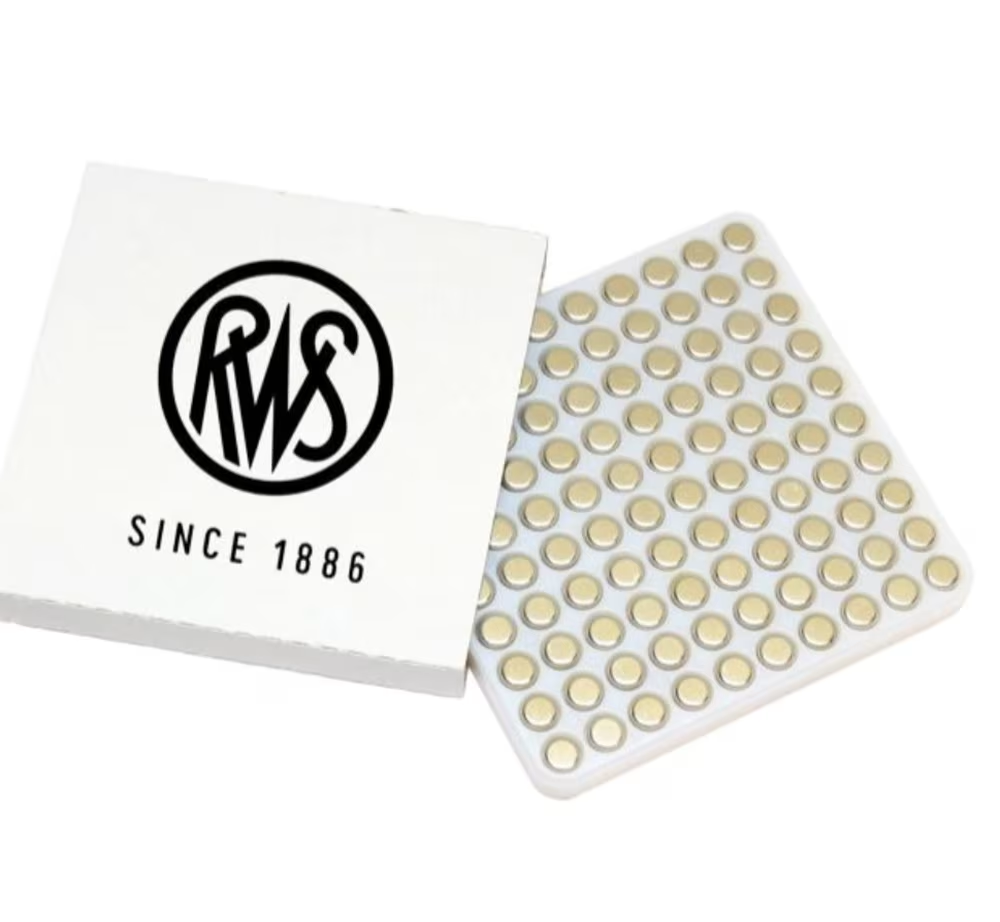
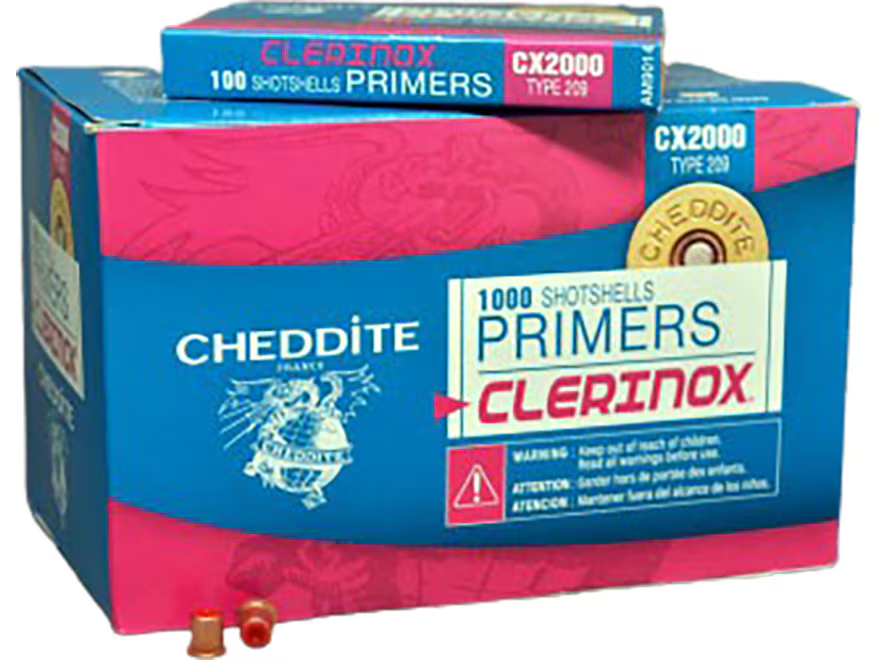
Primers: Federal 210, Federal GM210M, and CCI 200 standard large rifle primers for most applications. CCI BR-2 benchrest primers for precision hunting loads where ES/SD consistency is a priority. Federal 215 magnum primers for 338 Winchester Magnum and similar large magnum cartridges. CCI 250 is a further magnum primer option.
Cases: Norma’s own premium brass is an obvious pairing given the shared manufacturer. Lapua, Peterson, and other quality brass sources are also appropriate. The EcoStrike’s nickel coating means it generates somewhat different friction characteristics inside the case neck than bare copper bullets, potentially affecting neck tension; verify with Norma’s own load development guidance. Norma’s own Norma 204 powder is worth considering as a compatible-manufacturer choice for medium-speed rifle applications in this lineup. For larger magnum cases like 338 Winchester Magnum, Norma MRP is Norma’s own magnum rifle powder that pairs naturally with the EcoStrike in Norma brass. Standard powders from other manufacturers are equally suitable.
Seating depth: 0.010-0.050 inches off the lands per standard hunting bullet guidance. The nickel coating means the bearing surface engagement may differ slightly from bare copper alternatives; use Norma’s published data and start with their recommended seating depth.
Powder Selection by Application:
| Application | Caliber | Bullet Weight | Recommended Powders |
|---|---|---|---|
| Deer | 6.5 Creedmoor | 120 gr | Hodgdon H4350, Alliant Reloder 23, Alliant Reloder 26 |
| Elk | 270 Win | 125 gr | Hodgdon H4350, Alliant Reloder 19, IMR 4350, Accurate 4350, Hodgdon H4895 |
| Large game | 7mm Rem Mag | 135 gr | Hodgdon H4831SC, Alliant Reloder 26, Alliant Reloder 22, IMR 7828 SSC |
| Elk/moose | 300 Win Mag | 165 gr | Hodgdon H4831SC, Alliant Reloder 26, Hodgdon Retumbo, Hodgdon H1000, Vihtavuori N570 |
Reloading Parameters Summary:
| Parameter | Guideline |
|---|---|
| Neck tension | 0.002-0.004 inch interference |
| Seating depth | 0.010-0.050 inch off lands; verify with Norma data |
| Pressure start | 10% below monolithic-specific minimum |
| Activation velocity | 1,800 fps minimum |
| Weight retention | Near 100% |
Frequently Asked Questions
Q: What does the nickel coating actually do for performance?
A: Three documented benefits: reduced copper fouling in the bore (nickel’s different tribological interaction with steel versus bare copper), improved feeding in bolt-action and semi-automatic rifles (nickel’s natural lubricity), and enhanced corrosion resistance for stored bullets. The original article’s 15-20% fouling reduction claim is directionally consistent with published data on nickel-coated projectiles but should be treated as an approximation rather than a verified measurement. The feeding benefit is the most immediately practical for hunters whose rifles occasionally exhibit friction-fit feeding issues with bare copper monolithics.
Q: The original article claims the EcoStrike has “5% better retention than GMX.” Is this accurate?
A: No, not in a meaningful practical sense. Both the EcoStrike and the GMX are monolithic copper bullets, and both achieve near-100% weight retention as a fundamental property of their solid copper construction. A 5% difference at 95-100% retention levels would be unmeasurable in field use and is not documented in any available independent source. This claim should be understood as approximate marketing language for “similar very high retention” rather than as a measured performance differentiation.
Q: How does the EcoStrike compare to the Barnes TTSX?
A: Both are polymer-tipped monolithic copper bullets with 1,800 fps expansion thresholds and near-100% weight retention. The primary differences are: the EcoStrike’s nickel coating (TTSX uses bare grooved copper); the TTSX achieves higher BCs at comparable weights in some calibers (maximum 0.586 versus EcoStrike’s 0.482); and the TTSX has a more extensive published handloading data archive given Barnes’s longer production history in the North American market. For hunters in lead-restricted areas who want a nickel-coated option for feeding reliability, the EcoStrike fills a niche the TTSX does not. For hunters who specifically want the highest available BC in a lead-free copper hunting bullet, the Barnes LRX achieves higher BCs at comparable weights than either.
Q: The original article states a BC range of 0.39-0.443 but the table shows values up to 0.482. Which is correct?
A: This is an internal inconsistency in the original article – the introduction’s stated range does not match the table’s actual values. The table’s maximum of 0.482 for the 185-grain .338-inch appears to be the higher figure, making the introduction’s 0.443 likely an error or reflecting an earlier version of the product. Verify the current published BC figures at norma.com before load development.
Q: Is the EcoStrike appropriate for California hunting?
A: Yes. It is fully lead-free monolithic copper and compliant with California condor zone regulations and all other lead-restricted areas. Norma is a Swedish company with strong presence in European markets where lead-free hunting is broadly required in many jurisdictions – this means the EcoStrike was designed from the ground up for lead-free performance as a primary use case rather than an afterthought. For California hunters, the EcoStrike competes directly with the TTSX and GMX in its caliber range, with the nickel coating’s feeding benefit potentially relevant for hunters who use semi-automatic or gas-operated rifles for deer hunting in California where reliable feeding matters for follow-up shots.
Q: Does the nickel coating affect pressure or seating depth compared to bare copper monolithics?
A: Potentially, though the specific magnitude is difficult to quantify without Norma’s own testing data. The nickel coating changes the friction characteristics at the case neck and in the rifling during the engraving process, which can produce slightly different pressure signatures than bare copper. This is one reason using Norma’s own published data rather than transferring TTSX or GMX data to the EcoStrike is important even when caliber and weight are the same. For seating depth, the standard hunting bullet guidance (0.010-0.050 inches off the lands) applies, and the nickel coating is unlikely to meaningfully change the optimal seating depth versus a bare copper monolithic of the same profile, though individual rifle chambers may show different behavior. When in doubt, treat it as a separate bullet from the TTSX or GMX and develop loads from scratch using Norma’s published starting point.
Conclusion
The Norma EcoStrike is a well-positioned lead-free monolithic copper hunting bullet with one genuinely distinctive feature – the nickel coating – that no other bullet in this site’s coverage series uses. Its terminal performance (unified expansion at 1,800 fps, near-100% retention) is equivalent to the Barnes TTSX and Hornady GMX. Its BC figures (0.390-0.482) are competitive within the lead-free monolithic market though below the TTSX’s maximum. The nickel coating’s feeding and fouling benefits are real, making the EcoStrike specifically attractive for hunters whose rifles benefit from nickel-coated bullet smoothness or who hunt in humid environments where corrosion resistance matters.
The data quality observations from this article follow the same positive pattern as the preceding Lehigh Defense articles: TTSX and GMX competitor BC figures are accurately cited, and the primary correction needed is the “5% better retention than GMX” claim that is not meaningful for two near-100% monolithic copper designs. The internal inconsistency (stated BC range 0.39-0.443 in the introduction versus 0.482 actual maximum in the table) is the article’s most significant data quality issue and is flagged for verification at norma.com.
Choose the EcoStrike if: you want a lead-free monolithic copper bullet with nickel coating for improved feeding reliability and reduced fouling; you hunt with a Norma-cased load system and want matched manufacturer components; or your European-designed rifle chamber is specifically optimized for Norma’s bullet specifications.
Choose something else if: you need maximum BC in a lead-free bullet – the Barnes LRX achieves higher BCs at comparable weights. If you want the broadest published handloading data archive, the Barnes TTSX has a deeper North American handloading data library. If you are not specifically benefiting from nickel coating, the TTSX and GMX offer equivalent terminal performance at similar or lower cost.
Disclaimer: Reloading monolithic copper bullets requires caution. Never substitute lead-core bullet charge data; always use Norma-published data specific to the EcoStrike. The nickel coating may produce different pressure characteristics than bare copper monolithics in the same caliber and weight. Lead-free; compliant with California and all lead-restricted areas. Wear eye protection at all times. The author and myreloading.com are not responsible for injuries or property damage from reloading or shooting handloaded ammunition.
Have you loaded and shot the Norma EcoStrike? Leave a comment with your weight, cartridge, powder, charge, and what you observed on game or target. Notes on feeding performance and barrel fouling compared to bare copper monolithics (TTSX or GMX) are especially valuable given the nickel coating’s claimed benefits.