Published: October 2025 | Last updated: June 2026
Introduction
The Lehigh Defense Close Quarters Battle (CQB) bullet is the most specialized product in Lehigh’s lineup and arguably one of the most specialized commercial handloading components available in any caliber. Introduced in 2015, it is a single-variant design: 78 grains in .308-inch diameter, intended for 300 Blackout supersonic loads. Its terminal mechanism is intentional complete fragmentation – the CQB is designed to disintegrate entirely into fine copper particles upon hitting soft tissue at the required velocity.
This design philosophy places the CQB in a distinct category from every other Lehigh bullet covered in this series. The Lehigh Defense Controlled Chaos fragments the front petals while the base continues penetrating. The Lehigh Defense Controlled Fracturing fractures at depth after initial penetration. The CQB does neither – it is engineered to transfer essentially all its kinetic energy within the first few inches of tissue through complete disintegration, with minimal or no penetrating fragment continuing beyond the fragmentation zone.
The practical applications are specific: close-quarters defensive and tactical use where over-penetration through the target is the primary concern, and suppressed or unsuppressed 300 Blackout supersonic loads where the 78-grain weight produces higher muzzle velocity than standard supersonic 300 Blackout bullets in the 110-125 grain range. The lighter weight also reduces felt recoil, which matters in rapid-fire tactical scenarios. For comprehensive 300 Blackout loading guidance including supersonic loads generally, see the 300 Blackout supersonic loads guide. The 7.62x39mm vs 300 Blackout comparison provides context for where 300 Blackout sits in the close-range tactical ecosystem.
The original article describes the CQB as “ideal for tactical use or close-range varmint control.” The varmint framing is a stretch – at $0.60-$1.00 per bullet, the CQB is priced far above any varmint bullet. The tactical and defensive application is the genuine use case, with handloaders who want 300 Blackout supersonic loads maximizing velocity and minimizing penetration in CQB scenarios as the primary audience.
Disclaimer: Reloading is an inherently dangerous activity. Always consult current published load data from Lehigh Defense at lehighdefense.com before loading any cartridge. Solid copper bullets generate higher chamber pressures than lead-core bullets of the same weight. Never use lead-core load data for the CQB. Start at the published minimum charge and work up carefully. The CQB requires a minimum impact velocity of 2,350 fps for reliable fragmentation – verify that your load achieves this velocity. Never exceed maximum published loads. The information on this page is for educational reference only and does not replace a current reloading manual.
Technical Characteristics
Complete fragmentation mechanism: The CQB’s defining feature is total disintegration in soft tissue. Unlike the Controlled Chaos which retains a penetrating base after petal separation, the CQB is engineered with no retained fragment. The solid copper construction includes machined features that cause complete disintegration under the hydraulic pressure of high-velocity fluid tissue impact. All kinetic energy is transferred within a few inches of penetration, with the copper particles too small and light to penetrate beyond the initial wound volume at any significant distance.
This complete fragmentation is intentional and serves the over-penetration concern directly. In a close-quarters defensive scenario, a bullet that passes entirely through the target and continues with lethal velocity is a genuine liability. The CQB’s design eliminates this concern at the cost of penetration depth – if the immediate wound channel is not in a vital location, there is no continuing fragment to reach vitals deeper in the body.
Solid copper, lead-free: All-copper construction provides lead-free compliance. Higher bore friction from solid copper contributes to elevated chamber pressure versus lead-core bullets. Lehigh-specific load data is required.
Velocity-dependent fragmentation: The CQB requires 2,350 fps impact velocity for reliable fragmentation. This is the design’s critical constraint. From 300 Blackout with an appropriate supersonic load and a 16-inch barrel, muzzle velocity of 2,500-2,600+ fps provides an adequate margin to maintain 2,350 fps out to approximately 100-150 yards. From shorter barrels (10-inch SBR), muzzle velocity is lower and the effective fragmentation range shrinks. Calculate retained velocity at your maximum intended engagement distance before finalizing a load.
BC 0.150 and SD 0.117: These are very modest figures appropriate for a 78-grain .308-inch bullet designed for close-range use. SD 0.117 is deliberately low – high SD would mean the bullet has more mass relative to its frontal area and would resist fragmentation. Low SD facilitates the rapid deceleration and disintegration on impact that the CQB is designed for. BC 0.150 limits effectiveness to inside 150-200 yards before wind drift and drop become significant, which is appropriate for the close-quarters tactical application.
Not a long-range or hunting bullet: The CQB’s design parameters – low SD, low BC, complete fragmentation, high velocity requirement, single caliber/weight availability – define it as a close-range tactical tool rather than a hunting or long-range shooting product. It should not be used for deer hunting where consistent penetration to the vital organs is required regardless of shot angle.
Ballistics and Performance
One variant with G1 BC 0.150 and SD 0.117 defines the CQB’s entire performance envelope. These figures exist in a different context from other bullets in this series – the CQB’s performance goals are maximum energy transfer within a short tissue depth and minimum over-penetration, not maximum trajectory efficiency or downrange energy retention.
The 78-grain .308-inch CQB from 300 Blackout at approximately 2,550 fps (16-inch barrel) retains approximately 2,350 fps at 100 yards with BC 0.150. This is at the fragmentation threshold edge. At 150 yards, retained velocity drops to approximately 2,200 fps – below the activation threshold. The practical effective range for reliable complete fragmentation is therefore inside 100 yards, with 50-75 yards being the range where confidence in the fragmentation mechanism is highest.
Accuracy of 1.0-1.5 MOA is honest for this specialized bullet in typical 300 Blackout platforms. The fragmentation design’s machined geometry does not optimize for ballistic consistency in the same way a match bullet does. For close-quarters tactical use inside 100 yards where the CQB is designed to operate, 1.0-1.5 MOA is entirely functional.
Ballistics Table – CQB Specifications
Single variant. All specifications from Lehigh Defense. Verify current data at lehighdefense.com.
| Diameter (inches) | Weight (grains) | BC (G1) | Sectional Density | Application |
|---|---|---|---|---|
| .308 | 78 | 0.150 | 0.117 | 300 Blackout supersonic – complete fragmentation inside 100 yards |
Comparison within Lehigh’s Lineup
The CQB exists within a family of Lehigh fragmenting designs, each with different velocity windows and fragmentation mechanisms. Understanding where the CQB fits relative to other Lehigh options is the most useful comparison for handloaders evaluating this bullet.
The Lehigh Defense Controlled Chaos (CC) uses fluid-activated petal separation at 1,500+ fps, retaining the bore-diameter base for continued penetration. The CC is designed for hunting applications where penetration to the vitals is required alongside the fragmenting wound channel. The CQB provides faster energy dump but no retained penetrating fragment – appropriate when you explicitly do not want the bullet to continue past the initial fragmentation zone.
The Lehigh Defense Controlled Fracturing (CF) uses pre-stressed fracture lines that activate after initial penetration at 750+ fps, retaining a penetrating base. The CF covers subsonic and pistol velocities that the CQB cannot serve. At supersonic 300 Blackout velocities, the CF 198-grain subsonic design is not the relevant comparison – the CF’s .308-inch 198-grain is specifically for subsonic use, not for competition with the CQB in the supersonic window.
The Lehigh Defense Tipped Controlled Chaos is the polymer-tipped upgrade of the CC for better BC and more consistent activation. It occupies hunting velocity ranges above 1,400+ fps and serves hunting applications where the CC mechanism is the goal.
The Lehigh Defense Maximum Expansion uses large-cavity hydraulic expansion for maximum wound diameter without fragmentation. For applications where you want a single large-diameter wound channel rather than complete disintegration, the ME design is an alternative.
Comparison Table – Lehigh Defense .308-inch Options by Application
| Bullet | Weight | Mechanism | Velocity Window | Over-penetration | Retained Fragment |
|---|---|---|---|---|---|
| Lehigh CQB | 78 gr | Complete disintegration | 2,350+ fps | Minimal | None |
| Lehigh CC | 115-155 gr | Petal separation + base | 1,500+ fps | Moderate | Yes (base) |
| Lehigh CF | 198 gr (subsonic) | Pre-stressed fracture at depth | 750+ fps | Low-Moderate | Yes (base) |
The Lehigh Defense Xtreme Penetrator is the within-brand deep-penetration alternative for handloaders who want the opposite of complete fragmentation – maximum penetration depth with no expansion. The Lehigh Defense Xtreme Defense uses a fluted nose that creates a hydraulic cutting effect rather than expansion or fragmentation. These represent different terminal philosophies within Lehigh’s lineup that handloaders might compare when building 300 Blackout loads for different purposes. The 300 Blackout complete guide covers the cartridge context that the CQB was built for.
The Lehigh Defense Tipped Xtreme Chaos is another Lehigh option for hunters and tactical users who want polymer-tip initiation alongside the Controlled Chaos mechanism. The Lehigh Defense Xtreme Cavitator covers handgun defensive applications. For handloaders who reload multiple calibers alongside 300 Blackout, the 7.62x39mm is a common companion cartridge in the same AR-style platform ecosystem. For 300 Blackout supersonic load development with lighter bullets, Hodgdon BL-C(2) is an additional powder option alongside CFE Blk and H110.
Outside Lehigh’s lineup, directly comparable “complete fragmentation” commercial bullets in .308-inch are rare. The Barnes Varmin-A-Tor is a fragmenting copper bullet but covers smaller diameters and different application windows. The Hornady V-MAX is polymer-tipped for rifle fragmentation but is not a solid copper design and covers smaller diameters. The Barnes Varmin-A-Tor is a fragmenting copper bullet but covers smaller diameters and different application windows. The Hornady V-MAX is polymer-tipped for rifle fragmentation but is not a solid copper design and covers smaller diameters. The Barnes Varmin-A-Tor is a fragmenting copper bullet but covers smaller diameters and different application windows. The Hornady V-MAX is polymer-tipped for rifle fragmentation but is not a solid copper design and covers smaller diameters. The CQB’s specific design – single-caliber, single-weight, complete fragmentation, minimum 2,350 fps, 78 grains in .308-inch for 300 Blackout supersonic – is essentially unique in the commercial bullet market.
Applications and Practical Aspects
300 Blackout supersonic tactical/defensive: This is the CQB’s sole intended application. 300 Blackout was developed partly for suppressed use from short-barreled AR-15 platforms, with the ability to cycle the same platform with supersonic and subsonic loads. The CQB 78-grain fills the supersonic role with maximum velocity and minimum over-penetration from a light bullet that disintegrates on soft tissue impact.
The CQB 78-grain fills the supersonic role with maximum velocity and minimum over-penetration from a light bullet that disintegrates on soft tissue impact. This contrasts with the Lapua FMJ and similar full metal jacket options which do not expand at all, and with expanding lead-core soft-points which expand but may over-penetrate. The Lehigh Defense Wide Flat Nose covers a different geometry for 300 Blackout and similar cartridges. The Speer TNT is a varmint-weight fragmenting copper bullet in .224-inch that operates on similar fragmentation-first principles at smaller diameter and higher velocity. For 223 Remington users who want similar complete fragmentation in 5.56mm platforms, options are limited compared to what 300 Blackout specifically enables with the CQB.
For handloaders building 300 Blackout supersonic loads with the CQB, the target velocity is 2,500+ fps from a 16-inch barrel to provide adequate margin above the 2,350 fps fragmentation threshold at typical engagement distances inside 75 yards. For trajectory data on 300 Blackout at supersonic velocities, see the 300 Blackout ballistics guide. Hodgdon CFE Blk is a primary powder for 300 Blackout supersonic loads with light bullets. Hodgdon H110, Accurate 1680, and Alliant 1680 are also documented for 300 Blackout supersonic applications. For AR-15 platform loads with the CQB, use CCI No. 41 to prevent slam-fire from the AR’s free-floating firing pin.
Barrel length significantly affects velocity with the 78-grain CQB. From a 16-inch barrel, 2,500-2,600 fps is achievable with appropriate loads. From a 10-inch SBR, expect 2,100-2,200 fps – likely below the fragmentation threshold at any range. The CQB is less well-suited to short-barreled 300 Blackout platforms than to standard 16-inch carbines.
What this is not appropriate for: Deer or medium game hunting where consistent penetration to the vitals is required. The CQB provides no guaranteed penetration path to vitals from any shot angle that involves tissue depth greater than the fragmentation distance (approximately 2-4 inches). Lead-free hunting loads for 300 Blackout should use the Lehigh Defense Controlled Chaos 115-grain for supersonic hunting applications. For 8.6 Blackout supersonic hunters using .358-inch bullets, different Lehigh options apply. For handloaders who want a 300 Blackout precision target load, the Lehigh Defense Match Solid covers that role. For 300 Blackout subsonic loads, the Controlled Fracturing 198-grain is the Lehigh option.
Reloading
The CQB loads like other solid copper 300 Blackout supersonic components, with additional attention to velocity verification.
Load data: Lehigh Defense publishes CQB-specific data at lehighdefense.com. Use Lehigh’s data as the primary source. For 300 Blackout supersonic loads where Lehigh-specific CQB data is not available for a specific powder, 300 Blackout data for comparable solid copper 78-80 grain bullets at similar powder charges provides a reference starting point – begin 5% below even those minimum charges.
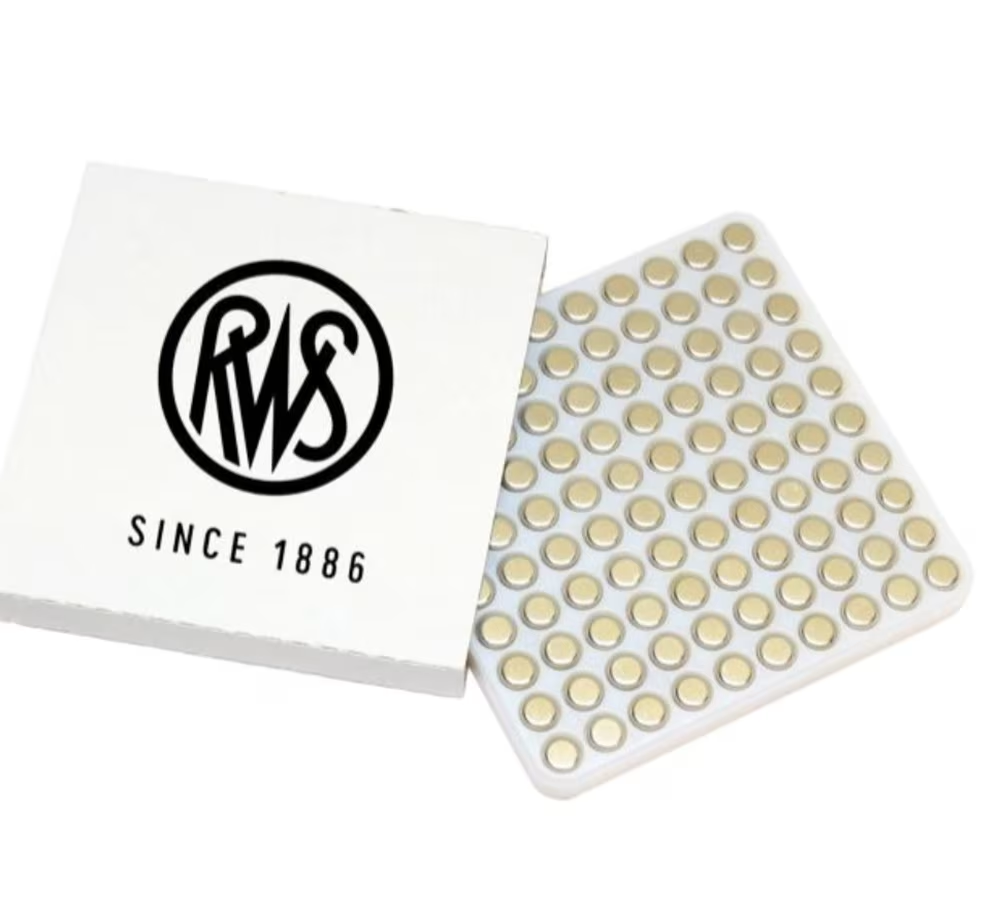
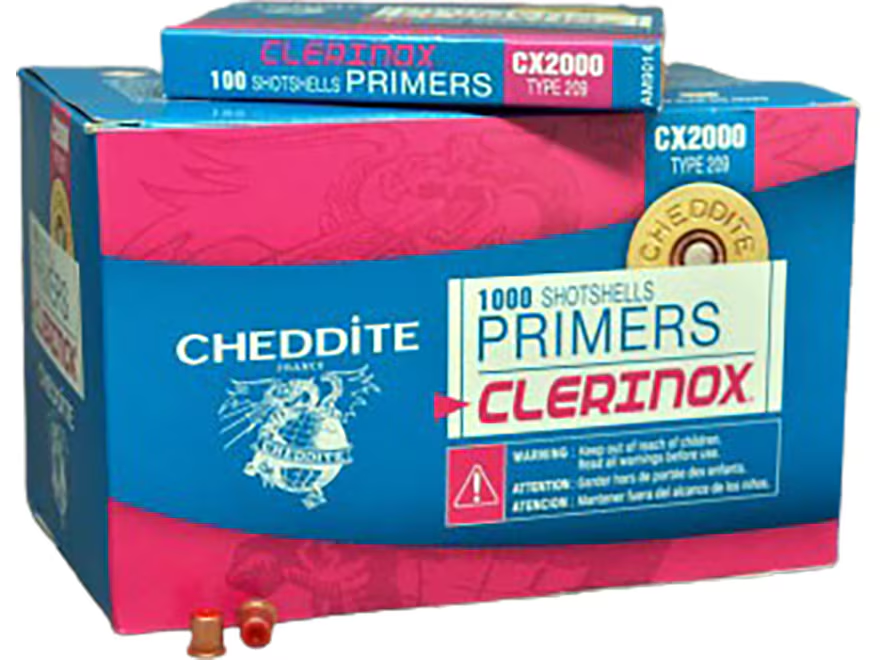
Primers: For AR-15 platforms using 300 Blackout, CCI No. 41 mil-spec primer is required to prevent slam-fire. Standard small rifle primers CCI 400, CCI BR-4, and Federal 205 are appropriate for bolt-action or single-shot 300 Blackout applications.
Cases: Standard 300 Blackout brass from Lapua, Starline, and Hornady are appropriate. Federal GM205M is the match-grade small rifle primer for precision applications. Lapua brass provides the best dimensional consistency for precision loads. Starline 300 Blackout brass is widely used for high-volume loading.
Additional powder options for 300 Blackout supersonic with 78-grain bullets: Hodgdon Varget and Winchester 748 are used in 300 Blackout supersonic loads by some handloaders, though CFE Blk and H110 are more commonly cited for lighter weights. Alliant Reloder 10x is another documented option for 300 Blackout supersonic. For the small rifle primer choice, CCI 450 magnum small rifle primer is used by some 300 Blackout handloaders with H110 for consistent ignition. Remington 7-1/2 is a standard small rifle primer option for bolt-action 300 Blackout applications.
For broader 300 Blackout supersonic load development resources, the 300 Blackout ballistics guide and 300 Blackout subsonic loads guide provide context on the full cartridge spectrum. For precision 300 Blackout accuracy work with lighter supersonic bullets, Hodgdon CFE 223 and Accurate 2230 are sometimes used. For handloaders who reload 300 Blackout alongside 308 Winchester with the same die set, IMR 4895 appears in both cartridge’s published data. Alliant 2400 is used in 300 Blackout supersonic loads by some handloaders as an alternative to H110.
For handloaders who form 300 Blackout brass from 223 Remington cases, the how to convert brass to 300 Blackout guide covers the case forming process. Winchester 296 and Hodgdon Lil’Gun are additional powder options documented for 300 Blackout supersonic loads by advanced handloaders.
Velocity verification: Chronograph every load development session. Confirm that the muzzle velocity achieves at least 2,350 fps before relying on the CQB’s fragmentation mechanism. Confirm that the muzzle velocity achieves at least 2,350 fps before relying on the CQB’s fragmentation mechanism. Calculate retained velocity at your maximum intended engagement distance – at BC 0.150, velocity drops approximately 50-75 fps per 50 yards.
Seating depth: Start at 0.050-0.100 inches off the lands – solid copper requires more freebore than lead-core bullets. Work in from this starting point systematically. 300 Blackout magazine length constraints usually drive seating depth more than throat engagement for supersonic loads.
Powder Selection:
| Application | Caliber | Bullet Weight | Recommended Powders |
|---|---|---|---|
| 300 BLK supersonic | 300 Blackout | 78 gr | Hodgdon CFE Blk, Hodgdon H110, Accurate 1680 |
Reloading Parameters Summary:
| Parameter | Guideline |
|---|---|
| Primer | CCI No. 41 for AR-15; CCI 400 for bolt-action |
| Neck tension | 0.002-0.004 inch interference |
| Seating depth | 0.050-0.100 inch off lands |
| Minimum fragmentation velocity | 2,350 fps at impact – verify at your engagement distance |
| Effective range | Inside 100 yards; confidence highest inside 75 yards |
| Load data source | Lehigh Defense at lehighdefense.com |
| Starting charge | Lehigh minimum; 5% below comparable solid copper data |
Frequently Asked Questions
Q: How is the CQB different from the Controlled Chaos and Controlled Fracturing?
A: The three designs represent three different fragmentation philosophies. The Controlled Chaos sheds the front petals while the bore-diameter base continues penetrating to depth – there is always a retained fragment reaching the vitals. The Controlled Fracturing fractures at depth after 2-4 inches of penetration, with the base again continuing. The CQB completely disintegrates – there is no retained fragment, no continued penetrating component, no base reaching past the initial fragmentation zone. This makes the CQB uniquely appropriate where over-penetration is the primary concern, and uniquely inappropriate where reliable penetration to the vitals is the goal.
Q: Can I use the CQB for deer hunting with 300 Blackout?
A: No. The CQB is not appropriate for deer hunting. Complete disintegration within the first few inches of tissue means no guaranteed penetration to the vitals from any shot angle involving tissue depth beyond the fragmentation distance. A quartering shot on a deer may require 8-12 inches of penetration to reach the heart and lungs – the CQB does not provide this. Use the Lehigh Defense Controlled Chaos 115-grain for 300 Blackout supersonic deer hunting, or the Barnes TTSX for a more conventional expanding design.
Q: Is the CQB appropriate for shorter-barreled 300 Blackout platforms?
A: Only if velocity is verified. The 2,350 fps fragmentation threshold must be met at impact. A 10-inch SBR 300 Blackout may produce 2,100-2,200 fps muzzle velocity with optimal loads – likely below the fragmentation threshold at any distance. An 8.5-inch pistol configuration is almost certainly too slow for reliable CQB activation. Chronograph your specific platform and load combination; if muzzle velocity is below 2,350 fps, the CQB will not fragment reliably and becomes an unpredictable projectile with neither the fragmentation benefits nor the penetration depth of conventional bullets.
Q: Why is the CQB only available in 78 grains in .308-inch?
A: The CQB’s design is specifically calibrated for the 300 Blackout supersonic velocity window and the close-quarters tactical application that cartridge was developed for. At 78 grains in .308-inch from 300 Blackout, the combination of velocity, sectional density, and machined fragmentation geometry produces complete disintegration in the intended velocity window. A different weight or diameter would require different geometry calibration to achieve the same complete-fragmentation result. Lehigh’s single-variant approach reflects that this is a purpose-built specialist tool, not a general-purpose bullet.
Q: What does “complete fragmentation” mean practically for the wound cavity?
A: When the CQB hits soft tissue at 2,350+ fps, it disintegrates into copper fragments small enough that they stop within the immediate wound channel rather than continuing as a penetrating mass. The wound cavity in the fragmentation zone is large – multiple small copper particles create a broad, temporary cavity through the hydraulic shock of their combined deceleration. Past the fragmentation zone, there are no large copper fragments continuing – just very small particles depositing in tissue. This is dramatically different from a mushroomed conventional bullet, which creates a large single wound channel from the entry point to a depth of 10-18 inches. The CQB creates its maximum damage in the first 3-5 inches and stops. Whether this is a feature or a limitation depends entirely on whether those 3-5 inches contain the vitals.
Q: Is lead from 300 Blackout game a concern with the CQB?
A: No – the CQB is solid copper and contains no lead. This makes it appropriate for California and other lead-restricted zones without additional consideration. For handloaders in California who use 300 Blackout for deer hunting but prefer supersonic loads, however, the CQB’s complete-fragmentation design still makes it inappropriate for hunting – use the Controlled Chaos for that application.
Conclusion
The Lehigh Defense CQB is one of the most narrowly specialized commercial handloading components available: a single weight, single caliber, complete-fragmentation solid copper bullet for 300 Blackout supersonic tactical applications inside 100 yards. It does exactly what it is designed to do – disintegrate completely in soft tissue at high velocity, transferring all kinetic energy without over-penetration – and it is inappropriate for any application that requires continued penetration past the initial fragmentation zone.
For handloaders evaluating the full lead-free spectrum for 300 Blackout applications, the lead-free hunting alternatives include the Barnes TTSX for conventional expanding performance, the Hornady GMX for gilding-metal monolithic construction, and the Nosler E-Tip for lead-free alloy expanding bullets. For varmint-type applications requiring lead-free compliance at rifle velocities, the Hornady NTX covers smaller diameters. For context on how barrel length affects 300 Blackout velocity (critical for CQB activation), the AR-15 barrel materials guide covers AR platform barrel considerations.
Choose the CQB if: you load 300 Blackout supersonic for close-quarters tactical or defensive applications where over-penetration is the primary concern; you need lead-free compliance in 300 Blackout; you shoot from a 16-inch barrel where muzzle velocity consistently exceeds 2,350 fps; or you specifically want complete energy transfer without a retained fragment.
Choose something else if: you want to use 300 Blackout for deer or game hunting – use Lehigh Defense Controlled Chaos or Barnes TTSX instead. If your 300 Blackout platform has a short barrel that cannot reliably achieve 2,350 fps muzzle velocity, the CQB will not fragment reliably. For longer-range 300 Blackout applications past 100 yards, the CQB’s BC 0.150 makes it impractical.
Disclaimer: Reloading involves inherent risks. The CQB is a solid copper bullet requiring minimum 2,350 fps impact velocity for reliable fragmentation – verify velocity at your intended engagement distance. Never use lead-core load data. Use Lehigh Defense-specific data from lehighdefense.com. For AR-15 platforms, use CCI No. 41 to prevent slam-fire. Start below minimum charges and increase gradually. The CQB is not appropriate for hunting applications requiring consistent deep penetration. Wear eye protection at all times. The author and myreloading.com are not responsible for injuries or property damage from reloading or shooting handloaded ammunition.
Have you loaded the Lehigh Defense CQB? Leave a comment with your load details: powder, charge, primer, barrel length, and confirmed chronograph velocity. What ES/SD did you achieve? Did you verify fragmentation in test media? Handloader accounts for this bullet are sparse and valuable – there is very little published CQB-specific load development data available anywhere.