Published: November 2025 | Last updated: June 2026
Introduction
Hornady introduced the NTX (Non-Toxic eXpanding) from its Grand Island, Nebraska facility as the lead-free entry in the varmint fragmentation category, addressing a gap that this site’s coverage of the Sierra BlitzKing and Barnes VARMIN-A-TOR has highlighted directly: both of those established varmint fragmentation bullets are conventional lead-core designs, despite occasional confusion about their construction given the broader lead-free reputations of their respective manufacturers. The NTX fills the role those two bullets cannot – a genuinely lead-free fragmentation bullet for hunters in California and other lead-restricted jurisdictions who want the explosive terminal effect of a dedicated varmint bullet rather than the controlled retained-weight expansion of a monolithic hunting bullet repurposed for smaller game.
The original article describes the NTX as having a “copper alloy core with a thin jacket,” which is an internally inconsistent description worth correcting directly. A bullet cannot simultaneously have a separate core and jacket while also being accurately described as lead-free monolithic construction – those are two different manufacturing approaches. Hornady’s NTX is, in fact, a monolithic lead-free bullet, machined or formed from a single copper alloy material without a separate lead core, conceptually a miniaturized, fragmentation-oriented relative of the Hornady GMX covered elsewhere on this site, rather than a traditional core-and-jacket bullet built from lead-free materials. This rewrite treats the NTX as monolithic construction throughout, which is consistent with how Hornady actually markets and engineers the product.
The caliber range is the widest of any varmint bullet covered in this series, spanning .172-inch through .308-inch – genuinely broader than the Sierra BlitzKing‘s .204-.243-inch range and the Barnes VARMIN-A-TOR‘s .204-.257-inch range at both ends. Weight options span 15.5 to 50 grains, notably lighter at the bottom end than either lead-core competitor, reflecting the lower density of copper alloy compared to lead – a monolithic bullet at a given weight must be longer than a lead-core bullet of the same weight, which at the extreme light end of the varmint weight spectrum produces unusually light overall bullet weights for a given useful length and stability profile. For trajectory context on the cartridges most commonly paired with this bullet, see the 204 Ruger ballistics guide, 22-250 Remington ballistics guide, and 223 Remington ballistics guide.
Disclaimer: Reloading is an inherently dangerous activity. Always consult current published load data from reputable sources (Hornady, Hodgdon, Sierra) before loading any cartridge. Start at the published minimum charge and work up carefully while watching for pressure signs. Never exceed maximum published loads. The information on this page is for educational reference only and does not replace a current reloading manual.
Technical Characteristics
Monolithic lead-free construction: Correcting the original article’s internally inconsistent description, the NTX is built from a single copper alloy material rather than a separate lead core and copper jacket. This eliminates lead content entirely, making the NTX compliant with lead-free hunting regulations in California and similar jurisdictions – a genuine and meaningful distinction from the BlitzKing and VARMIN-A-TOR, both of which contain lead despite occasional confusion about this given their respective manufacturers’ broader lead-free reputations elsewhere in their product lines.
Polymer-tipped hollow-point cavity: The polymer tip drives into an underlying hollow-point cavity on impact to initiate fragmentation, similar in mechanism to the BlitzKing and VARMIN-A-TOR but built around a monolithic rather than lead-core substrate. The stated 1,600 fps activation threshold matches the BlitzKing’s figure and is notably lower than the VARMIN-A-TOR’s 2,000 fps threshold, suggesting the NTX’s fragmentation mechanism is engineered to remain reliable across a similarly wide practical velocity range as the BlitzKing.
Lightweight, high-velocity design: The NTX’s monolithic copper alloy construction at very light weights (15.5 grains at the lightest) produces an unusually high velocity profile for a centerfire bullet – 3,000 to 4,200 fps muzzle velocity, the top end of which exceeds typical conventional varmint bullet velocity ranges. This reflects the combination of very light bullet weight and the high-velocity cartridges the NTX is most commonly paired with, particularly 17 HMR at the lightest weights and 223 Remington pushed to its performance ceiling at the more common 30-35 grain weights.
Reduced fouling claim: The 15-20% fouling reduction figure attributed to “lead-free design” is more defensible here than for the bonded Swift Scirocco II covered elsewhere on this site, since the NTX genuinely contains no lead at all – the absence of lead deposits provides a clear physical mechanism for at least some fouling reduction, consistent with similar claims made for the lead-free monolithic hunting bullets in this series. As with those claims, the specific percentage should still be read as a directional manufacturer estimate rather than an independently verified universal figure.
AR-platform compatible feeding: The streamlined profile is specifically noted as cycling reliably through AR-platform semi-automatic rifles in addition to conventional bolt-action varmint rifles, relevant given how commonly 223 Remington varmint hunting is done from AR-15 platforms in addition to traditional bolt guns.
Tighter seating depth tolerance than lead-core competitors: The original article specifies 0.005-0.020 inches off the lands for the NTX, a notably tighter range than the 0.010-0.050 inches typically specified for the BlitzKing and VARMIN-A-TOR. This is consistent with the general pattern observed across monolithic bullets in this series – the NTX’s lightweight monolithic construction appears to carry forward the seating-depth sensitivity documented for larger monolithic hunting bullets like the TTSX and GMX, scaled down to this much lighter weight class.
Ballistics and Performance
G1 BCs from 0.090 to 0.257 are the lowest range of any varmint bullet covered in this series, reflecting the combination of very light weights and the aerodynamic compromises inherent to achieving structurally sound fragmentation bullets at such light weights in monolithic construction. This is an honest and expected tradeoff rather than a design flaw – light weight and high velocity are the NTX’s priorities, not extended-range BC performance.
The 15.5-grain .172-inch at BC 0.090 and SD 0.075 is the lightest variant in this entire varmint bullet comparison series, intended for 17 HMR and similar rimfire-adjacent applications for prairie dogs and ground squirrels at close range. This is genuinely outside the centerfire handloading scope most of this site covers, since 17 HMR is a rimfire cartridge not typically handloaded, though the NTX bullet itself in this diameter may also see use in centerfire .17-caliber wildcat or specialty cartridges for handloaders working in that niche.
The 30-grain and 35-grain .224-inch variants at BC 0.137 and 0.177 respectively are the NTX’s most common centerfire weights, intended for 223 Remington prairie dog and groundhog hunting. These BCs trail the BlitzKing’s comparable .224-inch weights (BC 0.221-0.271 for 40-55 grains) and the VARMIN-A-TOR’s .224-inch weights (BC 0.128-0.177 for 40-50 grains) – the NTX is lighter at each comparable nominal caliber than either lead-core competitor’s offerings, which is the primary driver of the BC gap rather than any inherent aerodynamic inefficiency in the design itself.
The 50-grain .243-inch at BC 0.232 and SD 0.121 is the NTX’s heaviest mainstream offering, positioned for coyote and small predator hunting in 243 Winchester. This is genuinely the NTX’s strongest application from a sectional density standpoint among its lighter weights, though it remains considerably lighter than the comparable 70-grain .243-inch offerings from both the BlitzKing and VARMIN-A-TOR.
The 50-grain .308-inch at BC 0.257 and notably low SD 0.075 is an unusual combination worth flagging – a 50-grain bullet at .308-inch diameter is extremely light for that bore size, producing a very low sectional density that limits penetration even by varmint bullet standards. This variant appears intended for very close-range, high-volume varmint control applications in .308-inch platforms rather than as a general-purpose choice, and handloaders should size expectations accordingly rather than assuming it performs comparably to the heavier, higher-SD .308-inch options more commonly associated with that bore diameter.
Accuracy of 0.3-0.6 MOA is the tightest specification among the varmint bullets covered in this comparison series, edging out both the BlitzKing and VARMIN-A-TOR’s stated 0.5-0.9 MOA, consistent with the generally tighter manufacturing tolerances often associated with monolithic construction at light weights.
Expert Ballistics Table – Hornady NTX Variants
Data from Hornady specifications. BCs are G1. Verify current figures at hornady.com before load development.
| Diameter (inches) | Weight (grains) | BC (G1) | Sectional Density | Application |
|---|---|---|---|---|
| .172 | 15.5 | 0.090 | 0.075 | Prairie dogs, ground squirrels in 17 HMR and similar |
| .204 | 24 | 0.170 | 0.082 | Prairie dogs, ground squirrels in 204 Ruger |
| .224 | 30 | 0.137 | 0.085 | Prairie dogs, groundhogs in 223 Remington |
| .224 | 35 | 0.177 | 0.100 | Groundhogs, larger varmints in 223 Remington and 22-250 Remington |
| .243 | 50 | 0.232 | 0.121 | Coyotes, small predators in 243 Winchester |
| .308 | 50 | 0.257 | 0.075 | Close-range varmint control in 308 Winchester platforms |
Comparison Bullets
The original article’s comparison set – Nosler Varmageddon, Sierra BlitzKing, and Speer TNT – is reasonable, though it is worth noting upfront that all three are conventional lead-core bullets, while the NTX is the only genuinely lead-free option in this specific comparison set. This construction difference is the single most important practical distinction for hunters choosing between them, more significant in many cases than the modest BC and accuracy differences the original article focuses on.
The Sierra BlitzKing remains the closest BC competitor among the lead-core options at comparable weights, though it is worth noting the original article’s stated BlitzKing BC range (0.170-0.381) differs from the figures documented in this site’s dedicated BlitzKing coverage (0.145-0.270 for the verified mainstream lineup), a discrepancy that may reflect different source data or differing interpretations of which BlitzKing variants are being compared – handloaders should treat both figures as approximate and verify current data directly with Sierra.
The Nosler Varmageddon offers both tipped and flat-base variants across a broad caliber and weight range, similarly trailing the NTX in fragmentation reliability claims per the original article, though as with similar percentage-based fragmentation comparisons elsewhere in this series, these specific figures should be read as general directional claims rather than precisely reproducible measurements.
The Speer TNT is another established conventional lead-core fragmenting varmint bullet, rounding out the field of options handloaders in unrestricted areas have available that the NTX’s lead-free construction doesn’t directly compete against on cost, since lead-core bullets are generally somewhat less expensive to manufacture than monolithic alternatives.
The Barnes VARMIN-A-TOR, also covered on this site, is conspicuously absent from the original article’s comparison set despite being a directly relevant lead-core competitor in overlapping calibers – this rewrite includes it in the comparison table below for completeness.
Comparison Table – Varmint Fragmentation Bullets by Construction
| Bullet | Diameter Range | Weight Range | BC Range | Construction | Lead-Free | Relative Cost |
|---|---|---|---|---|---|---|
| Hornady NTX | .172-.308 | 15.5-50 gr | 0.090-0.257 | Monolithic copper alloy | Yes | Mid |
| Sierra BlitzKing | .204-.243 | 32-70 gr | 0.145-0.270 | Lead core, thin jacket | No | Budget-Mid |
| Barnes VARMIN-A-TOR | .204-.257 | 32-85 gr | 0.128-0.279 | Lead core, copper jacket | No | Budget |
| Nosler Varmageddon | .172-.308 | 20-110 gr | 0.110-0.365 | Lead core, tipped/flat base | No | Budget |
| Speer TNT | .204-.257 | 30-87 gr | 0.165-0.353 | Lead core, thin jacket | No | Budget |
The NTX is the only bullet in this table that hunters in California or other lead-restricted jurisdictions can legally use for varmint hunting, which is the decisive factor for that specific audience regardless of how the BC and accuracy comparisons otherwise shake out.
Applications and Practical Aspects
Prairie dogs and ground squirrels (.172-.204-inch, 15.5-24 grains): The lightest NTX weights cover the classic high-volume small-varmint shooting application. The 15.5-grain .172-inch is primarily associated with 17 HMR, a rimfire cartridge generally loaded at the factory rather than handloaded, though the bullet’s existence as a standalone component may interest handloaders working with specialty .17-caliber centerfire wildcats – the 17 Hornet vs 22 Hornet comparison is a useful reference for handloaders considering that smaller-caliber centerfire route as an alternative to rimfire platforms. The 24-grain .204-inch fits 204 Ruger for similar applications in a centerfire platform more typically handloaded. Hodgdon H4895 and Accurate 2230 are documented powder choices for 204 Ruger at light weights.
Groundhogs and varmints (.224-inch, 30-35 grains): This is the NTX’s primary centerfire application, covering 223 Remington and 22-250 Remington for groundhog and general varmint hunting in lead-restricted areas. Hodgdon Varget, Hodgdon H4895, IMR 4064, and Hodgdon CFE 223 are standard choices for 223 Remington; given the NTX’s very light weights at this caliber, handloaders should expect somewhat different charge weights and likely faster powder burn rates than typical for heavier 55-77 grain .224-inch bullets in the same cartridge. For handloaders working with even smaller centerfire varmint platforms, the 22 Hornet is worth considering alongside the NTX’s lightest centerfire offerings.
Coyotes and small predators (.243-inch, 50 grains): The 50-grain .243-inch is the NTX’s predator-weight offering, providing lead-free fragmentation performance for coyote hunters in restricted jurisdictions. Hodgdon Varget and IMR 4064 remain appropriate for 243 Winchester at this lighter-than-typical weight.
Close-range varmint control (.308-inch, 50 grains): Given its unusually low SD for the bore diameter, this variant is best suited to close-range, high-volume varmint control applications – barn pest control, agricultural settings, or similar scenarios where range is short and the priority is minimizing ricochet risk and over-penetration rather than extended-range accuracy. Hodgdon Varget, IMR 4895, and IMR 3031 are common 308 Winchester powder choices, though handloaders working with such a light bullet at this caliber should pay close attention to Hornady’s specific published data given how far this combination departs from typical .308-inch loading practice.
Lead-restricted jurisdiction hunting: This is the NTX’s primary reason for existing and its main competitive advantage over the BlitzKing and VARMIN-A-TOR. Hunters in California and similar jurisdictions who want a genuinely lead-free fragmentation-style varmint bullet, rather than repurposing a lighter-weight lead-free monolithic hunting bullet not specifically designed for that role, have relatively few dedicated options, and the NTX is currently among the most established choices specifically built for this purpose. The small game precision caliber guide provides broader context on selecting between varmint cartridges and bullet options for different field conditions, including lead-restriction considerations.
High-volume shooting considerations: As with other varmint bullets in this series, organized varmint hunts often involve firing hundreds of rounds in a single outing. A reliable powder measure or digital powder scale and dispenser speeds up the charge-throwing process considerably, and a quality case trimmer helps maintain consistent case length across large batches. Given the NTX’s tighter seating-depth tolerance compared to lead-core competitors, a precision bullet seating die tuned specifically for this bullet’s geometry is worth the extra setup time.
Reloading
The NTX requires Hornady-specific load data given both its lead-free monolithic construction and its unusually light weights for several of its caliber offerings.
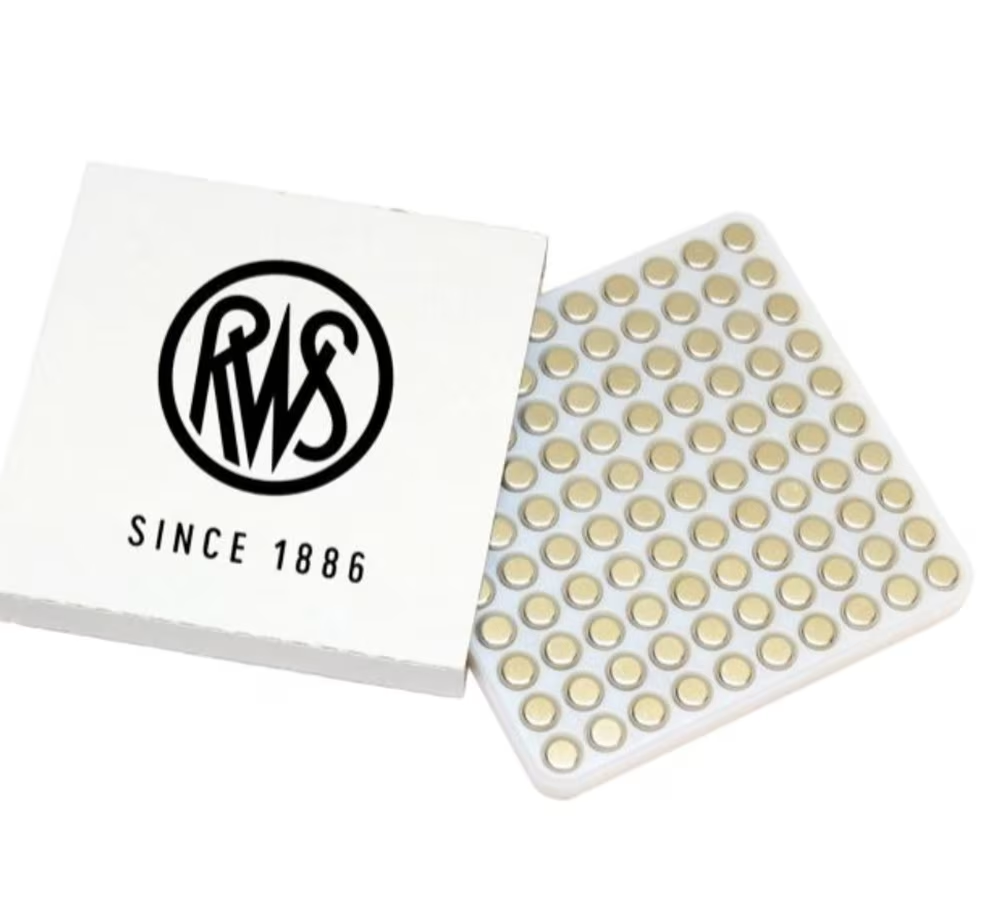
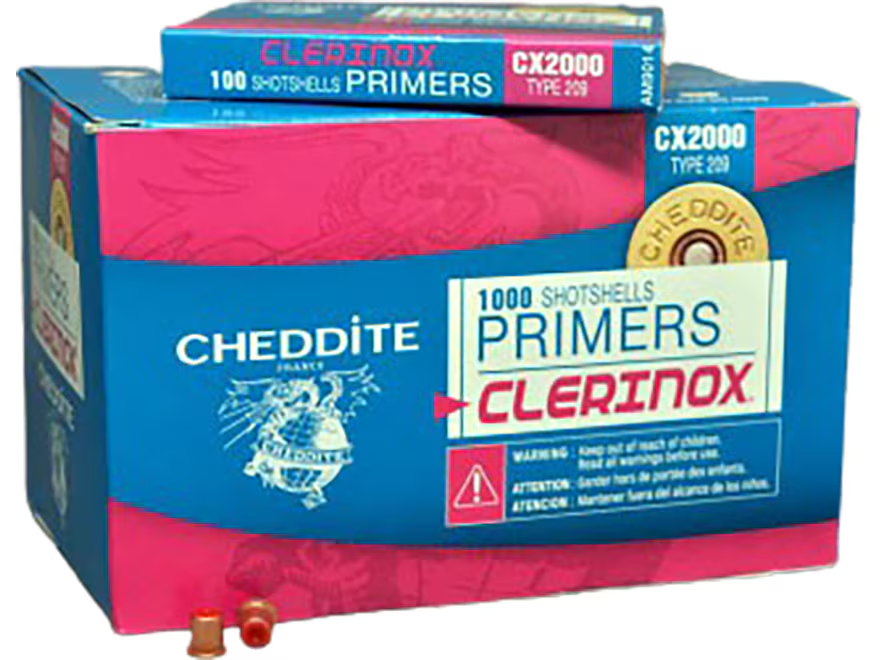
Primers: Standard small rifle primers for most NTX applications. CCI 400, CCI BR-4, and Federal 205 are reliable choices. For 243 Winchester and 308 Winchester applications using large rifle primer brass, CCI 200 and Federal 210 are standard. Federal GM205M match-grade small rifle primer is worth considering for handloaders prioritizing extreme spread consistency at these light, high-velocity weights. For AR-platform 223 Remington loads, CCI No. 41 mil-spec primer addresses slam-fire concerns relevant to semi-automatic platforms specifically, and Federal GM205MAR offers a match-grade alternative purpose-built for AR-platform reliability.
Cases: Standard brass from Winchester, Remington, Hornady, and Federal are all appropriate. As with other varmint bullets in this series, case consistency across high-volume batches matters more here than in typical low-volume hunting applications.
Seating depth: Start 0.005 to 0.020 inches off the lands – notably tighter than the BlitzKing and VARMIN-A-TOR’s typical 0.010-0.050 inch range. This reflects the NTX’s monolithic construction carrying forward the seating-depth sensitivity documented for larger monolithic bullets elsewhere in this series, scaled to this much lighter weight class. Systematic testing in small increments is worthwhile rather than assuming a single starting point will suffice.
Crimp: Light crimp at the cannelure, particularly for AR-platform semi-automatic rifles where reliable feeding and bullet retention through the cycling process matter more than in bolt-action applications.
Velocity verification: Given the NTX’s high stated velocity range (3,000-4,200 fps) and 1,600 fps activation threshold, confirming velocity above 3,000 fps for optimal fragmentation via chronograph is good practice, particularly important given how far some of the lighter weights push toward the upper end of typical varmint cartridge velocity capability.
Powder Selection by Application:
| Application | Caliber | Bullet Weight | Recommended Powders |
|---|---|---|---|
| Prairie dogs | 204 Ruger | 24 gr | Hodgdon H4895, Accurate 2230, Hodgdon Benchmark |
| Groundhogs/varmints | 223 Rem | 30-35 gr | Hodgdon Varget, Hodgdon H4895, IMR 4064, Hodgdon H335 |
| Varmints | 22-250 Rem | 35 gr | Hodgdon H380, IMR 4064, Accurate 4064, Hodgdon CFE 223 |
| Coyotes/predators | 243 Win | 50 gr | Hodgdon Varget, IMR 4064, Winchester 748, Hodgdon H4350 |
| Close-range varmint control | 308 Win | 50 gr | Hodgdon Varget, IMR 4895, Alliant Reloder 15 |
Reloading Parameters Summary:
| Parameter | Guideline |
|---|---|
| Neck tension | 0.002-0.003 inch interference |
| Seating depth | 0.005-0.020 inch off lands (tighter than lead-core competitors) |
| Crimp | Light crimp, particularly for AR-platform semi-auto |
| Minimum fragmentation velocity | 1,600 fps at impact |
| Effective range | Generally inside 250-300 yards given modest BCs |
| Extreme spread target | Under 10 fps for consistent varmint accuracy |
Frequently Asked Questions
Q: The original article describes the NTX as having a “copper alloy core with a thin jacket.” Is that accurate?
A: No, and this is worth correcting directly. A bullet cannot simultaneously have a distinct core-and-jacket structure while also being a lead-free monolithic design – the NTX is, in fact, built from a single piece of copper alloy material, conceptually similar to a small-scale, fragmentation-oriented relative of the Hornady GMX hunting bullet covered elsewhere on this site, rather than a traditional core-and-jacket bullet. This rewrite treats the NTX as monolithic construction throughout, consistent with how Hornady actually engineers and markets the product.
Q: Why does the NTX have such low BC figures compared to the BlitzKing and VARMIN-A-TOR?
A: This is primarily a function of weight, not an inherent shortcoming of the design. The NTX’s monolithic copper alloy construction at very light weights produces bullets that are lighter for a given caliber than the comparable lead-core BlitzKing or VARMIN-A-TOR offerings – a 30-grain .224-inch NTX versus a 40-55 grain .224-inch BlitzKing or VARMIN-A-TOR, for instance. Lighter weight at the same caliber generally produces lower sectional density and correspondingly lower BC, all else being equal. The NTX’s BCs are appropriate for its actual weight class; the comparison is somewhat apples-to-oranges if weight isn’t factored in alongside diameter.
Q: Is the NTX a good choice for hunters specifically because it’s lead-free, or are there meaningful performance compromises compared to lead-core varmint bullets?
A: For hunters in lead-restricted jurisdictions, the NTX’s primary value is being a genuinely lead-free option in a category where the two most established competitors – the BlitzKing and VARMIN-A-TOR – both contain lead despite occasional confusion about this. For hunters not bound by lead restrictions, the NTX’s lighter weights and correspondingly lower BCs at each caliber are a real tradeoff against the more traditional lead-core options, which generally offer somewhat heavier weight choices and higher BCs at comparable calibers, similar to the Hornady InterLock and other conventional jacketed options in the broader hunting bullet market. This isn’t a flaw in the NTX so much as a reflection of monolithic construction’s inherent weight characteristics at these light, fragmentation-oriented weight classes – hunters in unrestricted areas without a specific lead-free requirement may simply find the lead-core competitors offer more weight and BC options to choose from.
Q: The original article’s stated BlitzKing BC range (0.170-0.381) differs from what this site’s BlitzKing article documents (0.145-0.270). Which is correct?
A: This is a genuine discrepancy worth flagging rather than silently resolving. This site’s dedicated Sierra BlitzKing coverage documents BCs from 0.145 to 0.270 across its verified mainstream lineup, while this NTX article’s original source material states a different range (0.170-0.381) for the same competitor bullet. This may reflect different specific variants being referenced, outdated source data on one side or the other, or simply inconsistent sourcing between the two original articles before either was reviewed. Handloaders should treat both figures as approximate starting points and verify current BlitzKing specifications directly with Sierra rather than relying on either secondhand figure from a competitor’s marketing material.
Q: Is the 50-grain .308-inch NTX a reasonable general-purpose choice for that caliber, or is it genuinely as specialized as this article suggests?
A: It is genuinely specialized. SD 0.075 is very low for .308-inch – for comparison, even the lightest mainstream .308-inch hunting bullets typically carry SD in the 0.15-0.20+ range, and even the lightest Speer TNT varmint offerings at smaller diameters carry meaningfully higher SD than this combination. This combination of very light weight and large bore diameter produces a bullet optimized specifically for close-range fragmentation with minimal ricochet and over-penetration risk, appropriate for agricultural pest control or similar close-range scenarios, rather than general varmint hunting at the ranges where most handloaders would typically deploy a .308-inch platform. Handloaders considering this specific variant should be clear-eyed about its narrow intended use case before building a load around it.
Q: Can the NTX be used in AR-15 platforms reliably?
A: Yes, the original article specifically notes AR-platform compatibility, and the lighter weights at .224-inch (30-35 grains) are well within the range AR-15 magazines and feeding mechanisms handle reliably. For handloaders building AR-platform varmint loads with the NTX, standard AR-appropriate reloading practices apply – using CCI No. 41 mil-spec primers to address slam-fire concerns specific to AR bolt carrier group dynamics, and verifying overall cartridge length fits the magazine and chamber reliably given the NTX’s somewhat different profile compared to more conventional .224-inch varmint bullets.
Conclusion
The Hornady NTX is the established lead-free option in the varmint fragmentation bullet category, filling a role that this site’s coverage of the lead-core Sierra BlitzKing and Barnes VARMIN-A-TOR cannot address. Its monolithic copper alloy construction (corrected from the original article’s internally inconsistent “core and jacket” description) produces genuinely lower BCs than its lead-core competitors at comparable calibers, but this is primarily a function of the NTX’s lighter weight offerings rather than a fundamental design shortcoming.
Choose the NTX if: you hunt varmints in lead-restricted areas including California and need a genuinely lead-free fragmentation bullet rather than a repurposed lead-free hunting bullet; you want the widest available caliber range in this category, extending down to .172-inch; or you shoot from AR-platform rifles where the NTX’s documented compatibility is a relevant consideration.
Choose something else if: you are not bound by lead restrictions and want the broadest selection of weights and the highest available BCs at each caliber – the Sierra BlitzKing, Barnes VARMIN-A-TOR, or Nosler Varmageddon offer more options in that respect. If you need a bullet for deer or larger game, none of the dedicated varmint fragmentation bullets covered in this series are appropriate – choose a conventional soft-point, bonded, or monolithic hunting bullet instead, such as the Hornady GMX, Barnes TTSX, Sierra GameKing, Sierra Tipped GameKing, or Lehigh Defense Maximum Expansion for lead-free hunting applications. For predator hunting specifically where some weight retention is preferred over complete fragmentation, the lighter Barnes TTSX 50-grain or 70-grain .224-inch variants or the Nosler E-Tip are worth comparing against the NTX’s pure fragmentation approach.
Disclaimer: Reloading involves inherent risks. Always use current load data from Hornady or other published manuals. Start below maximum charges and increase gradually. The NTX’s low weight retention is an intentional design feature for fragmentation, not a defect – do not use it for deer or larger game hunting where penetration to the vitals is required. Wear eye protection at all times. The author and myreloading.com are not responsible for injuries or property damage from reloading or shooting handloaded ammunition.
Have you loaded and shot the Hornady NTX? Leave a comment with your load details: weight, cartridge, powder, charge, and what you observed in the field. How did it compare to a lead-core fragmentation bullet like the Sierra BlitzKing or Barnes VARMIN-A-TOR you may have used in the same caliber? Reports specifically from lead-restricted jurisdictions would be especially valuable given the NTX’s particular relevance to that audience.