Published: October 2025 | Last updated: April 2026
Your powder measure sits at the intersection of speed, consistency, and confidence. When it runs well, your session feels smooth and predictable. When it doesn’t, you waste time chasing the scale and start second-guessing every charge.
This guide covers the main measure types, what drives consistency, the common mistakes, and a practical checklist you can use at the bench.

Safety note: Always follow powder and component manufacturer manuals, use reputable published load data, and verify charges on a quality scale. Nothing here replaces official instructions or printed data.
Why Powder Measures Feel “Fussy”
Powder measures aren’t picky because designers missed something. They’re sensitive because they meter a loose, inconsistent material by volume while you care about consistency by weight.
Four variables show up in nearly every setup:
| Variable | What It Does |
|---|---|
| Powder shape | Ball/spherical powders flow like sand – excellent. Long extruded stick powders bridge, hang up, or get cut in the metering cavity. |
| Head pressure | Full hopper = more weight pressing powder into the cavity. As the level drops, pressure drops and charge weight drifts. A baffle helps. |
| Static and friction | Dry air + plastic hopper + fine powder = static that makes kernels cling and changes how the cavity fills. |
| Your rhythm | Same stroke, same tempo, every time. Change cadence or bump the bench and the scale will tell on you. |
Types of Powder Measures
There’s no single perfect measure for every job. Each design has a lane where it makes the most sense.
1. Classic Drum / Rotor Bench Measures
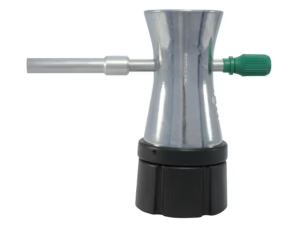
The traditional design from Redding, RCBS, Hornady, Lyman, and similar. An adjustable cavity in a rotating drum meters a set volume and dumps it into a case or pan.
Best for: Ball, spherical, and short-cut extruded powders; general-purpose bench work
| Pros | Cons |
|---|---|
| Durable, proven design | Can cut long stick kernels |
| Quick once tuned | Fine powders may leak in some models |
| Settings easy to record and repeat | Benefits from a baffle and consistent technique |
2. Sliding-Bar, Case-Activated Measures (Progressive Presses)
Common on Dillon and other progressive systems. The press stroke drives the measure, often only when a case is present.
Best for: High-volume pistol and small rifle; bulk production workflows
| Pros | Cons |
|---|---|
| High output with consistent press stroke | Some designs leak with very fine powders |
| Case activation reduces dry-fire charges | Still requires routine scale checks |
| Natural fit for progressive workflows | Affected by powder bridging at low hopper levels |
3. Precision Benchrest-Style Micrometer Measures
High-end rotor measures like Redding Competition BR-30, Redding Competition LR-1000, and Harrell’s designs. Micrometer adjustment for precise, repeatable settings.
Best for: Precision rifle; shooters who keep detailed records and return to the same loads repeatedly
| Pros | Cons |
|---|---|
| Very smooth operation | More expensive than standard measures |
| Micrometer settings easy to log | Still affected by powder geometry |
| Excellent repeatability with suitable powders | Verification remains mandatory |
4. Electronic Dispenser and Scale Combos
Units like the Hornady Auto-Charge Pro, RCBS ChargeMaster Supreme, RCBS ChargeMaster Link, and Frankford Arsenal Intellidropper. You enter a target weight; the unit runs the process.
Best for: Load development; precision rifle where every charge matters
| Pros | Cons |
|---|---|
| Simple for single-charge workflows | Slower per round for high volume |
| Excellent for precision rifle and development | Sensitive to drafts, vibration, temperature |
| Reduces mental load vs manual trickling | Requires warm-up and disciplined calibration |
5. Lab-Grade Scale + Auto-Trickler Setups
Premium route using a high-resolution scale paired with an auto-trickler. The RCBS MatchMaster and similar setups.
Best for: Top-level precision where you want fast cycle times without sacrificing accuracy
| Pros | Cons |
|---|---|
| Extremely accurate when set up correctly | High initial cost |
| Faster than most consumer combos for the precision level | Needs stable bench, controlled environment |
6. Dippers and Scoops
Old-school volumetric tools used with a scale.
Best for: Budget setups; portable reloading; components verification
| Pros | Cons |
|---|---|
| Inexpensive, no moving parts, no power | Purely volumetric unless you weigh each charge |
| Can be consistent with careful weighing | Not ideal for near-maximum work without strict weight confirmation |
Powder Type vs Tool: Quick Decision Map
Use this as a starting point, then confirm with your scale.
| Powder Type | Flow Behavior | Best-Fit Tools | Notes |
|---|---|---|---|
| Ball / spherical | Very free-flowing | Drum/rotor measures, progressive case-activated | Usually meters well. Watch for leakage with very fine granules. |
| Short-cut extruded | Moderate flow | Quality drum/rotor, micrometer measures | Consistent rhythm helps. A baffle reduces drift. |
| Long extruded stick | Resistant to packing | Electronic dispenser, lab scale + auto-trickler, or throw short and trickle | Expect kernel cutting in many volumetric measures. Weight-based workflows shine here. |
| Flake | Variable | Drum/rotor and progressives that handle your specific powder | Test with a 10-charge check before committing to volume production. |
What Really Drives Consistency
Marketing and brand loyalty are not the fundamentals. The fundamentals are predictable:
- Powder geometry – Long stick kernels don’t settle uniformly into small cavities. Bridging and kernel cutting add variation. This is manageable if measured, but it must be measured.
- Head pressure – A baffle stabilizes effective pressure across a session as the hopper empties.
- Operator rhythm – Your cadence is part of the machine.
- Environment – Static affects plastic hoppers. Drafts and vibration cause electronic scales to chase numbers. Humidity changes alter flow characteristics.
Common Mistakes
| Mistake | What Happens | Fix |
|---|---|---|
| “Set it and forget it” | Dial setting drifts; charges vary | The dial is not the truth. The scale is. Build in routine verification. |
| Switching powders without reset | Old settings don’t carry over | Empty and clean per the manual, then re-verify from scratch |
| Running hopper nearly empty | Charge weight drifts | Maintain a sensible working level; top off before it gets low |
| Ignoring static | Fine powder clings; cavity fills unevenly | Follow manufacturer guidance; avoid oils inside the powder path |
| Treating volume charts as final | Starting point ≠ verified charge weight | Charts are starting points only; verify every setup |
| Progressive press complacency | Undetected over/under charges | Case activation is a safety layer, not the only safety layer |
The Practical Checklist
Setup (Start of Session)
- [ ] Confirm current, reputable published load data for your exact components
- [ ] Verify scale is level and stable – no wobble, no vibration source nearby
- [ ] If electronic: allow proper warm-up per manufacturer (typically 5-10 minutes)
- [ ] Calibrate using the recommended procedure and check with calibration weights
- [ ] Install baffle if your measure supports one
- [ ] Ensure metering path is clean and dry inside
- [ ] Fill hopper to consistent working level
Validation (Before Loading)
- [ ] Throw and discard 5-10 settling charges to “season” the cavity
- [ ] Weigh 10 consecutive charges on a calibrated scale
- [ ] Record the average and note the spread
- [ ] If spread is larger than desired: slow rhythm / maintain steadier hopper level / consider weight-based method for that powder
In-Session
- [ ] Re-check charge weight at regular intervals (every 20-30 rounds minimum)
- [ ] Re-check after any interruption, bench bump, or rhythm change
- [ ] Re-check when you top off the hopper
- [ ] On a progressive: use good lighting and a powder-check system if the press supports one
Change Control
- [ ] Re-verify when you change powder type or lot number
- [ ] Re-verify when you change primers, bullets, or cases in a way that affects published data
- [ ] Re-verify if ambient conditions change significantly
Choosing the Right Tool for Your Loading Style
| Loading Style | Main Goal | Best Fit | What to Look For |
|---|---|---|---|
| High-volume pistol / training ammo | Lots of consistent rounds per hour | Case-activated measure on progressive press | Handles your powder with minimal leakage; smooth press stroke; integrates with powder-check system |
| General-purpose bench loading | One flexible setup for mixed work | Quality drum/rotor measure with baffle | Clear repeatable markings; works with powders you actually use; trickler and scale for fine-tuning |
| Precision rifle / load development | Tight velocity spreads, high confidence | Electronic dispenser/scale combo or lab scale + auto-trickler | Stable calibration; reasonable cycle time; anti-draft setup |
| Budget-conscious / minimalist | Safe, consistent ammo without premium gear | Entry-level drum measure or dippers | Trade speed for patience; with disciplined weighing, results can be excellent |
Real-World Habits That Save Headaches
- Keep simple records – Measure settings, powder lot numbers, average charge weights, notes on what the measure liked or disliked with each powder
- Standardize your routine – Same stroke, same tempo, same seating position every session
- Match tolerance to the job – Plinking ammo doesn’t demand the same process as match ammo
- Maintain the equipment – Clean and dry metering surfaces; no oils inside the powder path
- Treat the scale as the referee – If the scale is drifting, stop and fix that before continuing
So Who Wins?
There’s no universal champion. There’s only the best fit for your current job.
| Job | Best Tool |
|---|---|
| High volume production | Case-activated measure on a progressive press |
| All-around bench tool | Quality drum/rotor measure with baffle, backed by a solid scale and simple trickler |
| Practical precision | Reputable electronic dispenser/scale combo |
| Maximum precision and speed | Lab-grade scale with auto-trickler |
| Tight budget | Entry-level drum measure or dippers, with careful weighing |
A powder measure can’t fix poor technique, and great technique can’t make the wrong tool ideal for every job. Match the measure to what you actually load, validate your setup with a trustworthy scale, keep your routine consistent, and let real data guide your confidence.

FAQ
How do I know if my powder measure is “good enough” for my application?
Weigh 10 consecutive throws and calculate the spread (highest minus lowest) and standard deviation. For plinking and hunting ammo, a spread under 0.5 grains and SD under 0.2 grains is acceptable with most drum measures. For precision rifle loads, you want spread under 0.2 grains and SD under 0.1 grains – which typically requires either an auto-trickler or a high-quality micrometer measure with the right powder. If your measure exceeds these thresholds with a particular powder, the answer is either a different measure type or a weight-based workflow for that powder.
Does a powder baffle really make a difference?
Yes, noticeably with drum-style measures. The baffle creates a powder “bridge” above the metering cavity that maintains more consistent head pressure as the hopper empties. Without a baffle, charge weight can drift 0.2-0.4 grains over the course of a session as the hopper goes from full to near-empty. With a baffle, that drift typically drops to 0.05-0.1 grains in the same session. If your measure came without a baffle and the manufacturer offers one, it’s worth buying.
Ball powder meters noticeably better than stick powder – why?
Spherical granules roll and settle into the metering cavity uniformly, like fine sand. Long extruded stick kernels (H4350, Varget, IMR 4350, etc.) are irregular, prone to bridging, and get cut by the edge of the rotor as it cycles. Cut kernels change the volume of the charge and add variation. This is a physics problem, not a calibration problem – no amount of adjustment makes a volumetric drum measure meter long-stick powder as well as it meters ball powder. For long-stick powders, consider weighing each charge individually or using an auto-trickler.
How often should I clean my powder measure?
Any time you change powder types – always. Beyond that, a full cleaning every 500-1,000 rounds of the same powder is reasonable maintenance. More frequently with ball powders that leave more dust residue, and any time you notice the metering feeling “gritty” or the charges drifting unexpectedly. Use a brush and compressed air or a clean dry cloth – no solvents or oils inside the metering path.
Can I use the same drum measure for pistol and rifle powders without adjustment?
Yes, but you need to empty and clean the hopper between powder changes and re-verify your settings from scratch. Different powder shapes and densities mean that a setting that throws 4.5 grains of a fast pistol powder will throw a completely different weight of a slow rifle powder. Never assume a previous setting transfers to a new powder.
My electronic dispenser is consistently throwing charges that are 0.1-0.2 grains light. What’s wrong?
Several possibilities: the scale needs re-calibration (most common), the unit hasn’t fully warmed up, there’s a draft affecting the scale platform, the unit needs cleaning, or the powder is particularly difficult to trickle (some fine ball powders stick to the trickler tube). Start by recalibrating with your reference weights, ensure the unit has warmed up for at least 5-10 minutes, and check that nothing is touching or near the scale pan. If charges are consistently light rather than variable, calibration is the most likely cause.

Is a powder trickler necessary if I have an electronic dispenser?
For the dispenser itself – no, it has a trickle function built in. A standalone trickler (Frankford Arsenal, Lyman) is useful if you throw charges from a mechanical drum measure and want to bring them up to exact weight on a separate scale. The workflow is: throw a charge that is intentionally 0.2-0.3 grains under target, then trickle individual kernels until you hit the exact target weight. This is slower than an electronic combo but costs much less.
How do I handle static in my powder measure hopper?
The manufacturer-recommended approach is a few drops of “Bounce” or similar anti-static dryer sheet wiped on the outside of a plastic hopper (not inside the powder path). Some reloaders use a Bounce sheet folded and placed across the top of the hopper opening. Anti-static sprays designed for electronics work on the outside of the hopper. What not to do: put any oil, solvent, or spray inside the metering cavity or powder path. If static is severe, consider a metal hopper option – some drum measures allow hopper replacement.
Editorial note: This article was originally published in October 2025 and revised in April 2026.