Published: October 2025 | Last updated: March 2026
The 300 Blackout was born out of a specific military requirement, but it turned into something far more interesting: a cartridge that does two completely different things exceptionally well, and does both of them from the same rifle with nothing but a magazine swap.
Introduced in 2011 by Advanced Armament Corporation (AAC) and Remington Defense, the 300 BLK was developed in response to a USSOCOM request for a round that could deliver 7.62×39mm-level terminal performance from an AR-15 platform – particularly in short-barreled configurations with a suppressor. The .30 caliber bullet was a hard requirement; suppressed subsonic operation was non-negotiable. And it all had to work with standard AR-15 magazines and bolt carriers, changing only the barrel.
What AAC delivered was a cartridge that accomplishes all of that, and has since found a following well beyond special operations: hog hunters running suppressed SBRs, competition shooters running steel plates, homeowners looking for a home-defense load that won’t blow out eardrums in a hallway, and reloaders who find the wide velocity range – from 1,020 fps subsonic to 2,300+ fps supersonic – genuinely fascinating to develop for.
This guide covers everything a reloader needs to understand about the 300 Blackout: where it came from, what it actually does, and how to load it safely and effectively for both of its operating modes.

Caliber Description
The 300 Blackout fires a standard 0.308-inch diameter bullet – the same diameter used by the .308 Winchester, 7.62×51 NATO, and 7.62×39mm Soviet. That’s important, because it means the entire ecosystem of .30 caliber projectiles is available to reloaders: varmint bullets, hunting bullets, FMJ, match-grade, subsonic-optimized heavy bullets. Few cartridges offer this breadth of component availability.
The case length is 1.368 inches – substantially shorter than the .308 Win’s 2.015-inch case – and here’s where the clever engineering shows. The 300 BLK case is formed by cutting down 5.56×45mm / .223 Remington brass, then rebelling the neck to accept .308-diameter bullets. You can use a commercial case trimmer and forming die to produce 300 BLK brass from your spent 5.56 cases, which dramatically reduces the cost of reloading for anyone who already shoots an AR-15.
Bullet weights span a remarkable range: 78-grain monolithic copper bullets at the light end (primarily for specialized use), up to 230-grain cast bullets for the heaviest subsonic loads. In practice, the cartridge divides naturally into two distinct operating modes, each with its own bullet weight range and powder selection:
- Supersonic loads (110–135 grains): Operate above the speed of sound (~1,125 fps at sea level). These loads behave like a conventional rifle cartridge – relatively flat trajectory, reliable gas-operated cycling, and meaningful terminal performance out to 300 yards. Muzzle velocities range from roughly 2,100 to 2,350 fps depending on bullet weight and barrel length.
- Subsonic loads (190–230 grains): Operate below the speed of sound – typically between 1,010 and 1,060 fps – which is precisely where they need to be to eliminate the supersonic crack that accompanies every standard rifle shot. When paired with a suppressor, subsonic 300 BLK is genuinely quiet: the loudest sound is typically the mechanical action of the bolt cycling, not the report. This is what the cartridge was fundamentally designed for.
Common bullet types and their use cases:
- Full Metal Jacket (FMJ): Standard training and plinking loads. In supersonic configuration, inexpensive and reliable. In subsonic, used as budget practice when the bullet weight (typically 220 grains) is appropriate for the twist rate.
- Hunting (Soft Point, Ballistic Tip, Expanding Monolithic): Designed for controlled expansion on game. At supersonic velocities, 110–135 grain expanding bullets work effectively on hogs, coyotes, and deer-sized animals within 200 yards. Subsonic hunting loads with heavy expanding bullets (Barnes 190-grain, Lehigh Defense 194-grain) offer an intriguing option for close-range suppressed hunting.
- Match-Grade (HPBT): Sierra’s 125-grain MatchKing is a popular target bullet in supersonic loads. Match-grade subsonic options are less common commercially, but handloaders can tune heavy bullets for excellent consistency at 50–100 yard suppressed steel sessions.
Common powders for supersonic loads include Hodgdon CFE BLK and IMR 4198; for subsonic, Hodgdon H110, Accurate A1680, and Lil’Gun are standard references. Subsonic loads require particular attention to powder selection – the goal is to achieve consistent 1,010–1,060 fps velocities without going over the sound barrier (which ruins the point) or dropping so low that the gas-operated action fails to cycle reliably.
Compatible rifles include the AR-15 platform with a 300 BLK barrel (no other changes required), SIG MCX, CMMG Resolute, Ruger American Ranch, and a growing number of bolt-action options. The AR-15 compatibility is a major part of the cartridge’s appeal – if you already own an AR-15, you’re one barrel change away from shooting 300 Blackout.

Advantages and Disadvantages
The 300 Blackout occupies a specific niche, and understanding what it does and doesn’t do is essential before committing to it as a platform.
The core advantage is the subsonic/supersonic duality. No other widely available AR-15 cartridge can switch between genuinely suppressed subsonic and meaningful supersonic performance by simply changing magazines. The 5.56 NATO doesn’t have a practical subsonic mode – its case geometry doesn’t favor heavy bullets, and its fast twist rates can over-stabilize heavy .224-diameter bullets. The 7.62×39 can be suppressed, but not from a standard AR-15 lower, and subsonic performance in that platform is inconsistent.
The primary limitation is trajectory. Supersonic 300 BLK loads shed velocity significantly beyond 200 yards, and the subsonic loads are effectively limited to 100–150 yards for any application requiring terminal effect. This is not a long-range cartridge, and it’s not trying to be one. Anyone expecting .308 Winchester performance at 500 yards will be disappointed. Anyone who needs a reliable, versatile 0–300 yard system in an AR-15-compatible package will find it hard to beat.
The other limitation is cost. Dedicated 300 BLK brass from Starline or Hornady is more expensive than common .223 brass, and subsonic loads in particular require heavier (and therefore pricier) projectiles. Reforming .223 brass substantially reduces the cost for high-volume reloaders, but it adds a processing step.
| Advantages | Disadvantages | |
|---|---|---|
| 300 BLK | Subsonic suppression in AR-15; no bolt change; wide bullet selection; case formed from .223 brass | Limited effective range; steep drop beyond 200 yards; subsonic loads require careful development; ammunition cost |
Technical Characteristics
| Characteristic | Value |
|---|---|
| Bullet Diameter (inches) | 0.308 |
| Case Length (inches) | 1.368 |
| Overall Cartridge Length (inches) | 2.260 (max) |
| Bullet Weight Range (grains) | 78–230 |
| Muzzle Velocity – Supersonic (fps) | ~2,200 (125 gr) |
| Muzzle Velocity – Subsonic (fps) | ~1,020–1,060 (220 gr) |
| Muzzle Energy – Supersonic (ft-lbs) | ~1,340 (125 gr) |
| Muzzle Energy – Subsonic (ft-lbs) | ~510 (220 gr) |
| Max Pressure – SAAMI (PSI) | 55,000 |
| Parent Case | 5.56×45mm / .223 Rem |
The 55,000 PSI SAAMI pressure ceiling is worth noting – it’s lower than both the .308 Win (62,000 PSI) and 5.56 NATO (62,366 PSI). This is a deliberate choice that accommodates the short case and ensures reliable operation across a wide range of chamber temperatures and barrel lengths, particularly in the short-barreled configurations the cartridge was designed for.
Twist Rate Overview
Twist rate is more consequential for the 300 Blackout than for most cartridges, precisely because the bullet weight range is so wide. A twist rate optimized for 220-grain subsonic bullets may over-stabilize 110-grain supersonic projectiles (which can actually reduce accuracy); a rate designed for light supersonic bullets may fail to stabilize the heaviest subsonic loads.

The practical answer most 300 BLK barrel makers have converged on is 1:8, which handles the 110–220 grain range well in most configurations. The faster 1:7 twist is found in military-spec barrels and gives a margin of stability for the heaviest subsonic bullets in cold weather, when air density increases and stabilization becomes harder.
| Twist Rate | Optimal Bullet Weight (grains) | Recommended Barrel Length (inches) | Notes |
|---|---|---|---|
| 1:7 | 190–220 | 8–12 | Heavy subsonic; military spec; suppressed SBR |
| 1:8 | 110–220 | 10–16 | Best all-around choice; handles full weight range |
| 1:10 | 110–150 | 16–20 | Supersonic-only; not suitable for heavy subsonic |
Barrel length has an outsized effect on this cartridge compared to most rifle rounds because so many 300 BLK rifles are built with 8–10 inch barrels. Each inch of barrel below the optimal length costs approximately 25–50 fps. A supersonic load producing 2,200 fps from a 16-inch barrel might drop to 2,000–2,050 fps from a 9-inch barrel – still supersonic, still effective for close-range use, but with less retained energy at distance.
For subsonic loads, barrel length matters less in terms of velocity (you’re trying to stay below ~1,100 fps anyway), but shorter barrels can increase muzzle blast even with a suppressor and may affect cycle reliability with some powder/bullet combinations.
Recoil
The 300 Blackout is comfortable to shoot in any configuration. Supersonic loads generate roughly 7–10 ft-lbs of recoil in a standard AR-15 – noticeably more than 5.56 NATO but significantly less than full-power rifle cartridges like .308 Win or 7.62×39. The sensation is a moderate push rather than a sharp jolt, and follow-up shots are fast.

Subsonic loads produce even less felt recoil – closer to 4–5 ft-lbs – making suppressed subsonic shooting almost eerily comfortable. First-time shooters running a suppressed 300 BLK with subsonic ammunition often describe it as one of the most pleasant shooting experiences available in a centerfire rifle.
The AR-15 platform’s buffer system and adjustable gas blocks play a role in how recoil is managed. Many dedicated 300 BLK uppers come with heavier buffers (H or H2) to slow the bolt cycle with fast-burning subsonic powders and prevent bolt bounce. Getting this right is part of the load development process.
| Caliber | Recoil (ft-lbs) | Rifle Weight (lbs) | Notes |
|---|---|---|---|
| 300 BLK (supersonic) | ~8 | 7 | Moderate; easy for sustained shooting |
| 300 BLK (subsonic) | ~4–5 | 7 | Very mild; ideal with suppressor |
| 5.56 NATO | ~5 | 7 | Light; fast follow-ups |
| 7.62×39 | ~11 | 8 | Heavier push; AK/CMMG platforms |
Caliber Comparison
The 300 Blackout exists in a competitive space alongside two closely related cartridges: the 5.56 NATO on the light end and the 7.62×39mm Soviet on the heavy end. Understanding where each one fits is useful for anyone deciding which to build around.

300 BLK vs. 5.56 NATO: The 5.56 is faster, flatter-shooting, and more effective at distance. It’s the better general-purpose round for engagements beyond 300 yards, and it’s significantly cheaper to feed. The 300 BLK’s advantage is terminal performance at close range – a 125-grain expanding bullet at 2,200 fps creates more tissue disruption than a 55-grain 5.56 bullet at equivalent range – and its subsonic mode, which the 5.56 simply cannot match. For pure range work or general-purpose use, 5.56 wins on cost and trajectory. For suppressed applications or close-range hunting, 300 BLK wins.
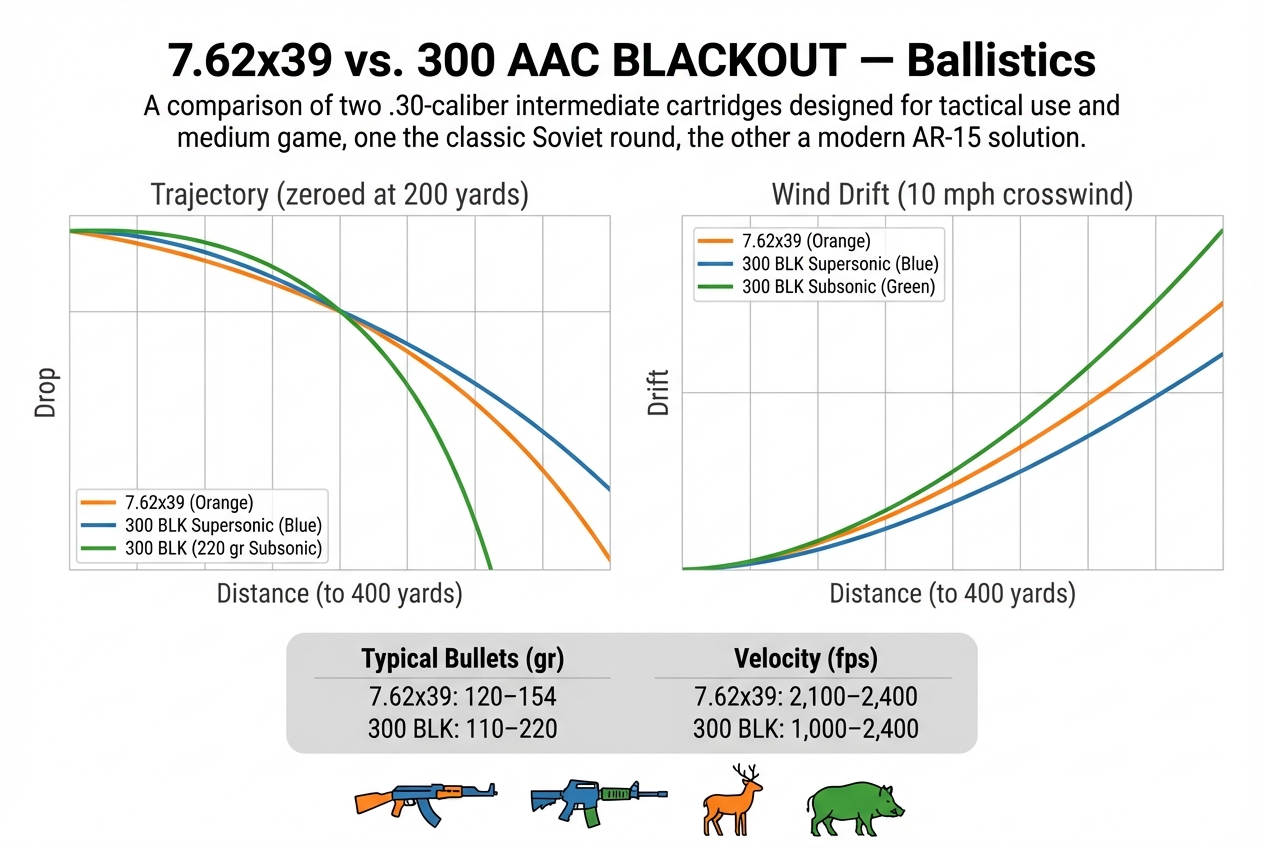
300 BLK vs. 7.62×39: On paper, these cartridges are nearly identical in supersonic ballistics. The 7.62×39 has a slightly larger case and slightly more muzzle energy, but the difference is marginal within 300 yards. The meaningful difference is platform: the 7.62×39 runs in AK-pattern rifles and dedicated AR-15 lowers (with modified bolt and magazine); the 300 BLK runs in any standard AR-15 lower with no modification whatsoever. For suppressed operation, the 300 BLK is far ahead – its case geometry and SAAMI pressure spec make it much better suited to consistent subsonic cycling than the 7.62×39.
| Caliber | Bullet Weight (grains) | Muzzle Velocity (fps) | Muzzle Energy (ft-lbs) | Effective Range (yards) |
|---|---|---|---|---|
| 300 BLK (supersonic) | 125 | 2,200 | 1,340 | 300 |
| 300 BLK (subsonic) | 220 | 1,025 | 513 | 100–150 |
| 5.56 NATO | 55 | 3,200 | 1,280 | 500 |
| 7.62×39 | 123 | 2,300 | 1,440 | 400 |
Applications and Practical Use
Hunting
The 300 Blackout has earned a genuine following among hog hunters – a use case where most of its strengths align perfectly. Hog hunting often happens at night (legal in most states with appropriate permits and equipment), at ranges under 150 yards, with a premium on quiet operation that doesn’t scatter a sounder after the first shot. A suppressed 300 BLK running subsonic or high-subsonic loads is nearly ideal for this application.
For supersonic hunting loads, 110–125 grain expanding bullets are effective on deer, coyote, and feral hogs within 200 yards. The Barnes TAC-TX 110-grain is particularly well-regarded for its reliable expansion and deep penetration even at the lower velocities seen from short barrels. The Hornady 135-grain FTX is a solid choice for deer-sized game where the extra mass improves penetration through brush and bone.
A realistic note on range: the 300 BLK in supersonic form drops approximately 25 inches at 300 yards (zeroed at 100 yards). That’s manageable with holdover knowledge, but ethical hunting past 200–250 yards requires accurate range estimation and careful shot placement. Know your limits, and the 300 BLK is an excellent hunting round in its niche. Push it beyond 250 yards on game and you’re asking more of it than it was designed to deliver.
Suppressed Shooting and Sport
This is where the cartridge truly shines. A quality suppressor mounted on a 300 BLK upper with subsonic ammunition produces sound levels that are genuinely safe for unsupported hearing – typically in the 130–140 dB range, compared to 160+ dB for unsuppressed 5.56. Whether for backyard plinking where noise is a neighborly concern, competitive suppressed-division shooting, or just the pure mechanical pleasure of hearing the action work without ear protection, the experience is legitimately different from conventional shooting.
For steel plate shooting, 220-grain subsonic loads hit with authority at 50–100 yards and cycle reliably in a properly tuned AR-15. The report is a soft “thump” followed by the ring of steel. It’s an addictive combination.

Military and Self-Defense
The 300 BLK was developed for military and special operations use, and continues to see service in that role – primarily in suppressed SBRs where the ability to engage targets quietly without sacrificing reliable terminal performance is operationally valuable. The 110-grain Barnes TAC-TX in supersonic configuration is used by several units precisely because it expands reliably even from 9-inch barrels at short range.
For civilian home defense, the suppressed 300 BLK addresses a real concern: indoor gunfire without hearing protection causes immediate and significant hearing damage. A suppressed 300 BLK with subsonic ammunition dramatically reduces that risk while maintaining stopping power at the ranges relevant to home defense (typically under 25 yards). The trade-offs are the NFA paperwork, the cost and wait time for a suppressor, and the fact that subsonic loads don’t offer the same terminal velocity as faster cartridges.
Recommendation Summary
- Hog hunting (suppressed, night): 190–220 grain subsonic expanding bullets; suppressed barrel 8–10 inches; 1:7 twist
- Deer / medium game: 110–135 grain supersonic expanding bullets (Barnes TAC-TX, Hornady FTX, Hornady SST); 150–200 yard limit
- Home defense: Supersonic expanding loads for standard use; subsonic with suppressor for noise-mitigated option
- Steel/suppressed plinking: 220-grain FMJ subsonic; budget-friendly volume shooting
- Training / practice: Supersonic FMJ; cheapest per-round cost
Ballistics and Performance
The 300 BLK’s trajectory is the most important practical limitation to understand. Unlike high-velocity cartridges that stay relatively flat to 300 yards, the 300 BLK in supersonic form starts dropping significantly after 200 yards. In subsonic form, the drop past 100 yards becomes severe.
Supersonic 125-grain load reference data:
- Muzzle velocity: 2,200 fps
- BC (G1): ~0.320
- Muzzle energy: 1,340 ft-lbs
- Energy at 300 yards: ~620 ft-lbs
- Drop at 300 yards (100-yard zero): approximately −25 inches
Subsonic 220-grain load reference data:
- Muzzle velocity: 1,025 fps
- BC (G1): ~0.270–0.310 (varies by bullet)
- Muzzle energy: ~513 ft-lbs
- The subsonic load is not intended for ranges beyond 100–150 yards in practical application
Basic Ballistics Table – Supersonic 125-grain Load
| Distance (yards) | Velocity (fps) | Energy (ft-lbs) | Drop (inches, 100-yd zero) |
|---|---|---|---|
| 0 | 2,200 | 1,340 | −1.5 |
| 100 | 1,950 | 1,056 | 0 |
| 200 | 1,720 | 822 | −10 |
| 300 | 1,500 | 624 | −30 |
Standard conditions: 59°F, sea level, 1.5-inch sight height, zeroed at 100 yards.
The velocity decay is rapid compared to cartridges with higher BC bullets. A 125-grain .30 caliber bullet at 2,200 fps loses speed significantly faster than a 168-grain .308 bullet at 2,650 fps simply because it sheds momentum more quickly at a lower starting energy. This isn’t a flaw – it’s the expected behavior of a short-case, moderate-velocity cartridge. Plan for it, and the 300 BLK performs exactly as intended within its envelope.
Long-Range Performance
The numbers at 1,000 yards are technically interesting but practically irrelevant for this cartridge. A supersonic 300 BLK load that starts at 2,200 fps has dropped to transonic velocity (roughly 1,100–1,340 fps) somewhere between 400 and 600 yards, and transonic flight is aerodynamically unstable – groups open dramatically. For any practical purpose, the 300 BLK’s effective range with supersonic loads is 300 yards maximum, and for hunting applications 200 yards is a more responsible ceiling.
Subsonic loads behave differently at distance: they stay subsonic (by design), so there’s no transonic instability. But the energy drops to levels that make ethical hunting impossible, and wind drift becomes severe. At 200 yards, a 10 mph crosswind moves a 220-grain subsonic bullet approximately 8–10 inches. At that point, consistent hits require significant wind reading skill for targets smaller than a steel plate.

For reference: at 1,000 yards, a supersonic 125-grain load has approximately 800 fps of remaining velocity, 244 ft-lbs of energy, has dropped over 600 inches, and has drifted nearly 100 inches in a 10 mph crosswind. These numbers are not a recommendation – they illustrate why 300 BLK is a close-range specialist, not a long-range tool.
Factors Affecting Performance
Atmospheric Conditions
At high altitude, reduced air density means less aerodynamic drag – bullets fly slightly flatter and retain velocity better. For the 300 BLK’s effective range this matters less than for longer-range cartridges, but hunters in the Rockies will notice their supersonic loads hold on a bit better than sea-level data suggests.
Temperature affects powder burn rate, which is particularly important for subsonic loads. If you develop a subsonic load at 70°F that produces 1,040 fps, that same load on a cold November morning at 25°F may drop to 980 fps – below the reliable cycling threshold for many gas-operated AR-15 setups. This is why subsonic load development should be tested across the temperature range you’ll actually shoot in, and why temperature-sensitive powders are a real concern for this application.
Powder Selection – The Critical Variable
For the 300 Blackout more than almost any other cartridge, powder selection determines which of the two operating modes you’re in. This isn’t a subtle optimization – it’s a fundamental choice that affects case fill, cycling reliability, and whether you’re above or below the speed of sound.
Subsonic powders need to be relatively fast-burning for this application. The goal is to produce consistent pressure and velocity with a heavy bullet at a modest velocity. Slow powders that work well with light, fast bullets at high pressure simply don’t generate enough energy at subsonic speeds to cycle the action consistently. H110, A1680, and Lil’Gun are the benchmark subsonic powders for 300 BLK – they have the burn characteristics to produce consistent 1,020–1,060 fps from heavy bullets with relatively low, predictable pressure.
Supersonic powders work with lighter bullets at higher velocities. CFE BLK (Hodgdon’s purpose-designed 300 BLK powder) is an excellent all-around choice that works across the supersonic weight range. IMR 4198 and Reloder 7 offer alternatives for lighter supersonic loads with good velocity and accuracy results.
A critical safety warning for mixed-load situations: If you reload both supersonic and subsonic 300 BLK, you must have a reliable system for keeping those loads completely separated – different storage, different labeling, different range bags. A 220-grain subsonic bullet seated in a case loaded with supersonic powder charge produces a dangerous overpressure condition. This is one of the more serious hazards in 300 BLK reloading, and experienced reloaders treat it with appropriate seriousness.
Barrel Length
The 300 Blackout was designed to function from short barrels, and it does so better than almost any other rifle cartridge. Where a .308 Win loses significant velocity and efficiency from a 10-inch barrel, the 300 BLK was engineered around short-barrel operation and loses proportionally less.

As a general rule: each inch of barrel below 16 inches costs approximately 25–50 fps for supersonic loads. A load that produces 2,200 fps from 16 inches will produce roughly 2,050–2,100 fps from 10 inches – still supersonic, still within the effective range envelope. For subsonic loads, the target velocity window (1,020–1,060 fps) is easy to hit from any barrel length between 8 and 20 inches with appropriate powder selection.
Reloading
The 300 Blackout rewards careful reloading more than most cartridges, because the consequences of getting it wrong are more concrete: a subsonic load that goes supersonic (defeating the purpose of suppression), a supersonic load that fails to cycle (creating a stoppage at a bad moment), or a mixed-up load that causes an overpressure event. Understanding the mechanics behind each choice makes for better, safer reloads.
Case Preparation – Forming from .223 Brass
The most economical path for high-volume 300 BLK reloaders is forming brass from .223 Remington or 5.56×45mm cases. The process requires a case trimmer set to 1.368 inches and a dedicated 300 BLK forming die that opens the neck from .224 to .308 diameter.
Key considerations in the forming process:
- Trim to length consistently. Cases that are too long will not chamber properly. Cases that vary significantly in length create inconsistent seating depth, which affects velocity consistency – especially critical for subsonic loads where a few fps of variation can mean the difference between subsonic and transonic.
- Check for military crimped primer pockets. Military-headstamped 5.56 brass has crimped primer pockets that must be swaged or reamed before repriming. Commercial .223 brass typically does not.
- Inspect cases after forming. Case neck cracks can develop during the forming process, particularly with work-hardened brass that has been fired many times. Discard any cases with visible cracks.
- Anneal regularly. Forming cases work-hardens the neck and shoulder. Periodic annealing (heating the neck and shoulder area to restore brass temper) extends case life and improves neck tension consistency.
Dedicated 300 BLK brass from Starline, Hornady, or Peterson is more convenient than forming your own, but costs significantly more per case. For the serious reloader producing high volumes of subsonic ammunition, forming your own is worth the time investment.
Primers and Cases
The 300 Blackout uses Small Rifle primers – a departure from the Large Rifle primers used by .308 Win and 7.62×51. Standard Small Rifle primers are appropriate for most supersonic loads and many subsonic loads. Small Rifle Magnum primers are sometimes preferred for the slower powders used in heavy subsonic loads (H110, Lil’Gun), where the hotter ignition helps with consistency, particularly in cold weather.
| Component | Type | Common Brands | Suitable For |
|---|---|---|---|
| Primer | Small Rifle | CCI 400, Federal 205, Winchester SR | Standard supersonic loads |
| Primer | Small Rifle Magnum | CCI 450, Federal 205M | Heavy subsonic loads; cold weather |
| Case | Brass (dedicated) | Starline, Hornady, Peterson | All loads; consistent dimensions |
| Case | Formed .223/5.56 | Lake City, Winchester, Federal | All loads; economical |

Bullets
The breadth of available .308-diameter projectiles is one of the 300 BLK’s genuine advantages. For subsonic-specific use, several manufacturers have produced bullets engineered for optimal performance at subsonic velocities – these typically have high sectional density, controlled expansion profiles designed to work at 1,000–1,060 fps rather than the 1,800–2,800 fps range typical hunting bullets are designed for.
| Bullet Brand/Model | Weight (grains) | Type | Best For |
|---|---|---|---|
| Barnes TAC-TX | 110 | Expanding monolithic | Supersonic hunting; terminal performance from short barrels |
| Sierra MatchKing | 125 | HPBT | Supersonic target/competition |
| Hornady FTX | 135 | Polymer Tip | Supersonic deer hunting |
| Lehigh Defense Controlled Chaos | 115 | Monolithic | Supersonic hunting; deep penetration |
| Nosler Ballistic Tip | 220 | Ballistic Tip | Subsonic hunting; expands at 1,000 fps |
| Sierra MatchKing | 220 | HPBT | Subsonic target/plinking |
| Hornady A-MAX / ELD-M | 208 | HPBT | Subsonic precision; excellent BC |
Powders
The powder list for 300 Blackout divides cleanly into subsonic and supersonic categories. Using the wrong category is not simply a matter of accuracy – it can result in dangerously high or inconveniently low pressure. Reference current data from Hodgdon, Hornady, or Sierra for specific charge weights; the list below identifies which powders are appropriate for which application.
| Powder | Suitable Bullet Weights (grains) | Best For | Notes |
|---|---|---|---|
| Hodgdon H110 | 190–220 | Subsonic | Benchmark subsonic powder; consistent, accurate |
| Accurate A1680 | 190–220 | Subsonic | Excellent velocity consistency for heavy bullets |
| Hodgdon Lil’Gun | 190–220 | Subsonic | Good cycling reliability; slightly dirty |
| IMR 4227 | 190–220 | Subsonic | Traditional pistol/magnum powder; works well here |
| Winchester 296 | 190–220 | Subsonic | Metered well; similar to H110 |
| Alliant 2400 | 190–220 | Subsonic | Consistent; slightly lower velocity than H110 |
| Hodgdon CFE BLK | 110–150 | Supersonic | Purpose-designed for 300 BLK; broad supersonic range |
| IMR 4198 | 110–150 | Supersonic | Traditional; good velocity/accuracy with light bullets |
| Alliant 300-MP | 110–150 | Supersonic | Ball powder; meters well; good supersonic velocities |
| Reloder 7 | 110–125 | Supersonic (light) | Best with lightest supersonic bullets |
| Vihtavuori N110 | 110–220 | Both modes | Clean-burning; good data across weight range |
| Hodgdon H380 | 125–150 | Supersonic hunting | Versatile mid-range supersonic option |
Practical Considerations
Barrel Wear
Short barrels and fast-burning powders are a combination that generally produces more erosive conditions than long barrels with slower powders. The 300 BLK’s lower pressure ceiling (55,000 PSI vs. 62,000 for .308 Win) partially offsets this, but high-volume shooting through a 9-inch barrel with hot supersonic loads will wear the throat faster than a 16-inch barrel running the same loads.
Realistic expectations for barrel life: a quality chrome moly barrel running supersonic loads at moderate volume should last 5,000–10,000 rounds before notable accuracy degradation. Stainless barrels may last slightly longer between cleanings but don’t necessarily outlast chrome moly at the same rate. Subsonic loads, with their lower pressure and slower powder burn, are generally gentler on the throat.
Signs of throat erosion are the same as any rifle: progressively widening groups at distance, increased velocity standard deviation between shots (visible on a chronograph), and visible erosion rings or cratering when viewed with a bore scope.
Gas System Tuning
The 300 Blackout in an AR-15 benefits significantly from an adjustable gas block – especially for anyone who plans to run both supersonic and subsonic loads, or who shoots suppressed. The reasoning:
- Subsonic loads produce lower gas pressure and may not cycle a standard direct-impingement system reliably, particularly with a heavier buffer
- Suppressed shooting increases back-pressure, which can over-gas the action and cause accelerated bolt carrier wear, increased felt recoil, and failures to feed
- Mixed loads (subsonics one session, supersonics the next) may require different gas settings for optimal cycling
An adjustable gas block lets you tune the gas port opening for each configuration. Combined with an appropriately weighted buffer (H or H2 for most subsonic applications, standard for unsuppressed supersonic), this gives you reliable cycling across the full range of loads the cartridge is capable of.
Optics and Setup
The 300 BLK’s effective range limits make high magnification optics mostly unnecessary. For most applications, a 1–4× or 1–6× variable is ideal – low magnification for close-range suppressed work and fast target acquisition, higher magnification available for the occasional 200-yard precision shot.
Red dot sights work extremely well with subsonic loads at 50–100 yards, and for CQB-oriented home defense builds, a fixed red dot keeps the setup simple and lightweight.
If longer-range supersonic work is planned (200–300 yards), a BDC reticle calibrated specifically for 300 BLK supersonic loads is more useful than a generic .223 or .308 BDC – the trajectory is different enough that a generic reticle will produce significant errors at distance.
Conclusion
The 300 Blackout occupies a genuinely unique position in the AR-15 ecosystem. It’s not trying to be a long-range precision cartridge, and it’s not trying to replace the 5.56 as a general-purpose fighting round. What it does – deliver reliable .30 caliber performance with the option of genuinely quiet subsonic operation, all from a standard AR-15 platform – it does better than anything else currently available.
For reloaders, the cartridge offers unusual depth: the ability to develop loads across a 1,100 fps velocity range, the economy of forming brass from spent .223 cases, and the intellectual challenge of tuning loads that work reliably in both subsonic and supersonic modes. That challenge is also the caution: this is a cartridge where powder selection is mission-critical, mixed loads are a real hazard, and careful load development matters more than in most mainstream rifle cartridges.
The 300 Blackout’s adoption continues to grow in 2026, with expanding component availability, a maturing commercial ammunition market, and a well-established role in suppressed shooting sports and close-range hunting. For the right shooter with the right application, it remains one of the more interesting choices in the AR-15 caliber landscape.


Editorial note: This article was originally published in October 2025 and substantially revised in March 2026. The update expanded coverage of subsonic/supersonic load development, case forming from .223 brass, gas system tuning, safety considerations for mixed loads, and practical hunting applications. Technical data reviewed for accuracy against current SAAMI specifications and published reloading manuals.