Published: 2026 | Last updated: April 2026
Alliant Reloder 26 is a slow-burning, double-base extruded rifle powder manufactured by Nitrochemie in Switzerland for Alliant Powder. It occupies the slower end of the Alliant Reloder series – faster than Alliant Reloder 33 and Alliant Reloder 50, and positioned to compete directly with Hodgdon H1000 in the large-capacity magnum cartridge market. The defining characteristics that separate it from older slow magnum powders are: a proprietary EI impregnation technology that integrates energy-controlling compounds deeper into the grain structure than surface coating alone, and a built-in decoppering additive (tin and bismuth) that reduces copper fouling accumulation during extended shooting.
What Reloder 26 is genuinely known for in the field is velocity. In 300 Winchester Magnum, 7mm Remington Magnum, and 6.5 PRC with heavy-for-caliber bullets, it routinely produces 80-100 fps more muzzle velocity than Hodgdon H1000 at comparable pressure levels. That velocity advantage is not trivial at long range – it shifts the supersonic threshold, reduces time of flight, and flattens the trajectory in ways that translate to meaningful differences at 800-1,200 yards.
The trade-off that every Reloder 26 user needs to understand before loading maximum charges is the elevated-temperature pressure behavior. At standard temperatures up to approximately 85°F, Reloder 26 is well-behaved and shows good velocity consistency. Above 85-90°F, the pressure curve can shift upward more significantly than the manufacturer’s general stability claims suggest. A load developed in cool-weather conditions that appears safe at 60°F may produce sticky bolt lift or blown primers in a hot desert summer or a high-desert afternoon hunt. This is not a reason to avoid the powder – it is a reason to develop loads specifically at summer temperatures if you shoot in warm conditions.
Powder Description and Technical Profile
Alliant Reloder 26 is a double-base extruded stick powder produced using Nitrochemie’s EI (Impregnation) technology. The impregnation process integrates the deterrent and energy-controlling compounds more deeply into the grain structure than conventional surface coating. The practical result is a more linear energy release through the burn cycle – pressure builds progressively rather than spiking early, which is precisely what large-capacity magnum cases need to sustain velocity through a 24-26 inch barrel.
The bulk density is 0.989 g/cc – the highest figure in this article series and among the highest of any extruded magnum powder on the market. This density is the single most practically important specification for large-capacity magnum reloading. The 300 Winchester Magnum, 7mm Rem Mag, and similar cases require substantial charge weights to develop working pressure, and a lower-density powder may not physically fit enough charge into the case to reach those pressures without dangerously compressed loads. Reloder 26’s high density allows full-charge loads that fill the case to 95-100% capacity at working pressures, producing the consistent powder column ignition that low extreme spreads require.
The decoppering additive – tin and bismuth compounds – is embedded in the propellant rather than applied as a surface coating. Each shot deposits small amounts of these compounds in the bore, creating a chemical environment that prevents copper jacket material from bonding to bore steel. The cumulative effect over a shooting session is significantly reduced copper fouling buildup compared to powders without this chemistry. For a precision rifle used at 50-100 round development sessions, the practical benefit is that copper fouling has minimal effect on group size throughout the session rather than progressively degrading accuracy as the barrel fouls.
Alliant also states that Reloder 26 is free of DNT (Dinitrotoluene) and DBP (Dibutyl phthalate) – two compounds present in older powder formulations that are environmental and handling concerns. This is a manufacturing cleanliness characteristic rather than a ballistic one, but it is worth noting for reloaders who are aware of chemical handling.
Strengths:
- 80-100 fps velocity advantage over Hodgdon H1000 in primary magnum applications at comparable pressure levels – documented and consistent across multiple cartridges
- Highest bulk density in class (0.989 g/cc) – fills large-capacity magnum cases efficiently, enabling the high load density required for consistent ignition and low standard deviations
- Proprietary EI impregnation technology produces a linear, progressive pressure curve suited to long magnum barrels
- Integrated decoppering chemistry (tin and bismuth) reduces copper fouling accumulation, extending accuracy intervals between deep bore cleaning
- Free of DNT and DBP – cleaner chemistry than older double-base powder formulations
- Excellent lot-to-lot consistency – loads developed with one container replicate reliably on the next lot
Limitations:
- Elevated-temperature pressure behavior above 85-90°F – this is the most important limitation and requires explicit awareness. Loads developed at cool temperatures (40-65°F) may produce unsafe pressures when shot in summer heat. Always develop final loads at the highest temperature you expect to shoot
- Double-base chemistry means higher flame temperature than single-base alternatives – throat erosion in magnum barrels is more aggressive than with Hodgdon H1000 or Norma MRP at the same pressure level
- High retail demand creates availability gaps – Reloder 26 sells out faster than most magnum powders; maintain inventory reserve well before hunting season
- Extruded geometry meters less consistently than ball powders – hand-weighing or precision dispensers are necessary for match-grade charge consistency
- Magnum primers required in virtually all applications – a hard requirement, not a recommendation
Technical Characteristics
| Property | Specification |
|---|---|
| Manufacturer | Nitrochemie AG (Switzerland) for Alliant Powder |
| Technology | EI Impregnation |
| Type | Double-Base Extruded (Stick) |
| Bulk Density (g/cc) | 0.989 |
| Decoppering Agent | Tin and Bismuth compounds |
| DNT / DBP | Free of both |
| Burn Rate Category | Slow Rifle (Magnum) |
| Package Size | 1 lb, 5 lb |
The High-Temperature Pressure Warning – Understanding the Risk
Before loading Alliant Reloder 26 to or near maximum published charge weights, every reloader needs to understand the elevated-temperature pressure behavior in practical terms.
At temperatures between 20°F and approximately 85°F, Reloder 26 shows velocity variation of approximately 0.5 fps per degree Fahrenheit – excellent stability that makes it reliable for hunting and competition in that range. Above 85°F, the pressure curve can shift in a non-linear way. Field reports from reloaders in the American Southwest, Texas, and other hot-climate regions consistently describe the same phenomenon: a load that felt safe in a 60°F spring session, confirmed by comfortable bolt lift and clean primer faces, produced sticky extraction or blown primers when shot on a 95°F summer afternoon.
The practical implication is direct: if you hunt or compete in temperatures above 85°F, develop your loads in those conditions, not in cool-weather sessions. Start lower – 5-7% below the listed maximum rather than the standard 10% – and work up at the highest temperature you expect to encounter. The load you validate at 95°F is the one that will be safe all year.
This is not a manufacturer defect or a powder quality problem. It is a characteristic of double-base extruded powders at high energy densities, and it is more pronounced in Reloder 26 than in some competitors due to its high bulk density and energy content. Acknowledge it in the load development process and it is entirely manageable. Ignore it and load to maximum in cool weather for a summer hunt, and you are running an unacceptable risk.
| Powder | Stability Rating | Notes |
|---|---|---|
| Hodgdon H1000 | Extreme (0.21 fps/°F) | Hodgdon Extreme series – benchmark |
| Hodgdon Retumbo | Extreme | Slightly slower, similarly stable |
| Alliant Reloder 26 | Very Good (0.5 fps/°F to 85°F) | Non-linear above 85°F |
| Alliant Reloder 25 | Sensitive (1.5+ fps/°F) | Older formulation, high sensitivity |
| IMR 7828 SSC | Moderate | Traditional alternative |
Burn Rate Comparison and Competing Powders
Alliant Reloder 26 sits in the slow-magnum burn rate position – slower than Alliant Reloder 22 and Alliant Reloder 25, roughly comparable to Hodgdon H1000, and faster than Alliant Reloder 33 and Hodgdon Retumbo.
| Powder | Type | Density (g/cc) | Key Character |
|---|---|---|---|
| Alliant Reloder 22 | Double-Base Extruded | 0.860 | Faster – standard belted magnums |
| Alliant Reloder 25 | Double-Base Extruded | 0.940 | Slightly faster, older formulation |
| Hodgdon H1000 | Single-Base Extruded | 0.880 | Extreme stability, deeper data library |
| Alliant Reloder 26 | Double-Base Extruded | 0.989 | Reference – maximum velocity in class |
| Vihtavuori N570 | Double-Base Extruded | 0.960 | European alternative, similar burn rate |
| Hodgdon Retumbo | Single-Base Extruded | 0.870 | Slightly slower, overbore focus |
| Alliant Reloder 33 | Double-Base Extruded | 0.930 | Slower – ultra-large cases |
| Norma 217 | Single-Base Extruded | 0.890 | Similar burn, lower erosion |
| Accurate MagPro | Double-Base Spherical | 0.950 | Ball powder – better metering |
vs. Hodgdon H1000: The central comparison. H1000 belongs to the Hodgdon Extreme series and carries genuine temperature stability credentials – 0.21 fps per degree Fahrenheit versus Reloder 26’s 0.5 fps. That stability gap is meaningful in practice: H1000 stays reliable across all practical hunting and competition temperatures without the above-85°F concern. The velocity gap favors Reloder 26 by 80-100 fps in most primary applications. This is the central trade-off in the slow magnum powder market: if seasonal consistency across temperature extremes is the priority, H1000 is the more conservative choice. If maximum velocity is the priority and you manage the temperature development protocol, Reloder 26 wins that contest.
vs. Alliant Reloder 25: Reloder 25 is the older member of the Alliant slow magnum lineup, without the EI impregnation technology or the decoppering additive. Its temperature sensitivity runs 1.5+ fps per degree Fahrenheit – substantially more than Reloder 26. In most primary magnum applications, Reloder 26 is the more modern and capable choice. Reloder 25 is slower-burning than Reloder 26 in some burn rate charts and may be appropriate in specific very large-case applications where 26 is slightly too fast. Always verify against published data for the specific cartridge.
vs. Vihtavuori N570: N570 is a slow-magnum European powder at a comparable burn rate with a similar high-energy focus. It is generally well-regarded for accuracy and consistency but typically produces slightly lower peak velocities than Reloder 26 in direct comparisons. Availability in North America can be spotty, and the cost per pound is typically higher. For reloaders who prioritize European manufacturing quality and work in 338 Lapua Magnum and similar cartridges, N570 is a legitimate alternative. For maximum velocity in 300 Win Mag and 7mm Rem Mag, Reloder 26 is typically faster.
vs. Hodgdon Retumbo: Retumbo burns slightly slower than Reloder 26 and is specifically optimized for overbore cartridges with very large powder columns – the 300 RUM, 300 PRC, and similar large-capacity cases. Its lower density (0.870 g/cc) can limit case fill in some applications where Reloder 26’s 0.989 g/cc allows more charge mass. For 300 Winchester Magnum and 7mm Rem Mag, Reloder 26 is the better fit. For 300 RUM and 338 RUM, Retumbo or Reloder 33 may be more appropriate.
vs. Accurate MagPro: Accurate MagPro is a double-base spherical powder at a comparable burn rate. Its ball geometry meters through volumetric measures more consistently than any stick powder, making it the practical choice for high-volume loading on a progressive press. Reloder 26 produces higher velocities in most primary magnum applications due to its higher energy density and the EI impregnation chemistry. For precision single-stage loading where every charge is hand-weighed, Reloder 26’s metering disadvantage is irrelevant and the velocity advantage is the deciding factor.
Recommended Cartridges and Applications
Alliant Reloder 26 is designed for large-capacity magnum cartridges loaded with heavy-for-caliber, high-BC bullets where maximum velocity at safe pressure is the objective.
| Cartridge | Bullet Weight Range | Notes |
|---|---|---|
| 300 Winchester Magnum | 190-230 gr | Flagship application – maximum performance |
| 7mm Remington Magnum | 160-195 gr | High-BC heavy bullets specifically |
| 6.5 PRC | 143-156 gr | ELR hunting and precision |
| 338 Lapua Magnum | 250-300 gr | Long-range precision, military applications |
| 300 PRC | 200-230 gr | Purpose-built ELR cartridge |
| 300 RUM | 200-230 gr | Ultra-mag heavy bullet loads |
| 270 Winchester | 150-160 gr | Heavy-bullet loads – burn rate is slightly slow |
| 243 Winchester | 105-115 gr | Heavy 6mm bullet – specialized application |
| 6.5 Creedmoor | 147-153 gr | Ultra-heavy bullets only |
The 300 Winchester Magnum with 210-215 grain high-BC bullets – the Berger Hybrid Target, Hornady ELD-M, or Sierra MatchKing in the same weight range – is the defining application for Reloder 26. The case capacity, barrel length (typically 24-26 inches), and operating pressure ceiling of the 300 Win Mag are precisely matched to Reloder 26’s burn rate and high density. Velocities in the 2,850-2,950 fps range with 210-215 grain bullets at SAAMI-compliant pressure are achievable with this combination – figures that require a slower or lower-energy powder to either exceed maximum pressure or fall short of that velocity band.
The 243 Winchester with 105-115 grain bullets is the counterintuitive application. The 243 Winchester is a medium-capacity cartridge that normally uses medium-burn-rate powders in the H4350 range. With 105-115 grain ultra-heavy-for-caliber bullets – weights that require a 1:8 twist or faster and leave minimal powder space in the case – the effective powder space decreases enough that a slow powder like Reloder 26 can find its operating pressure range. This is not a general 243 Winchester application; it is specific to these heavy bullet weights. Lighter 80-95 grain hunting bullets in 243 Winchester use faster powders. Verify against current Alliant published data before loading.
Similarly, the 6.5 Creedmoor application with 147-153 grain projectiles is at the extreme heavy end of the 6.5 Creedmoor bullet weight range. Standard 6.5 Creedmoor loads with 130-143 grain bullets use powders in the H4350 burn rate class. Reloder 26 only becomes appropriate in the Creedmoor with the heaviest bullets that reduce effective powder space. Most Creedmoor shooters are better served by Alliant Reloder 16, Hodgdon H4350, or Winchester StaBALL 6.5.
Bullets
Alliant Reloder 26 produces its best results with heavy, high-BC bullets that extract maximum value from the velocity advantage it provides. The combination of high muzzle velocity and a high-BC projectile extends the effective range in ways that light bullets cannot replicate regardless of initial speed.
| Brand | Model | Weight | Cartridge | Application |
|---|---|---|---|---|
| Berger | Hybrid Target | 195-215 gr | 300 Win Mag / 300 PRC | ELR Competition |
| Berger | LRHT | 175-215 gr | 300 Win Mag / 7mm Rem Mag | Long-Range Hunting |
| Berger | VLD Hunting | 168-195 gr | 300 Win Mag / 7mm Rem Mag | High-BC Hunting |
| Hornady | ELD-M | 195-225 gr | 300 Win Mag / 300 PRC | Long-Range Match |
| Hornady | ELD-X | 178-212 gr | 300 Win Mag / 7mm Rem Mag | Long-Range Hunting |
| Sierra | MatchKing | 168-230 gr | 300 Win Mag / 338 Lapua | Competition Match |
| Sierra | Tipped MatchKing | 175-200 gr | 300 Win Mag / 6.5 PRC | Match Accuracy |
| Nosler | AccuBond | 160-200 gr | 7mm Rem Mag / 300 Win Mag | Bonded Hunting |
| Lapua | Scenar-L | 250-300 gr | 338 Lapua Magnum | ELR Competition |
| Barnes | TTSX | 150-180 gr | 300 Win Mag / 7mm Rem Mag | Lead-Free Hunting |
| Barnes | LRX | 168-200 gr | 300 Win Mag | Lead-Free Long Range |
The Berger Hybrid Target 215-grain in 300 Winchester Magnum with Reloder 26 is the combination most often cited by ELR shooters when this powder comes up in discussion. The BC of the 215 Berger at the velocities Reloder 26 produces in a 26-inch barrel keeps the bullet supersonic well past 1,500 yards in standard conditions. This is the specific combination where Reloder 26’s velocity advantage over H1000 translates to a real difference in how far the bullet stays stable and predictable.
For hunting applications where terminal performance must be predictable rather than just velocity-maximizing, bonded or controlled-expansion bullets like the Nosler AccuBond and Hornady ELD-X are the appropriate choices. VLD and hybrid target bullets at very high velocities on game at close range can produce incomplete expansion or bullet failure because impact velocity exceeds the bullet’s designed expansion window.
Primers
Magnum large rifle primers are required for Alliant Reloder 26 in all applications. The slow-burning dense powder column in large-capacity magnum cases demands a high-brisance primer to ensure complete and consistent ignition. Standard large rifle primers do not deliver enough energy to reliably ignite the full powder column under cold conditions or at dense charge weights.
| Primer | Type | Application |
|---|---|---|
| Federal GM215M | Large Rifle Magnum Match | Gold standard for precision magnum loads |
| CCI 250 | Large Rifle Magnum | Excellent all-weather reliability |
| Winchester WLRM | Large Rifle Magnum | Consistent ignition for hunting loads |
| Remington 9-1/2M | Large Rifle Magnum | Reliable magnum ignition |
| Federal 215 | Large Rifle Magnum | Standard magnum choice for heavy charges |
| CCI BR-2 | Large Rifle Benchrest | Competition loads where lowest SD required |
| RWS 5337 | Large Rifle Magnum | Premium European option |
| Fiocchi Large Rifle Magnum | Large Rifle Magnum | Consistent alternative |
The Federal GM215M – the large rifle magnum match-grade primer – is the most commonly cited primer pairing with Reloder 26 in high-precision long-range loading. Its tight brisance tolerances complement the powder’s own lot-to-lot consistency to produce the lowest extreme spreads in competition-grade loads.
The CCI No. 34 military large rifle primer is appropriate for semi-automatic platforms chambered in large-caliber cartridges where Reloder 26 is used – its extra-thick cup resists slam-fire in free-floating firing pin designs.
Never substitute a standard large rifle primer for a magnum primer in Reloder 26 loads. The difference in ignition energy between a standard and magnum primer is not cosmetic in a large-capacity magnum case – it is the difference between complete and incomplete combustion of the powder column, which shows as erratic velocity, large extreme spreads, and in cold conditions, possible hangfires.
Metering and Equipment Compatibility
Alliant Reloder 26 is an extruded stick powder and meters with the limitations inherent to that geometry. At the large charge weights typical of magnum loading – 80-92 grains for 300 Winchester Magnum, 75-85 grains for 7mm Rem Mag – the percentage variance from a 0.3-grain throw-to-throw difference is smaller than it would be in a small cartridge. A 0.3-grain variance on an 85-grain charge is 0.35% – a smaller consistency concern than the same variance on a 35-grain 223 Remington charge.
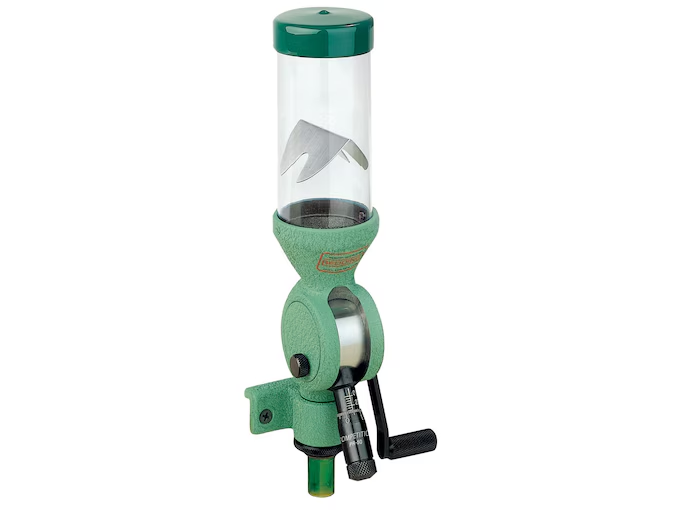
For precision competition loading in 300 Win Mag where single-digit standard deviations are the goal, the recommended approach is a precision auto-dispenser: the RCBS ChargeMaster Supreme, Hornady Auto-Charge Pro, or RCBS MatchMaster all handle large-charge extruded powders reliably. Paired with the Lyman Gen 6 Compact or Frankford Arsenal Precision Digital Scale for final charge verification, this produces the charge-to-charge precision that the powder’s inherent consistency potential can fully exploit.
For hunting load production at moderate volume, the Redding Match Grade 3BR Powder Measure with a Frankford Arsenal Powder Trickler gives adequate precision for field ammunition without the full auto-dispenser setup. The Redding Big Boss II or RCBS Rock Chucker Supreme are appropriate single-stage presses for this workflow.
Reloading Safety Notes
The critical safety consideration for Reloder 26 is temperature-dependent pressure behavior above 85°F. Develop your final loads – the ones you will hunt or compete with – at the highest ambient temperature you expect to encounter. If you are loading for a summer prairie dog hunt or a high-desert sheep hunt in August, your load development sessions must happen at comparable temperatures. Do not validate a load at 55°F in your basement in January and assume it is safe for a 95°F August hunt.
All charge weights must come from current published Alliant load data for Reloder 26 specifically. Do not substitute H1000 or Retumbo charge weights without verification. The higher energy density of Reloder 26 means that charge weights from single-base lower-density powders in the same burn rate range will be too high.
Start 10% below the listed maximum and work up in 0.3-grain increments. In magnum cartridges, pressure can rise steeply in the top few percent of the charge range. Sticky bolt lift is the earliest reliable pressure indicator in bolt-action rifles using this powder class – take it seriously and stop well before primers show other pressure signs.
See the overpressure in reloading guide for systematic pressure sign identification.
The single-base vs. double-base powder overview explains the chemistry behind why Reloder 26’s double-base formulation produces both its velocity advantage and its temperature sensitivity characteristics.
FAQ
Is Reloder 26 safe for summer hunting?
Yes – with the correct load development protocol. Develop and validate your final load at the highest temperature you expect to hunt in, not in cool-weather conditions. If you are hunting in conditions above 85°F, do your final pressure testing at that temperature. A load validated at 95°F is safe year-round. A load validated at 50°F may not be safe at 95°F near maximum charge weights.
How much faster is Reloder 26 than H1000 in 300 Winchester Magnum?
Typically 80-100 fps faster with 200-220 grain bullets at comparable pressure levels. The H1000 trade-off is substantially better temperature stability (0.21 vs 0.5 fps per degree Fahrenheit) and confirmed safe behavior above 85°F. Both are legitimate choices depending on whether velocity or seasonal stability is the higher priority.
Does the decoppering additive eliminate the need for bore cleaning?
No. The tin and bismuth decoppering chemistry reduces the rate at which copper fouling accumulates – it does not eliminate it. In a typical 50-round precision session, copper fouling that would normally begin affecting accuracy at rounds 20-30 may not show until rounds 35-45 with Reloder 26. Full bore cleaning is still required; the interval is extended rather than eliminated.
Can Reloder 26 be used in a gas-operated semi-automatic platform in 300 Win Mag?
Semi-automatic 300 Winchester Magnum platforms exist (LWRC REPR, semi-auto DSR variants, etc.) and Reloder 26 can be used in them with appropriate load development for reliable gas system function. The CCI No. 34 military-spec primer is recommended for its extra-thick cup. Load development in semi-auto gas-gun applications should prioritize function reliability alongside accuracy, and charge weights that produce reliable cycling while staying within pressure limits require specific development for that platform.
What is the shelf life of Reloder 26?
Properly stored in a cool, dry, dark location in a sealed container, Reloder 26 maintains its ballistic characteristics for 10+ years. High temperatures accelerate degradation; do not store powder in a hot garage or a car. Reddish-brown discoloration or a sharp acid smell are signs of powder deterioration – powder showing these signs should be disposed of through appropriate channels rather than loaded.
Conclusion
Alliant Reloder 26 is the right powder when maximum velocity in large-capacity magnum cartridges is the objective and the reloader is prepared to manage the temperature development protocol that its elevated-temperature pressure behavior requires. The 80-100 fps velocity advantage over Hodgdon H1000 at the same pressure level is real, consistent, and meaningful at the distances where the 300 Winchester Magnum and 7mm Remington Magnum are typically deployed in precision hunting and ELR competition. The decoppering chemistry is a genuine practical benefit that extends accuracy intervals between deep cleaning sessions.
The temperature limitation above 85°F is the honest trade-off. It is manageable through correct load development practice, not an inherent flaw – but it requires discipline and awareness that the Hodgdon Extreme series powders do not demand.
Choose Alliant Reloder 26 if you load 300 Winchester Magnum, 7mm Remington Magnum, 6.5 PRC, or 338 Lapua Magnum and prioritize maximum velocity and decoppering benefit, and you will develop loads at realistic field temperatures. Choose Hodgdon H1000 if temperature stability across the full seasonal range – including summer – is more important than peak velocity, or if you shoot in conditions above 85°F and do not want to manage the temperature protocol. Choose Alliant Reloder 33 if you load ultra-large cases like 300 RUM or 338 Lapua where the burn rate is too fast for Reloder 26 at full charge weights.