Published: December 2025 | Last updated: June 2026
Introduction
The Cutting Edge CuRx is the most unusual bullet in this site’s Cutting Edge series: it addresses .22 LR rimfire rather than the centerfire rifle applications of the Cutting Edge ER Raptor, ESP Raptor, FB Raptor, and other Cutting Edge products covered in this site’s rifle bullet series.
The CuRx’s primary market is lead-free rimfire ammunition for California and other jurisdictions where lead projectiles in hunting applications are restricted. In California, the condor zone lead-free mandate applies to all hunting, including small game and varmint hunting where .22 LR is commonly used. The CuRx provides a solid copper alternative to standard lead .22 LR bullets for this application.
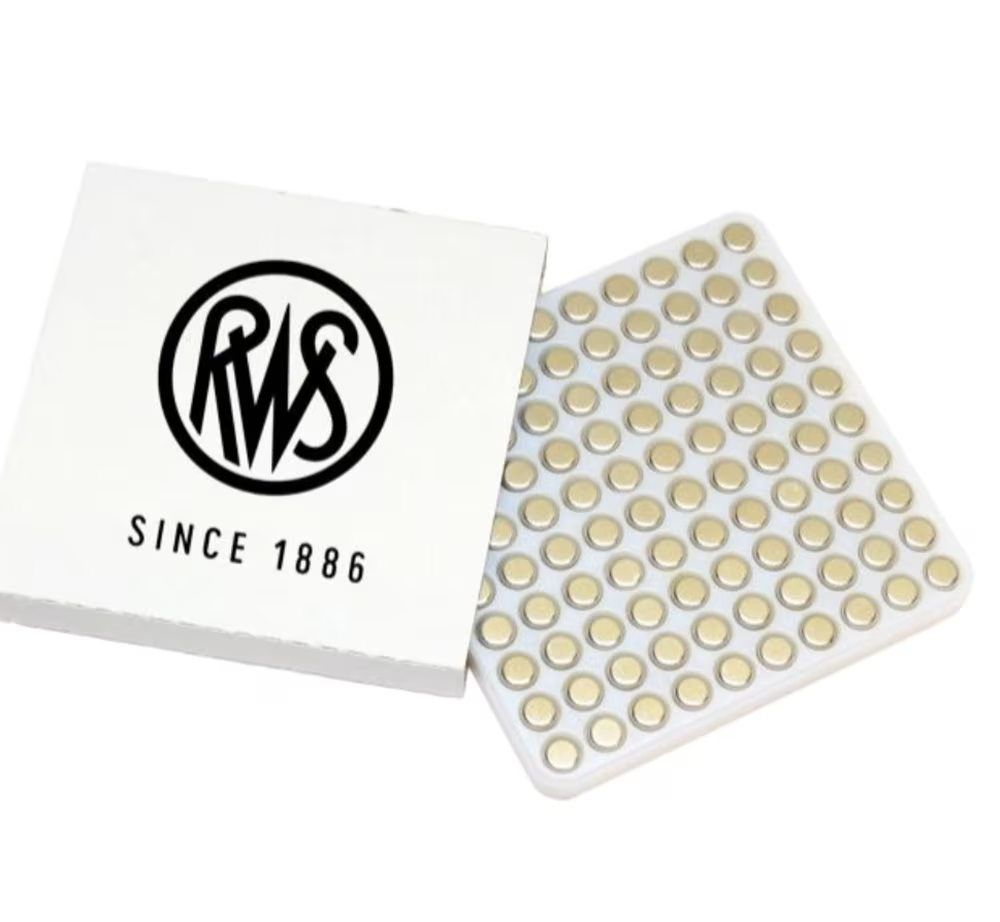
The critical reloading limitation: .22 LR is a rimfire cartridge. The priming compound is contained within the folded rim of the case rather than in a separate primer pocket. This design makes .22 LR cases non-reloadable: the case cannot be reprimed, and the thin rimfire brass is not designed to withstand the resizing required for reloading. This site covers reloading exclusively for centerfire cartridges; .22 LR factory ammunition is purchased and used, not handloaded.
This is a fundamental distinction for myreloading.com readers: the CuRx in .22 LR is a component of commercial ammunition, not a component for handloading. Cutting Edge produces .22 LR ammunition loaded with the CuRx; handloaders cannot purchase CuRx bullets to load into .22 LR brass because .22 LR brass cannot be reloaded. The article coverage here is relevant to: (1) understanding the CuRx’s properties and where it fits relative to other lead-free .22 LR options for purchasing decisions, and (2) potentially using CuRx bullets of this diameter and weight in centerfire .22 caliber cartridges that can be handloaded.
However, the CuRx’s .223-inch bullet diameter and 32-50 grain weight range also make it applicable to centerfire .22 caliber cartridges that this site’s readers do reload: 22 Hornet, 222 Remington, 223 Remington, 22-250 Remington, and 204 Ruger at appropriate bullet diameters. Whether Cutting Edge specifically loads the CuRx for centerfire applications should be confirmed at cuttingedgebullets.com; the 32-50 grain .223-inch range is consistent with light varmint bullet weights in these cartridges.
The comparison bullets cited in the original article – the Hornady NTX and Barnes Varmint Grenade – are appropriate comparisons in the lead-free .22 LR and centerfire small-caliber segment. The “Lehigh Defense XD developmental” entry at .223-inch 28 grains is not a product this site covers; the Lehigh Defense Xtreme Defense covered elsewhere covers larger handgun calibers (.312 and up).
The comparison with Nosler Varmageddon bullets cited in the original article is less appropriate – Nosler Varmageddon is a centerfire varmint bullet in .224 to .308-inch, not a .22 LR product.
Important application note: The Cutting Edge CuRx is primarily a .22 LR rimfire bullet. .22 LR is a rimfire cartridge and cannot be reloaded – the primer is contained within the rim of the case, and .22 LR cases are not designed for the resizing and repriming required for handloading. If you are looking for a solid copper bullet to reload, the CuRx’s .223-inch diameter is also appropriate for centerfire .22 caliber cartridges including 22 Hornet, 222 Remington, and 223 Remington, which are fully reloadable. This article addresses both applications.
Disclaimer: For centerfire .22 caliber handloading with the CuRx: consult Cutting Edge’s own published data. Solid copper generates higher pressures than lead-core bullets at the same charge weight – start 10% below the published minimum. For .22 LR factory ammunition, the CuRx is a component available in Cutting Edge’s factory-loaded offerings.
Technical Characteristics
Monolithic solid copper construction: The CuRx is machined from solid copper rod rather than formed from a lead core and copper jacket. This produces: 100% weight retention on impact (no jacket-core separation); lead-free compliance for California condor zone and other restricted areas; and consistent dimensions from round to round from the machining process.
Pointed design for .22 LR: The CuRx features a streamlined pointed nose profile that improves BC relative to the round-nose bullets traditional in .22 LR. Standard lead .22 LR bullets use round-nose or flat-nose profiles with BC values typically in the 0.040-0.080 range; the CuRx’s pointed solid copper profile achieves BC 0.105-0.214 depending on weight, which is substantially higher for this bore diameter.
The BC improvement from a pointed versus round-nose profile matters most in wind-sensitive applications. At .22 LR velocities (1,000-1,300 fps), a BC of 0.100 versus a BC of 0.040 produces meaningful differences in wind drift at ranges beyond 50 yards – approximately 30-40% less wind drift at 100 yards. For varmint hunting in wind where the shooter cannot always wait for a lull, this BC improvement is practically useful. For plinking inside 50 yards where wind drift is small regardless of BC, the improvement is academic.
SealTite Band: Cutting Edge’s proprietary single or multi-groove band system reduces bore contact area, lowering fouling relative to full-bearing-surface solid copper designs. The 15-20% fouling reduction claimed in the original article is directional for this comparison; copper fouling is actually less problematic than lead fouling in rimfire barrels at the powder-charge levels used in .22 LR, but any reduction extends cleaning intervals for volume shooters.
The context for fouling in .22 LR is different from centerfire: .22 LR uses priming compound chemistry and very small powder charges that produce different fouling residues than centerfire rifles. Lead fouling from standard .22 LR bullets is the primary cleaning concern in rimfire barrels; the CuRx eliminates this lead fouling entirely since the bullet contains no lead. For high-volume shooters who fire thousands of rounds per range session, the elimination of lead fouling from the bullet may have more practical significance than the 15-20% reduction in copper fouling from the SealTite bands.
Twist rate requirements: The CuRx requires faster twist rates than standard lead .22 LR bullets because solid copper bullets are longer than equivalent-weight lead bullets (copper is less dense than lead). For the weights available (32, 42, 50 grains), the appropriate twist rates are approximately 1:16 for 32-grain, 1:10 for 42-grain, and 1:6-1:8 for 50-grain. These faster twists are uncommon in standard .22 LR rifle barrels, which typically come 1:16 twist for standard-weight lead bullets. Shooters should confirm their barrel’s twist rate before using the 42-grain or 50-grain CuRx.
Velocity range (1,000-1,300 fps): This corresponds to the standard .22 LR subsonic and standard velocity range. High-velocity .22 LR loads at 1,200-1,280 fps are within this range. .22 LR Magnum (.22 WMR) at 1,500-1,900 fps is outside this range and a different cartridge entirely.
Ballistics and Performance
G1 BCs from 0.105 to 0.214 span the CuRx lineup from the 32-grain to 50-grain. These BCs are substantially higher than typical lead .22 LR bullet BCs, primarily because the CuRx’s pointed profile is more aerodynamically efficient than the round-nose or flat-nose lead bullets it replaces.
The 32-grain .223-inch at BC 0.105 and SD 0.091 is the lightest CuRx entry, appropriate for standard .22 LR barrels with 1:16 twist and for plinking and small varmint applications. At SD 0.091, penetration depth is modest but adequate for small game (squirrels, rabbits, rats) at .22 LR velocities.
The 42-grain .223-inch at BC 0.187 and SD 0.119 provides meaningfully higher BC and SD than the 32-grain, requiring a faster barrel twist (approximately 1:10) for reliable stabilization. The BC jump from 0.105 to 0.187 between 32 and 42 grains reflects the longer, more aerodynamically efficient shape of the heavier bullet. At standard .22 LR high-velocity loads (approximately 1,200 fps), the 42-grain CuRx retains approximately 87% of its muzzle velocity at 100 yards due to its higher BC – compared to roughly 78% retention for a standard round-nose lead bullet at the same distance. For varminting at 75-100 yards where the velocity differential matters, the 42-grain CuRx provides the best balance of twist-rate accessibility and improved aerodynamic performance within the CuRx lineup.
The 50-grain .223-inch at BC 0.214 and SD 0.142 is the heaviest CuRx entry, requiring 1:6-1:8 twist for reliable stabilization – a very fast twist uncommon in standard .22 LR sporting rifles. At BC 0.214, the 50-grain CuRx is among the highest-BC bullets available in .22 LR applications. The SD 0.142 provides more substantial penetration depth than the lighter entries, making this weight appropriate for larger varmints.
Expert Ballistics Table – Cutting Edge CuRx Variants
Data from Cutting Edge specifications. BCs are G1. The .223-inch diameter accommodates .22 LR rimfire applications. For centerfire use, verify compatibility with your specific cartridge at cuttingedgebullets.com.
| Diameter (inches) | Weight (grains) | BC (G1) | Sectional Density | Twist Required | Application |
|---|---|---|---|---|---|
| .223 | 32 | 0.105 | 0.091 | 1:16 | .22 LR plinking, small varmint |
| .223 | 42 | 0.187 | 0.119 | 1:10 | .22 LR medium varmint |
| .223 | 50 | 0.214 | 0.142 | 1:6-1:8 | .22 LR / centerfire large varmint |
Comparison Bullets
The lead-free .22-caliber bullet category is smaller than the lead-core category. The primary comparisons are:
The Hornady NTX is Hornady’s lead-free polymer-tipped .22 caliber bullet for both rimfire and centerfire applications. The NTX is specifically designed for California-compliant varmint hunting with expansion at .22 centerfire velocities. In .22 LR applications at lower velocities, the NTX’s expansion mechanism may not fully initiate, making the CuRx’s non-expanding solid copper design more reliable for terminal performance at .22 LR velocity levels. For centerfire applications where velocities are 2,500+ fps, the NTX’s polymer-tip expansion advantage becomes more relevant compared to the CuRx’s non-expanding design; centerfire varminters choosing between these two lead-free options should consider whether expansion or penetration consistency is the higher priority for their application.
The Sierra BlitzKing and Sierra Varminter are lead-core comparison bullets in .22 centerfire applications that do not meet California lead-free requirements but provide the baseline for accuracy and terminal performance comparison in centerfire cartridges.
The Hornady V-MAX and Nosler Varmageddon are lead-core varmint bullets in .22 centerfire calibers, providing performance reference for what the CuRx replaces in those applications.
The Barnes Varmin-A-Tor is Barnes’ solid copper varmint bullet in .22 centerfire calibers, the closest direct competitor in the lead-free centerfire .22 space. The Nosler Varmageddon Explosive is a lead-core varmint alternative. The Cutting Edge HG Raptor and Cutting Edge HG Solid complete the within-brand Cutting Edge comparison set for handgun and large-bore rifle applications.
Comparison Table – Lead-Free .22 Caliber Options
| Bullet | Caliber | BC Range | Construction | Expansion |
|---|---|---|---|---|
| Cutting Edge CuRx | .22 LR / CF | 0.105-0.214 | Solid copper, SealTite | None |
| Hornady NTX | .22 LR / CF | ~0.120-0.150 | Compressed poly tip | Limited |
| Barnes Varmin-A-Tor | .22 CF | ~0.200-0.280 | Solid copper | None (frangible) |
| Berger Varmint Explosive | .22 CF | 0.180-0.229 | Lead core, thin jacket | Explosive |
Applications and Practical Aspects
California-compliant .22 LR hunting: The primary application for the CuRx is lead-free small game and varmint hunting in California and other lead-restricted jurisdictions. Squirrel, rabbit, and similar small game; crow and raven pest control; ground squirrel varminting at .22 LR ranges (inside 100 yards). The 32-grain for small targets where minimal pelt or hide damage is preferred (pelting hunters may value the non-expanding CuRx for this reason); the 42-grain for standard small game; the 50-grain for larger varmints like jackrabbits or coyotes at close range where .22 LR is appropriate. For California hunters, the CuRx is one of the very few options that combines the accessibility and low cost of .22 LR with full lead-free compliance. See the small game and varmint caliber guide for broader context on caliber selection in this application.
Centerfire .22 caliber handloading: For handloaders who want a solid copper non-expanding varmint bullet in centerfire .22 cartridges, the CuRx’s .223-inch diameter and 32-50 grain weights may apply. Relevant centerfire applications include:
- 22 Hornet: 32-45 grain bullets are standard for the 22 Hornet’s modest case capacity. The CuRx’s 32 and 42-grain weights are appropriate for this cartridge. At typical 22 Hornet velocities (2,600-2,900 fps with light bullets), the CuRx’s solid copper design produces a flat trajectory for varmint work inside 200 yards. Verify Cutting Edge’s CuRx data for 22 Hornet specifically, as solid copper generates more pressure than lead-core at the same charge in this small case. See 22 Hornet ballistics and 17 Hornet vs 22 Hornet comparison for caliber context.
- 222 Remington: The 222 Rem is among the most accurate .22 centerfire cartridges ever produced. Light bullets (32-50 grains) at high velocity produce excellent varmint performance inside 300 yards. The CuRx’s solid copper non-expanding design is appropriate for California-compliant varminting in this cartridge. See 222 Remington ballistics for trajectory context.
- 223 Remington: 35-55 grain bullets are standard varmint weights in 223 Remington. At 2,800-3,200 fps for 45-50 grain bullets, the CuRx achieves excellent flat trajectories for varminting inside 300 yards. The 223 Remington’s widespread availability and gas-gun compatibility (AR-15) make it the most likely centerfire platform for handloaders looking to use the CuRx as a reloadable component. See 223 Remington ballistics for trajectory context with light varmint bullet weights.
- 22-250 Remington: Higher velocity .22 centerfire for longer-range varminting. See 22-250 Remington ballistics and 243 Winchester vs 22-250 Remington comparison for context on where 22-250 fits in the varmint cartridge spectrum. The 50-grain CuRx may apply at appropriate twist rates.
- 22 Nosler, 22 ARC, 224 Valkyrie, and 22 Creedmoor are modern .22-caliber cartridges using .224-inch bullets; confirm CuRx compatibility for each at cuttingedgebullets.com. See also 223 Remington ballistics for light .22 caliber bullet trajectory context.
- 204 Ruger: Uses .204-inch bullets, NOT .223-inch – the CuRx does NOT apply to 204 Ruger. The .204-inch bore is distinct from .22 caliber (.223-.224 inch). See 204 Ruger ballistics.
Powders for centerfire applications (if using CuRx in centerfire): For 32-50 grain .224-inch bullets in .22 caliber centerfire cartridges, faster-burning rifle powders are appropriate. For small-capacity cases (22 Hornet): Hodgdon Benchmark, Hodgdon H322, Alliant Reloder 7, IMR 4198, Hodgdon H4198. For medium-capacity cases (222 Rem, 223 Rem): Hodgdon CFE 223, Alliant Power Pro Varmint, Vihtavuori N120, Accurate 2015, Hodgdon Varget, and [Alliant AR-Comp](https://myreloading.com/alliant-ar-comp/ for 223 Remington). Use Cutting Edge’s own CuRx data, not lead-core starting points. See 22 ARC handloaders guide, develop a custom 22 ARC load, your first 22 ARC handload, and best bullets for 22 ARC for additional context on .22 caliber centerfire load development. The 22 GT is another modern .22 caliber centerfire that may be compatible. The Hornady CX 50-grain 223 review demonstrates solid copper performance in .223 Remington at comparable bullet weights.
Frequently Asked Questions
Q: Can I reload .22 LR ammunition using the CuRx bullet?
A: No. .22 LR is a rimfire cartridge – the priming compound is contained within the folded rim of the case, and the brass is not designed for repriming or resizing. .22 LR cannot be reloaded; this is a fundamental characteristic of rimfire ammunition design. The CuRx is used in factory-loaded .22 LR ammunition from Cutting Edge or in centerfire .22 caliber cartridges (22 Hornet, 222 Remington, 223 Remington) that can be handloaded. If you are looking for a solid copper bullet for handloading, the CuRx’s .223-inch diameter applies to these centerfire cartridges; verify specific product availability and load data at cuttingedgebullets.com.
Q: Why does the CuRx require faster twist rates than standard .22 LR bullets?
A: Copper is less dense than lead. A 40-grain solid copper bullet must be longer than a 40-grain lead bullet to achieve the same weight, because the copper occupies more volume. A longer bullet requires a faster rifling twist to achieve adequate gyroscopic stabilization – this is why solid copper bullets in any caliber typically require faster twist than their lead-core counterparts at the same weight. The 50-grain CuRx’s requirement for 1:6-1:8 twist in .22 LR is a significant constraint because most .22 LR rifles are produced with 1:16 twist for standard lead bullets. Before purchasing the 42-grain or 50-grain CuRx for an existing .22 LR rifle, confirm your barrel’s twist rate.
The practical implication is that the CuRx is most accessible for shooters with newer or custom-barreled .22 LR rifles with faster twists. The 32-grain CuRx’s 1:16 twist compatibility means it works in most standard .22 LR rifles; the 42 and 50-grain entries require verification. Many serious rimfire competition rifles come with faster twist barrels that accommodate the 42-grain well. The 50-grain at 1:6-1:8 twist is primarily appropriate for rifles specifically built for heavy .22 LR loads.
Q: How does the CuRx perform compared to standard lead .22 LR bullets at the same velocity?
A: The CuRx’s solid copper non-expanding construction produces different terminal performance from standard lead .22 LR bullets. Lead .22 LR bullets typically deform on impact, producing a slight mushroom or fragmentation that creates a larger wound channel than the bullet’s original diameter. The CuRx does not expand – its solid copper construction maintains its profile on impact. For small game where the lead bullet’s deformation is part of the desired terminal performance, the CuRx may produce cleaner but narrower wound channels. For pest control where rapid disabling is less critical than lead-free compliance, this distinction matters less.
A useful way to understand this difference: a standard .22 LR hollow-point at 1,200 fps on a squirrel produces an expanded bullet diameter of approximately 0.30-0.35 inches – about 35-55% larger than the original .223-inch diameter. The CuRx at the same velocity maintains 0.223 inches throughout penetration. The hollow-point’s larger wound channel from expansion is the reason most hunters prefer expanding bullets for small game; the CuRx’s lead-free compliance is the reason to accept the non-expanding trade-off.
Q: Is the CuRx available in .22 WMR (.22 Magnum) as well?
A: The original article covers only .22 LR at 1,000-1,300 fps. .22 WMR uses a larger case and bullet (.224-inch diameter, 1,500-1,900 fps) and is a different cartridge. Verify with Cutting Edge whether CuRx products extend to .22 WMR applications. The bullets’ .223-inch diameter (as specified in the article) is slightly undersized for .22 WMR’s .224-inch groove diameter; however, many .22 LR bullets are .223-inch and function adequately in .22 WMR bores.
Q: Does the CuRx expand for game harvest?
A: No. The CuRx is a non-expanding solid copper bullet. For small game hunting where clean one-shot kills are important, this matters: the CuRx relies on solid-profile wound channel rather than hydraulic expansion for terminal effect. At .22 LR velocities (1,000-1,300 fps) with a non-expanding bullet, the primary wound channel is approximately the bullet’s diameter (0.223 inches). This is appropriate for head shots on squirrels and rabbits or body shots at close range where bullet placement is precise. It is not appropriate for body shots on game where the larger wound channel from an expanding or fragmenting bullet is needed for reliable rapid harvest.
Q: Is the CuRx appropriate for .204 Ruger reloading?
A: No. 204 Ruger uses .204-inch diameter bullets. The CuRx is .223-inch diameter. These are different bore sizes; a .223-inch bullet cannot be used in a .204-inch bore. The 204 Ruger is a 20-caliber cartridge (.204-inch bore), not a .22 caliber cartridge. See the 204 Ruger guide for lead-free options specific to that caliber.
Conclusion
The Cutting Edge CuRx occupies a specific and defensible niche in lead-free small-caliber shooting: a solid copper machined bullet for .22 LR rimfire and potentially centerfire .22 caliber applications, providing California-compliant lead-free performance with Cutting Edge’s SealTite Band fouling reduction for volume shooters.
In the broader context of this site’s bullet series, the CuRx is both the smallest-caliber bullet covered (.223-inch versus the next-smallest entries at .224-inch in centerfire varmint contexts) and the only bullet addressed primarily in a non-reloadable rimfire context. This makes the CuRx article a natural bridge for readers who use .22 LR for small game and varmints and are also reloaders of centerfire cartridges – the CuRx speaks to both communities, with the rimfire community purchasing factory CuRx ammunition and the centerfire community potentially using CuRx bullets as handloading components in 22 Hornet, 222 Remington, 223 Remington, and similar cartridges.
This site’s coverage of the CuRx is therefore somewhat different from all other bullet articles: it is primarily a purchasing guide for .22 LR factory ammunition rather than a handloading guide, with a secondary handloading section that applies if Cutting Edge’s CuRx bullets are available as centerfire components.
For .22 caliber centerfire reloaders exploring lead-free options, the 22 ARC vs 224 Valkyrie vs 22 Nosler comparison, 17 Hornet vs 22 Hornet comparison, and 22 WMR vs 17 HMR comparison provide caliber selection context for the small-caliber shooting category where the CuRx applies.
The primary editorial correction from the original article: .22 LR cannot be reloaded, and the original article’s “Reloading” section is inapplicable to the rimfire application. The reloading context applies only if the CuRx is used in centerfire .22 caliber cartridges, where standard solid copper loading principles apply: use Cutting Edge’s own CuRx data, start 10% below the published minimum, and do not substitute lead-core data.
Choose the CuRx if: you hunt small game or varmints in California or other lead-restricted areas with a .22 LR platform; you want a solid copper non-expanding lead-free bullet in .22 LR for plinking where lead at the range is a concern; or you are loading centerfire .22 caliber cartridges (22 Hornet, 222 Rem, 223 Rem) and want solid copper lead-free performance. Confirm your barrel’s twist rate before purchasing the 42 or 50-grain weights.
Choose the Hornady NTX instead if: you want a lead-free .22 caliber option with some expansion potential for faster game harvest. The Hornady NTX provides limited expansion capability that the CuRx’s solid copper design does not.
Choose a lead-core option instead if: you are not in a lead-restricted area and prioritize the wide range of accuracy data and terminal performance documentation available for standard lead and lead-core jacketed .22 LR and .22 centerfire options.
Disclaimer: .22 LR is not reloadable; do not attempt to reload .22 LR brass. For centerfire .22 caliber applications with the CuRx: use Cutting Edge’s published data; begin 10% below the published minimum; confirm twist rate compatibility for the specific weight. Lead-free; compliant with California and all lead-restricted areas. Wear eye protection at all times. The author and myreloading.com are not responsible for injuries or property damage from any shooting activities.