Published: 2026 | Last updated: May 2026
Hodgdon H4831SC is a slow-burning, single-base short-cut extruded powder from the Hodgdon Extreme series – the short-cut version of the original H4831 formulation, engineered to address the metering inconsistency of long-grain slow-rifle powders while preserving the temperature stability and ballistic profile that made H4831 a benchmark for magnum cartridge loading.
The “SC” designation means exactly what it says: Short Cut. The grain length was reduced to improve metering performance in standard powder measures. The internal chemistry, deterrent package, and Extreme series temperature stability are the same as the original H4831 – only the grain geometry changed.
Burn rate positioning must be stated clearly upfront: H4831SC burns faster than IMR 4831 – not slower. It also burns faster than Hodgdon H4350 is incorrect – H4831SC is slower than H4350. The correct position: H4831SC sits between Hodgdon H4350 (faster) and Hodgdon H1000 (slower), at a distinctly slow burn rate appropriate for 270 Winchester, 7mm Remington Magnum, and standard belted magnums. The original article’s description of H4831SC as “slightly slower than H4350” is correct – the confusion in the article comes from an inconsistent comparison table. H4831SC is slower than H4350, not faster.
This article is based on published manufacturer specifications, established load data, and documented field reports. Specifications and performance figures can vary between lots, rifles, and conditions. If you have loaded Hodgdon H4831SC in practice – leave a comment below: real-world experience from the reloading bench is what separates verified data from manufacturer claims.
Powder Description and Technical Profile
Hodgdon H4831SC is a single-base, short-cut extruded powder. The single-base formulation – nitrocellulose without nitroglycerin – is the chemical basis for the Extreme series stability advantage and the clean-burning behavior at high pressures.
The short-cut grain geometry is the defining improvement over the original long-grain H4831. Traditional long-stick slow-rifle powders bridge in small-caliber drop tubes, shear at the drum edge during metering, and pack inconsistently in the case. The shortened grain geometry of H4831SC reduces these behaviors. On quality volumetric equipment, ±0.1-0.15 grain charge-to-charge variance is consistently achievable – meaningfully better than long-cut alternatives at the same burn rate, though still not at ball powder metering precision.
The Extreme series deterrent coating is the mechanism behind the documented temperature stability. The coating regulates the initial ignition phase across temperature extremes, producing the ~0.3-0.5 fps/°F variation that Extreme series powders are known for. This is approximately 3-6x better seasonal stability than standard technology slow-rifle powders like Alliant Reloder 22 (~1.5-2.0 fps/°F) or IMR 4831 (~0.6-1.0 fps/°F).
Bulk density is approximately 0.875 g/cc – typical for short-cut extruded powders at this slow burn rate. The original article’s range of “0.940-0.980 g/cc” is significantly too high for an extruded powder at this burn rate; these figures are more consistent with high-density ball powders. At 0.875 g/cc, H4831SC provides good case fill in the medium-to-large magnum cases where it operates most efficiently.
The linear progressive pressure curve is the internal ballistics characteristic most discussed in the context of H4831SC’s accuracy reputation. Pressure builds gradually through the powder column, producing a “sustained push” rather than a sharp pressure spike. In overbore cartridges where pressure can spike erratically with faster alternatives, this linear progression provides load development stability.
Strengths:
- Extreme series temperature stability (~0.3-0.5 fps/°F) – the primary practical advantage; a hunter zeroing at 70°F who hunts in 10°F mountains sees approximately 18-30 fps velocity shift – negligible at any practical hunting distance
- Short-cut geometry meters at ±0.1-0.15 grains – substantially better than the original long-cut H4831 and traditional long-stick magnum powders
- Linear progressive pressure curve – forgiving load development in overbore magnum cartridges; pressure signs appear gradually
- Single-base clean burning – less carbon residue than double-base alternatives at equivalent pressures
- Ideal burn rate position for 270 Winchester with heavy bullets, 7mm Remington Magnum, and standard belted magnums
- Deep published data library in all major North American reloading manuals
Limitations:
- Too slow for standard cartridges – in 223 Remington, 308 Winchester, and similar standard-capacity cases, H4831SC produces poor combustion efficiency and elevated extreme spread
- Short-cut still not at ball powder metering levels – ±0.1-0.15 grain is good for extruded but does not reach Accurate 2520’s ±0.04-0.07 grain ball geometry performance
- Single-base energy density lower than double-base alternatives like Alliant Reloder 22 at the same burn rate – slightly less velocity per grain; the Extreme stability is the specific reason to accept this
- Large case applications at the slow limit – in 50 BMG and the very largest Ultra Magnum cases, H4831SC may be too fast; Hodgdon US 869 is more appropriate
Technical Characteristics
| Property | Specification |
|---|---|
| Manufacturer | Hodgdon Powder Company |
| Series | Hodgdon Extreme |
| Type | Single-Base Short-Cut Extruded |
| Bulk Density (g/cc) | ~0.875 |
| Grain Shape | Short Cylindrical |
| Coating | Graphite + Extreme Series Deterrent |
| Burn Rate Category | Slow Rifle / Standard Magnum |
| Temperature Stability | ~0.3-0.5 fps / °F (Extreme series) |
Burn Rate Positioning – The 4831/H4350/H1000 Relationship
The three critical burn rate relationships for H4831SC:
| Powder | Type | Density (g/cc) | Burn Rate vs H4831SC | Stability |
|---|---|---|---|---|
| Hodgdon H4350 | SB Short-Cut | 0.860 | Faster | Extreme |
| IMR 4451 Enduron | SB Short-Cut | 0.909 | Faster | Enduron |
| IMR 4831 | SB Long-Cut | 0.885 | Slower | Standard |
| Hodgdon H4831SC | SB Short-Cut | 0.875 | Reference | Extreme |
| Alliant Reloder 22 | DB Extruded | 0.930 | Slower | Standard |
| Alliant Reloder 23 | DB Extruded | 0.960 | Slower | Partial |
| Hodgdon H1000 | SB Extruded | 0.910 | Much Slower | Extreme |
Three clarifications from this table:
H4831SC is faster than IMR 4831, not slower. A commonly confused relationship. IMR 4831 burns slower – typically 2-4 positions slower on the Hodgdon chart. Never apply IMR 4831 charge weights to H4831SC; the H4831SC burns faster and will produce higher pressure at IMR 4831’s charge weights.
H4831SC is slower than H4350. H4350 is in the medium-slow class; H4831SC is distinctly slow. In cartridges where both are documented (270 Winchester, 25-06 Remington), H4350 with lighter bullets and H4831SC with heavier bullets is the typical guidance – the slower burn of H4831SC becomes more efficient as bullet weight and seating depth increase.
H4831SC is faster than H1000. Hodgdon H1000 occupies the next-slower position for ultra-magnums and very large cases. H4831SC is more appropriate for standard magnum cases; H1000 for the ultra-magnums.
Temperature Stability – What 0.3-0.5 fps/°F Means in Practice
~0.3-0.5 fps per degree Fahrenheit is the documented Extreme series performance for H4831SC. To translate this into field-use terms:
A 7mm Remington Magnum load developed at 70°F producing 2,950 fps with 160-grain Berger VLD Hunting will produce approximately:
- At 10°F (60°F colder, mountain hunting scenario): 2,950 – (60 x 0.4) = approximately 2,926 fps – 24 fps slower
- At 400 yards: approximately 0.3 inches of additional drop versus summer zero
The same load with Alliant Reloder 22 (~1.7 fps/°F average):
- At 10°F: 2,950 – (60 x 1.7) = approximately 2,848 fps – 102 fps slower
- At 400 yards: approximately 1.5 inches of additional drop
Both are manageable for responsible hunting shots at 400 yards. But the H4831SC load requires no seasonal adjustment. The Reloder 22 load benefits from a temperature-corrected drop chart.
| Powder | 60°F Swing | At 300 yards | At 500 yards |
|---|---|---|---|
| Hodgdon H4831SC | ~18-30 fps | <0.5″ | ~1″ |
| Alliant Reloder 23 | ~30-42 fps | ~0.5″ | ~1.5″ |
| IMR 4831 | ~36-60 fps | ~1″ | ~2″ |
| Alliant Reloder 22 | ~90-120 fps | ~2″ | ~3.5″ |
Burn Rate Comparison and Competing Powders
vs. Alliant Reloder 22: Reloder 22 is a double-base powder at a slightly slower burn rate with 1.5-2.0 fps/°F sensitivity – approximately 3-6x more seasonal variation than H4831SC. It produces higher velocity from its double-base energy content. For maximum velocity with accepted seasonal variation protocol, Reloder 22 is a velocity-priority choice. For year-round consistency without load recalibration, H4831SC is the stability-priority choice.
vs. Alliant Reloder 23: Reloder 23 is a double-base powder at a slower burn rate with partial temperature-stabilizing additives – approximately 0.5-0.7 fps/°F, better than Reloder 22 but not quite at Extreme series levels. It is specifically documented for 338 Lapua Magnum ELR loads where H4831SC’s burn rate is slightly fast. In H4831SC’s primary applications (7mm Remington Magnum, 270 Winchester), H4831SC’s Extreme series stability is meaningfully better.
vs. IMR 4831: IMR 4831 burns slower than H4831SC (despite the shared name) with standard temperature stability (~0.6-1.0 fps/°F). It has a long-cut grain geometry that meters with ±0.3-0.5 grain variance versus H4831SC’s ±0.1-0.15 grains. The Extreme series stability of H4831SC is the specific reason to prefer it over IMR 4831 in any shared application. Charge weights are not interchangeable.
vs. Vihtavuori N165: N165 is a single-base extruded powder at a comparable burn rate – clean burning from single-base chemistry, somewhat lower density (0.920 g/cc), and temperature stability comparable to but typically not quite at Extreme series levels. For European market access or shooters who value Vihtavuori’s manufacturing consistency above Extreme series stability, N165 is a legitimate alternative. In the North American market, H4831SC is more widely documented.
vs. Hodgdon H4350: H4350 burns faster and is better matched for lighter-weight bullets in the same cartridges. In 270 Winchester: H4350 is more appropriate for 130-140 grain bullets; H4831SC becomes better matched at 150-160 grain heavy bullets where effective case volume decreases. Both are Extreme series – the choice follows bullet weight.
Recommended Cartridges and Applications
Hodgdon H4831SC is most efficiently used in medium-to-large capacity magnum and standard long-action cases with standard-to-heavy-for-caliber bullets.
| Cartridge | Bullet Weight Range | Notes |
|---|---|---|
| 270 Winchester | 140-160 gr | Heavy-bullet applications |
| 25-06 Remington | 100-120 gr | Full application range |
| 7mm Remington Magnum | 154-175 gr | Primary magnum application |
| 300 Winchester Magnum | 165-200 gr | Heavy hunting and match loads |
| 6.5-284 Norma | 140-160 gr | ELR competition |
| 284 Winchester | 150-175 gr | F-Class competition |
| 270 Weatherby Magnum | 140-160 gr | Overbore hunting |
| 7mm WSM | 150-175 gr | Short-action magnum |
| 280 Remington | 150-175 gr | Heavy-bullet hunting |
| 7×64 Brenneke | 150-175 gr | European hunting standard |
270 Winchester with 140-160 grain heavy bullets is where H4831SC’s Extreme series stability is most practically valuable for hunters – the same load that patterns at 70°F on the pre-hunt range will hit where expected at 10°F during a November elk hunt. The original article’s loading density guidance (aim for 90-95% case fill) is sound practical advice for this cartridge.
7mm Remington Magnum is the core magnum application. With 160-175 grain high-BC bullets for western hunting, H4831SC delivers the consistent velocities and progressively linear pressure that produce the low extreme spread that long-range hunting accuracy requires.
300 Winchester Magnum with 180-200 grain heavy bullets is documented and appropriate. For 300 Win Mag with standard 150-180 grain bullets, Hodgdon H4350 or Alliant Reloder 22 are typically better burn rate matches. H4831SC becomes more appropriate as bullet weight increases.
7mm-08 Remington with 160-175 grain bullets is at the edge of what H4831SC can do efficiently in this smaller case – the burn rate may be slightly slow for 7mm-08 Remington with standard 140-154 grain bullets; verify from current Hodgdon published data for your specific bullet weight.
Bullets
Hodgdon H4831SC is specifically matched to high-BC hunting and competition bullets in standard magnum bore sizes.
| Brand | Model | Weight | Cartridge | Application |
|---|---|---|---|---|
| Nosler | AccuBond | 140-200 gr | 270 Win / 7mm Rem Mag / 300 Win Mag | Bonded Hunting |
| Nosler | Partition | 140-200 gr | 270 Win / 7mm Rem Mag | Classic Big Game |
| Sierra | GameKing | 130-180 gr | 270 Win / 7mm Rem Mag | Traditional Hunting |
| Hornady | ELD-X | 143-212 gr | 7mm Rem Mag / 300 Win Mag | Long-Range Hunting |
| Berger | VLD Hunting | 140-210 gr | 7mm Rem Mag / 6.5-284 Norma | Long-Range Hunting |
| Berger | Hybrid Target | 155-185 gr | 284 Win / 6.5-284 Norma | F-Class / ELR |
| Barnes | LRX | 127-168 gr | 270 Win / 7mm Rem Mag | Lead-Free Hunting |
| Barnes | TTSX | 130-168 gr | 270 Win / 7mm Rem Mag | Lead-Free Hunting |
| Sierra | Tipped MatchKing | 150-175 gr | 7mm Rem Mag / 284 Win | Competition |
| Lapua | Scenar | 155-170 gr | 6.5-284 Norma / 284 Win | ELR Competition |
Have you loaded Hodgdon H4831SC? Your practical data on charge weights, accuracy nodes, seasonal temperature performance, or comparison with IMR 4831 or Reloder 22 helps other reloaders more than any spec sheet. Leave a comment below.
Primers
Hodgdon H4831SC as a slow-burning single-base powder in large-capacity magnum cases typically benefits from large rifle magnum primers. Standard large rifle primers work adequately in medium-capacity cases at moderate temperatures, but magnum primers improve consistency in large-capacity magnums at maximum charges and in cold conditions below 20°F.
| Primer | Type | Application |
|---|---|---|
| Federal GM210M | Large Rifle Match | Competition precision – gold standard |
| CCI BR-2 | Large Rifle Benchrest | Competition lowest SD |
| CCI 200 | Large Rifle Standard | 270 Win, 25-06 standard loads |
| Federal 210 | Large Rifle Standard | Consistent general use |
| Winchester WLR | Large Rifle Standard | Hunting loads general use |
| CCI 250 | Large Rifle Magnum | 7mm Rem Mag, 300 Win Mag, cold weather |
| Federal 215 | Large Rifle Magnum | Maximum ignition large magnum cases |
| Winchester WLRM | Large Rifle Magnum | Magnum hunting loads versatile |
| Remington 9-1/2M | Large Rifle Magnum | Traditional magnum choice |
| RWS 5337 | Large Rifle Magnum | Premium European competition |
| Fiocchi Large Rifle Magnum | Large Rifle Magnum | Consistent European alternative |
| Ginex Large Rifle | Large Rifle Standard | Cost-effective general use |
The original article listed “RWS 5333” as a large rifle magnum primer. The correct RWS large rifle magnum designation is RWS 5337. Verify from current RWS product documentation before ordering.
The original article’s “Pro Tip” about switching to a milder primer to reduce standard deviation in near-maximum loads is counterintuitive and not standard reloading practice. If extreme spread is elevated near maximum charge weight, the primary remedy is charge weight adjustment, seating depth optimization, or case preparation improvement – not primer reduction, which can produce incomplete powder ignition.
Metering and Equipment Compatibility
Hodgdon H4831SC’s short-cut geometry is the practical improvement over the original long-grain H4831. On quality volumetric equipment, ±0.1-0.15 grain variance is consistently achievable – adequate for hunting ammunition and a significant upgrade from long-grain alternatives.
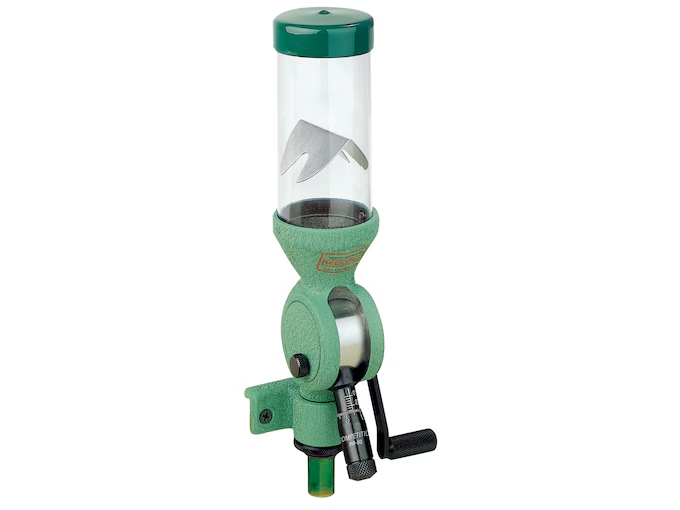
For precision single-stage hunting and competition loading, the workflow that eliminates volumetric variance entirely: throw slightly under target weight with a Redding Match Grade 3BR or similar quality measure, then trickle to exact weight with a Frankford Arsenal Powder Trickler on a RCBS MatchMaster or Lyman Gen 6 Compact. This achieves ±0.02 grain consistency.
For auto-dispenser loading, the RCBS ChargeMaster Supreme and Hornady Auto-Charge Pro handle the short-cut grains well. Dispensing time is longer than ball or fine-grain alternatives, but charge accuracy is equivalent.
Reloading Safety Notes
All charge weights must come from current published Hodgdon load data for H4831SC specifically. Do not substitute IMR 4831 charge weights – H4831SC burns faster and produces higher pressure at IMR 4831 charge weights. Do not substitute Alliant Reloder 22 or Hodgdon H4350 charge weights without independent verification.
Temperature protocol: the Extreme series stability means seasonal pressure variation is minimal – this is a genuine advantage, not a guarantee. Still develop maximum charges at the highest expected firing temperature.
Start 10% below the listed maximum and work up in 0.3-grain increments for standard magnums, 0.5-grain for large magnums. Watch for flattened primers, stiff bolt lift, ejector marks.
See the overpressure in reloading guide for systematic pressure sign identification.
FAQ
Is H4831SC and IMR 4831 the same burn rate?
No – H4831SC burns faster than IMR 4831, typically 2-4 positions faster on the Hodgdon relative chart. They share a name coincidence from different development histories, not a formulation connection. H4831SC carries Extreme series temperature stability; IMR 4831 does not. Charge weights are not interchangeable in either direction.
Is H4831SC better than Alliant Reloder 22 for 7mm Remington Magnum?
Different trade-offs. Reloder 22 is a double-base powder that produces higher velocity from its nitroglycerin energy content – typically 30-50 fps more at equivalent pressures. H4831SC produces 3-6x better temperature stability across seasonal swings. For a hunter who hunts at consistent temperatures and wants maximum velocity, Reloder 22 is competitive. For a hunter who shoots the same load from 85°F summer practice to 0°F winter hunting without recalibration, H4831SC is the more reliable performer.
What is the case fill target for H4831SC in 270 Winchester?
The 90-95% case fill guidance in the original article is sound for 270 Winchester with H4831SC. Near-complete case fill in the 270 Winchester case eliminates position sensitivity and typically correlates with the lowest extreme spread. If working charge weights produce less than 88-90% case fill, a slightly faster powder like Hodgdon H4350 may be more efficient for lighter bullets in that cartridge.
Conclusion
Hodgdon H4831SC earns its place as one of the most consistently recommended slow-rifle powders in North American hunting through a genuine combination of Extreme series temperature stability, improved short-cut metering over the original long-grain H4831, and a burn rate precisely positioned for the 270 Winchester, 7mm Remington Magnum, and standard belted magnum class of cartridges that defines North American big game hunting.
The trade-off – slightly lower velocity than double-base alternatives and not at ball powder metering precision – is offset by the Extreme series stability that a hunter carrying the same ammunition from summer practice to winter field use relies on.
Choose Hodgdon H4831SC if you load 270 Winchester with heavy 140-160 grain bullets, 7mm Remington Magnum, or 300 Winchester Magnum with heavy 180-200 grain loads for hunting across seasonal temperature variations and want year-round Extreme series stability. Choose Alliant Reloder 22 if maximum velocity in these cartridges is the priority and seasonal temperature protocol is acceptable. Choose Hodgdon H4350 if 270 Winchester with lighter 130-140 grain bullets or 6.5 Creedmoor are the primary applications. Choose Hodgdon H1000 if Ultra Magnum cases (300 RUM, 338 RUM) require a slower burn rate than H4831SC can provide efficiently.
Editor’s note: Published load data and manufacturer specifications are the starting point – not the final word. Field experience from reloaders who have actually worked with this powder is the most reliable guide to what it does in practice. If you have used Hodgdon H4831SC, share your results in the comments.