Published: November 2025 | Last updated: April 2026
Disclaimer: All load data referenced in this article is drawn from published manufacturer sources. Always consult a current reloading manual before developing any load. Start below published minimums and watch for pressure signs.
Seven stations changes what a progressive press can do. On a 4- or 5-station press, every station is occupied by a required loading operation – sizing, powder charging, seating, crimping – which leaves no room for the dies that separate good production loading from truly safe production loading: a powder check die that visually confirms every charge before a bullet goes in, a lock-out die that physically stops the cycle if a case is missed, a dedicated crimp station separate from bullet seating. On the RCBS Pro Chucker 7, those stations exist without compromise. You can run the full sizing-through-crimping sequence with a powder checker, a separate crimp station, and still have a station open for a bullet feeder interface or a second powder-related function.

That station count is the defining feature of this press, and it’s the lens through which everything else about the Pro Chucker 7 should be evaluated. At approximately 600 rounds per hour with a full setup running cleanly, it’s a legitimate high-volume production press for 9mm Luger, 45 ACP, 223 Remington, and comparable calibers. The quick-change die plate and powder measure reduce caliber-swap time meaningfully. The safety-shielded primer system handles large and small primers without drama. And RCBS’s limited lifetime warranty backs the tool for the long term.
For an experienced reloader who has outgrown a 4- or 5-station progressive and wants the safety margins and workflow flexibility that extra stations provide without stepping up to the price of a Dillon RL 1100, the Pro Chucker 7 is built for exactly that position.
What’s in the Box
The RCBS Pro Chucker 7 ships with:
- Pro Chucker 7 press with 7-station auto-indexing shell plate holder
- Quick-change die plate for the 7-station turret
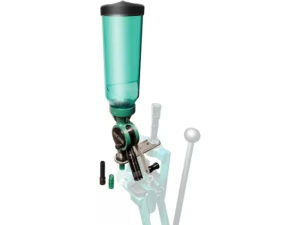
- Quick-change powder measure assembly
- Primer feed system with large and small primer trays
- Safety-shielded primer tube housing
- Spent-primer catcher bin (bottom-drop design)
- Loaded cartridge collection bin
- Operating handle with steel shank and ball knob
- Printed instructions and parts list
What’s not included: shell plates, dies, a case feeder, or bench mounting hardware. Shell plates are caliber-specific and sold separately – budget for at least one per caliber head size you plan to run. The quick-change die plate makes caliber swaps faster once you have die plates configured per caliber, but those plates need to be purchased and set up as you expand.
The quick-change powder measure is one of the key workflow features. Rather than threading a measure in and out when switching calibers, the Pro Chucker 7’s measure removes and reinstalls quickly via the quick-change interface – retaining its charge weight setting for the next time you return to that caliber. For a reloader who regularly runs 9mm Luger one session and 45 ACP or 223 Remington the next, that time savings across the setup process adds up over a year of regular loading sessions.
Build and Materials
The Pro Chucker 7 frame is die-cast aluminum with RCBS’s standard green powder-coat finish. The choice of die-cast aluminum over cast iron keeps the press in a manageable weight class relative to its 7-station footprint while providing adequate rigidity for the pistol and mid-class rifle calibers it’s designed to handle. The ram is 1-inch diameter polished hardened steel – smaller diameter than the oversized rams in heavy single-stage presses like the RCBS Rock Chucker Supreme but entirely appropriate for a progressive press where the loading force per station is distributed across multiple operations per cycle rather than concentrated on one.
The linkage is heavy-duty steel with a compound leverage system that delivers efficient force transfer through the handle stroke. The result is a handle pull that feels lighter than the actual sizing force at the bottom of the stroke – which matters in a 600-rounds-per-hour production environment where the cumulative effect of each stroke adds up over a two-hour session.
Some of the secondary components – certain covers, guards, and housings – use polymer construction. This is standard practice across the progressive press category at this price tier, and RCBS has engineered the load-bearing and wear-critical components as steel and aluminum. The polymer components are more likely to show cosmetic wear than functional failure under normal use, though heavily-used commercial setups have reported wear on some secondary parts over extended service. For a home reloading bench running several hundred rounds per week, this is a long-term consideration rather than an immediate concern.
The four-hole base pattern provides stable bench mounting. Use 2-inch hardwood or equivalent, Grade 8 bolts, and large washers to distribute clamping force across the press feet. A press that rocks or shifts during the loading cycle produces inconsistent indexing and primer seating – get the mounting right before evaluating the press’s performance.
Key Specs and Compatibility
| Feature | Specification |
|---|---|
| Frame Material | Die-cast aluminum, green powder coat |
| Ram Diameter | 1 inch, polished hardened steel |
| Stations | 7 (auto-indexing) |
| Die Thread | Standard 7/8-14 |
| Die Plate | Quick-change system |
| Powder Measure | Quick-change, included |
| Operating Window | 4.625 inches |
| Max Cartridge Class | 30-06 Springfield class |
| Shell Plates | RCBS quick-change format, sold separately |
| Primer System | Safety-shielded, large and small trays |
| Spent Primer | Bottom-drop to detachable bin |
| Mounting | Four-hole base pattern |
| Production Rate | Approximately 600 rounds/hour |
| Case Feeder | Not included – optional upgrade |
| Warranty | Limited lifetime against defects |
| Origin | RCBS, USA |
The 4.625-inch operating window handles 9mm Luger, 45 ACP, 38 Special, 357 Magnum, 40 S&W, 223 Remington, 308 Winchester, 300 Blackout, and 30-06 Springfield class cartridges without case-length restrictions. Very large magnum cases that push beyond 30-06 class dimensions are outside its design range.
Why Seven Stations?
This is the question the Pro Chucker 7’s price premium needs to answer, and it deserves a specific explanation rather than a vague claim about “versatility.”
A 5-station progressive press running 9mm Luger or 45 ACP typically uses its stations something like this: (1) size and decap, (2) expand case mouth, (3) charge powder and seat primer, (4) seat bullet, (5) crimp. That’s the minimum required sequence, and it fills all five stations. There’s no room left for anything else.
On the Pro Chucker 7, the same sequence uses five stations and leaves two open. Those two open stations are where production safety and workflow refinement happen:
Station 6 – Powder check die. A powder check or lock-out die positioned after the powder charging station gives you a visual or mechanical confirmation that every case has powder before a bullet is seated. A double-charged 9mm Luger or 223 Remington case is a serious safety event. A powder check die catches the problem before it reaches the seating station. On a 5-station press, adding this die means sacrificing another station in the sequence. On the Pro Chucker 7, it’s additive. For the overpressure risks in reloading context, this isn’t a luxury feature – it’s the right approach to high-volume production.
Station 7 – Bullet feeder interface, second crimp, or case inspection. The seventh station can hold a bullet feeder die for automated bullet placement, a separate roll crimp die for revolver rounds like 38 Special or 357 Magnum where crimp quality is critical, or a visual inspection station. The exact configuration depends on what you’re loading and what your production priorities are.
This is why experienced reloaders specifically seek 7-station presses over 5-station alternatives. It’s not about station count for its own sake – it’s about what those extra stations make possible without workflow compromises.
Where the Pro Chucker 7 Excels
High-volume pistol production with safety margins. 9mm Luger and 45 ACP are the natural home calibers for this press. With the full 7-station sequence running – size, expand, charge, check, seat, crimp, and a seventh station for bullet feeder or additional inspection – you can produce 500-600 rounds per hour with confidence that every case has been verified at the powder stage before bullet seating. For a competitive shooter who loads 5,000 rounds of 9mm Luger per month, this is the level of production automation that makes the investment worthwhile. The best powders for 9mm Luger handloading guide covers the powder selection for this volume work; ball powders like Hodgdon Titegroup, Winchester 231, Hodgdon CFE Pistol, and Hodgdon HP-38 meter most consistently through the quick-change powder measure.
Revolver calibers requiring dedicated crimp stations. 38 Special, 357 Magnum, and 44 Magnum benefit from a roll crimp applied separately from bullet seating – combining seating and crimping in one station can produce inconsistent crimp depth on cases that vary slightly in length. With 7 stations, you run a dedicated seating station and a dedicated crimp station without sacrificing the powder check. The best powders for 38 Special handloading and best powders for 357 Magnum handloading guides cover powder selection for revolver production work.
Mixed-caliber production sessions. The quick-change die plate means switching from 9mm Luger to 45 ACP to 40 S&W involves swapping the pre-configured die plate and shell plate rather than threading individual dies in and out. For a reloader who runs multiple pistol calibers in a single session, the time savings across setup and breakdown are real.
Rifle caliber production for hunting and practice. 223 Remington with Hodgdon Varget or Hodgdon CFE 223 and 308 Winchester with IMR 4064 or Hodgdon Varget run through the Pro Chucker 7 for hunting ammo and practice batches. Progressive loading of bottleneck rifle cases requires more careful case prep than pistol calibers – clean primer pockets, deburred flash holes, consistent case length – but the powder check die in station 6 provides an additional safety margin for rifle charges where overpressure consequences are more severe than in pistol loading.
Realistic Limitations
Not a beginner press. Seven stations, an auto-indexing shell plate, a quick-change powder measure, a primer feed system, and a case feeder interface all operating simultaneously produce a complex setup that requires systematic die adjustment and troubleshooting capability. A reloader who hasn’t worked through the fundamentals of sizing die adjustment, seating die tuning, and primer feed behavior on a simpler press will find the Pro Chucker 7’s setup learning curve steep. The Lee Pro 1000 or Lee Classic Turret is the right starting point before committing to 7-station progressive production.
Shell plates sold separately. Unlike some progressive presses that include a shell plate for a specified caliber, the Pro Chucker 7 requires shell plate purchases on top of the press price. If you load four calibers, plan for four shell plates. At the per-plate cost, this adds up and should be factored into the total investment calculation before comparing the press price to competitors.
No built-in case feeder. Automated case feeding – which turns a 600 rounds/hour theoretical maximum into a practically achievable rate without constant manual case placement – is an optional upgrade rather than a base-kit feature. The case feeder option adds significant cost and complexity to the setup. For a reloader who hand-cycles cases or uses a separate case feeder collator, the Pro Chucker 7 functions well without it – but the production rate ceiling without automated case feeding is lower than the spec suggests.
Aluminum frame limitations for heavy rifle work. The die-cast aluminum frame handles 223 Remington and 308 Winchester production loading without problematic flex. For very large-capacity magnum rifle cases where full-length sizing generates significant force, the frame’s rigidity is below what cast-iron alternatives offer. This is not the press for progressive loading of 300 Winchester Magnum or 338 Lapua Magnum at volume.
Setup and Mounting
Bench preparation. Mount on 2-inch or thicker hardwood with Grade 8 bolts and large washers through all four mounting holes. Verify the bench doesn’t flex perceptibly under downward handle force before running a production session. A flex in the bench translates directly into inconsistent shell plate indexing.
Station layout. The standard 7-station layout for pistol calibers:
- Station 1: Full-length size and decap
- Station 2: Expand case mouth and prime
- Station 3: Powder charge
- Station 4: Powder check die
- Station 5: Seat bullet
- Station 6: Crimp
- Station 7: Optional – bullet feeder die, factory crimp die, or empty inspection station
For 38 Special and 357 Magnum where roll crimp is preferred: seat at station 5, roll crimp at station 6, inspect or factory crimp at station 7.
Die installation and tuning. Use the how to tune a sizing die guide to set the sizing die correctly. Use the seating die tuning guide for consistent OAL. Set the powder measure by throwing and weighing 10 consecutive charges on a quality scale – the RCBS Rangemaster 2000 or Frankford Arsenal Platinum Series Digital Scale – before running production.
Primer system. Install the appropriate tray – small for CCI 500, Winchester WSP, Federal 100 small pistol; large for CCI 300, Winchester WLP, Federal 150 large pistol. The safety shield around the primer tube is a real safety feature – keep it in place during all priming operations. Use a Frankford Arsenal Vibra-Prime or equivalent tube filler to load primers efficiently at the start of a session.
Lubrication. The Pro Chucker 7 has a zerk fitting for ram lubrication – apply grease at the start of every session and after every 500-1,000 rounds. Keep oil off the die and primer areas; lubrication in the wrong place contaminates cases.
Powder measure. Ball and flake powders meter most consistently through the quick-change measure. Hodgdon Titegroup, Winchester 231, Hodgdon CFE Pistol, Alliant Power Pistol, Alliant BE-86, Alliant Unique, and Hodgdon HP-38 all run cleanly. For 223 Remington, ball powders like Hodgdon H335, Hodgdon CFE 223, and Ramshot TAC meter more consistently than coarser extruded powders in a progressive press measure. See the powder measure showdown for context on progressive press powder measure behavior across powder types.
Competitors – Four Direct Comparisons
Hornady Lock-N-Load AP
The Hornady Lock-N-Load AP is the most common 5-station progressive press the Pro Chucker 7 is evaluated against. The LNL AP uses Hornady’s Lock-N-Load bushing system for die changes – fast and effective – and has a proven track record across hundreds of thousands of installations. Its limitation relative to the Pro Chucker 7 is station count. Five stations fills up completely with the mandatory loading sequence, leaving no room for a powder check die or a dedicated crimp station separate from bullet seating. For a reloader who loads 9mm Luger or 45 ACP at high volume and wants a powder check die in the sequence without sacrificing a loading station, the Pro Chucker 7’s extra stations are the compelling argument. For a reloader whose 5-station sequence fits their workflow completely, the LNL AP’s lower price and bushing system make it the more pragmatic choice.
Choose the Pro Chucker 7 if: a powder check die or dedicated crimp station is a non-negotiable part of your production safety workflow. Choose the Lock-N-Load AP if: 5 stations cover your required loading sequence and you prefer Hornady’s bushing die-change system at a lower price point.
Dillon XL 750
The Dillon XL 750 is a 5-station progressive press with Dillon’s well-regarded build quality, optional auto-drive, and Dillon’s legendary no-hassle warranty and customer service. Like the LNL AP, its 5-station count limits add-on die stations in a full loading sequence. The XL 750’s primary advantages over the Pro Chucker 7 are Dillon’s parts availability and service reputation – when something needs replacing or adjusting, Dillon’s direct support is among the best in the industry. The Pro Chucker 7 counters with 7 stations and RCBS’s own lifetime warranty. For a reloader who prioritizes parts support above all else, Dillon’s ecosystem is the strongest argument. For a reloader who specifically needs 7 stations, the Pro Chucker 7 is the tool.
Choose the Pro Chucker 7 if: 7 stations and RCBS warranty backing address your workflow needs and the Dillon premium isn’t justified by your use case. Choose the Dillon XL 750 if: Dillon’s parts availability, no-hassle service reputation, and optional auto-drive are worth the price premium over 5-station capability.
Dillon RL 1100
The Dillon RL 1100 is an 8-station, production-grade progressive press built for commercial and high-volume competition reloading. At significantly higher cost than the Pro Chucker 7, it delivers a higher station count, faster production throughput, integrated case feed as standard, and Dillon’s production-grade construction. The Pro Chucker 7 is the pragmatic mid-tier choice for reloaders who want more than 5 stations but don’t need or can’t justify the RL 1100’s price and complexity. The RL 1100 is the tool for reloaders loading 10,000+ rounds monthly; the Pro Chucker 7 is the tool for reloaders in the 1,000-5,000 rounds monthly range who want professional-level safety margins without commercial-grade cost.
Choose the Pro Chucker 7 if: your loading volume is in the serious hobbyist to moderate competition range and the RL 1100’s cost is beyond what the volume justifies. Choose the RL 1100 if: your volume is commercial or high-competition grade and the investment is warranted by rounds-per-month throughput needs.
RCBS Pro Chucker 5
The RCBS Pro Chucker 5 is the sibling press – the same RCBS quick-change architecture and construction, but with 5 stations rather than 7. The Pro Chucker 5 is the right choice if your required loading sequence fills 5 stations comfortably and the additional cost of the Pro Chucker 7 isn’t justified by your specific add-on die needs. The Pro Chucker 7 is the right choice if a powder check die, dedicated crimp station, or bullet feeder interface is a real requirement rather than a future consideration. Choosing between them comes down to whether you actually need 7 stations or whether you’re paying for capacity you won’t use.
Choose the Pro Chucker 7 if: a powder check die and a dedicated crimp station are both genuinely part of your loading workflow. Choose the Pro Chucker 5 if: your required loading sequence fits 5 stations and you don’t need the additional stations that justify the 7’s price premium.
Comparison Table
| Feature | RCBS Pro Chucker 7 | Hornady LNL AP | Dillon XL 750 | Dillon RL 1100 | RCBS Pro Chucker 5 |
|---|---|---|---|---|---|
| Stations | 7 | 5 | 5 | 8 | 5 |
| Indexing | Auto | Auto | Manual | Auto | Auto |
| Frame Material | Die-cast aluminum | Steel | Aluminum/steel | Aluminum/steel | Die-cast aluminum |
| Quick-Change Die System | Yes (plate) | Yes (LNL bushing) | No | No | Yes (plate) |
| Quick-Change Measure | Yes | No (thread) | No (thread) | Integrated | Yes |
| Case Feeder | Optional upgrade | Optional upgrade | Optional upgrade | Standard | Optional upgrade |
| Primer Feed | Safety-shielded tube | Dedicated system | Dedicated system | Dedicated system | Safety-shielded tube |
| Production Rate | ~600 rph | ~500 rph | ~500-600 rph | ~1,000+ rph | ~500 rph |
| Powder Check Station | Available (Station 6) | No room | No room | Available | Limited |
| Warranty | Lifetime limited | Lifetime limited | No-hassle lifetime | No-hassle lifetime | Lifetime limited |
| Price Range | $$$ | $$$ | $$$-$$$$ | $$$$$+ | $$$ |
| Best For | Safety-margin production | High-volume versatility | Volume + Dillon support | Commercial production | Mid-volume production |
Real-World Use Notes
At 9mm Luger with Hodgdon Titegroup or Winchester 231, the Pro Chucker 7 runs smoothly once the setup is dialed in. Ball powders through the quick-change measure produce consistent charges, the auto-indexing cycles cleanly, and the bottom-drop primer collection bin keeps the work area clean. A full 7-station run with a powder check die at station 4 gives you visible confirmation of every charge before the bullet goes in – which is as close to production safety as you can get on a non-electronic progressive setup.
For 45 ACP with Alliant Unique or Alliant Power Pistol, the dedicated seating and crimping stations produce a clean, consistent taper crimp without the seating-crimp interaction that combined-station dies can produce. The best powders for 45 ACP handloading guide covers charge weight ranges for the most common 45 ACP production powders.
For 38 Special and 357 Magnum with a roll crimp requirement, the 7-station setup is genuinely superior to 5-station alternatives. Seat at station 5, roll crimp at station 6, factory crimp or inspect at station 7. The best powders for 357 Magnum handloading and best powders for 38 Special handloading guides help narrow down the production powder selection.
For 223 Remington practice and hunting ammo production, the press handles the caliber well within its design range. Consistent case prep – trimmed brass, cleaned primer pockets, deburred flash holes – matters more on rifle calibers than pistol, and the case prep essentials guide covers that workflow. Ball powders like Hodgdon H335 and Hodgdon CFE 223 meter consistently through the progressive measure for 223 Remington production loads.
The powder check die is not optional on this press – it’s why you bought a 7-station press. Run it.
Troubleshooting
Shell plate doesn’t index fully. The most common cause is insufficient handle stroke – the indexing mechanism requires the handle to complete its full travel to advance the shell plate correctly. A partial stroke leaves the shell plate between stations, which misaligns everything downstream. Complete every stroke fully even when the case feels like it’s stopping the movement early. Also check that the detent ball in the indexing mechanism is clean and spring-loaded correctly – debris in the detent can cause incomplete indexing.
Primer not seating consistently. Incomplete handle stroke is the primary cause here as well – the priming stroke is part of the full ram travel, and a partial stroke produces shallow primer seating. If the stroke is complete and seating is still inconsistent, check the primer tube for a bridged primer, verify the tube is fully seated in the housing, and confirm the shell plate is indexed fully before the priming station stroke.
Powder measure throwing light charges. Ball and flake powders are least susceptible to this, but can still vary if the measure isn’t properly locked. Verify the quick-change interface is fully latched. With extruded powders, bridging in the measure is the usual cause – tap the hopper and slow the stroke rate. For 223 Remington with Hodgdon Varget or other coarse extruded powders, check-weigh every 15-20 charges rather than relying solely on the powder check die, as stick powders can vary in ways that pass visual inspection but not weight verification. A Frankford Arsenal Platinum Series Digital Scale or RCBS Rangemaster 2000 at the bench makes this spot-check fast.
OAL inconsistent across a batch. Check the seating die lock ring first – it loosens during initial use and may need retightening after the first 20-30 rounds on a new setup. Also check bullet seating punch condition and that bullets are being presented consistently to the seating die – hand-placed bullets can vary in tip presentation if not placed uniformly. See the seating die tuning guide for systematic diagnosis.
Spent primer bin overflowing. Check every 200-300 cases and empty before it reaches capacity. An overfull bin can back up into the primer passage in the ram, which creates a jam that requires disassembly to clear. Keeping up with the bin is simpler than clearing a primer jam.
What to Buy with It
Shell plates. Required before loading anything. Purchase one per caliber head diameter. For 9mm Luger and 38 Special/357 Magnum, the small pistol plates cover multiple calibers. 45 ACP and 40 S&W use different shell plate numbers.
Die sets. The RCBS Pistol Die Set with carbide sizing die is the natural choice for pistol calibers. The Dillon Pistol Die Set is also well-suited to high-volume progressive loading in 9mm Luger and 45 ACP. The Hornady Custom Pistol Die Set and Lyman Deluxe Pistol Die Set are compatible alternatives. For 223 Remington and 308 Winchester, the RCBS Rifle Full-Length 2-Die Set covers sizing and seating.
Powder check die. This is not optional on a 7-station press. A powder check or lock-out die in station 4 or 6 confirms every charge before bullet seating. Budget for this before the first loading session.
Powder scale for session setup. Verify charge weights at the start of every session and after any powder measure adjustment. The Frankford Arsenal Platinum Series Digital Scale, RCBS Rangemaster 2000, or RCBS Chargemaster Supreme for automated verification all serve this purpose.
Primer tube filler. Filling primer tubes manually before each session is slow and involves more primer handling than necessary. A Frankford Arsenal Vibra-Prime handles tube loading efficiently and safely.
Case lube. Mandatory for 223 Remington and 308 Winchester bottleneck cases. Not needed for pistol carbide dies but reduces wear.
Digital calipers. OAL spot-checking on completed rounds. Verify at the start of every session and when changing die settings.
FAQ
Can it load 308 Winchester at production rates?
Yes, within parameters. 308 Winchester with ball powders like Hodgdon Varget or IMR 4064 runs through the Pro Chucker 7 for hunting and practice batch production. The 600 rounds/hour spec applies to pistol calibers – rifle calibers with the case prep overhead run at lower practical rates, typically 200-350 rounds/hour depending on case preparation needs.
What’s the real difference between 5 and 7 stations in practice?
Stations 6 and 7 are where the Pro Chucker 7 earns its price premium. Station 6 gets a powder check die that gives visual confirmation of every charge before bullet seating. Station 7 handles dedicated crimping, a factory crimp die, or bullet feeder interface without displacing a required loading station. On a 5-station press, you choose between a powder check die and a separate crimp station – you can’t have both. On the Pro Chucker 7, you have both.
Is the quick-change die plate as fast as Hornady’s bushing system?
Different but comparable in practice. Hornady’s Lock-N-Load bushings on the Lock-N-Load AP swap individual dies via a push-button release. The Pro Chucker 7 swaps an entire die plate – all 7 stations in a single plate removal and installation. For a full caliber change, the plate swap may actually be faster than individual die bushing swaps on a 5-station press, since you’re replacing the entire configured setup rather than 5 individual dies. The advantage is that each caliber’s plate is pre-configured and returns to its saved settings.
What powders work best in the quick-change measure?
Ball and flake powders consistently. For pistol calibers: Hodgdon Titegroup, Winchester 231, Hodgdon CFE Pistol, Alliant Power Pistol, Alliant BE-86, Alliant Unique, and Hodgdon HP-38. For 223 Remington: Hodgdon H335, Hodgdon CFE 223, and Ramshot TAC. Coarser extruded stick powders like Hodgdon Varget can be run but require more attention to measure consistency.
Is the case feeder worth adding?
For volumes above 300-400 rounds per session regularly, yes. Without the case feeder, you’re manually placing cases in the shell plate for every stroke, which limits practical throughput and introduces fatigue over long sessions. The case feeder converts the press from a hand-fed tool to a production-grade system. Factor the case feeder cost into the total investment comparison when evaluating this press against alternatives that include case feeding.
What primers run most reliably in the feed system?
CCI 500 and Winchester WSP for small pistol, CCI 300 and Winchester WLP for large pistol, CCI 400 for small rifle. Federal 100 small pistol and Federal 150 large pistol also feed consistently. Stick to one brand and lot number within a session for the most consistent primer feed behavior.
How does it compare to the RCBS Pro Chucker 5?
The RCBS Pro Chucker 5 is the 5-station version of the same press. If your required loading sequence uses all 5 stations for mandatory operations and you don’t run a powder check die or a dedicated crimp station, the Pro Chucker 5 is the right choice at lower cost. If you specifically want the powder check die in the sequence and separate seating and crimping stations – particularly for revolver calibers – the Pro Chucker 7 earns its price premium.
Conclusion
The RCBS Pro Chucker 7 delivers on its central premise: a 7-station auto-indexing progressive press with quick-change die plates and measure that produces up to 600 rounds per hour with enough stations to run the loading sequence, a powder check die, and a dedicated crimp station simultaneously. That combination is what separates it from the 5-station alternatives in the market, and for reloaders who specifically need those extra stations, there’s no meaningful way to get the same workflow on a 5-station press without compromising somewhere in the sequence.
It’s not a beginner press. The 7-station setup complexity, the die adjustment learning curve, and the progressive loading discipline required to run it safely are real prerequisites. For an experienced reloader who has worked through the fundamentals on a simpler press and is ready for production-grade capability with professional-level safety margins, the Pro Chucker 7 is a well-engineered tool backed by RCBS’s lifetime warranty.
The limitations – die-cast aluminum frame rather than cast iron, optional rather than included case feeder, shell plates sold separately – are the tradeoffs RCBS made to reach the price point and weight class they targeted. Within its design range of 9mm Luger, 45 ACP, 38 Special/357 Magnum, 223 Remington, and 308 Winchester class calibers, those tradeoffs don’t undermine the press’s core function.
Choose the Pro Chucker 7 if you load at serious hobbyist or moderate competition volume, specifically need a powder check die and a dedicated crimp station in your production sequence without sacrificing any mandatory loading station, and want RCBS warranty backing on a 7-station platform.
Choose the RCBS Pro Chucker 5 instead if 5 stations cover your required loading sequence and the Pro Chucker 7’s price premium for two additional stations isn’t justified by your workflow.
Choose the Hornady Lock-N-Load AP instead if 5 stations are sufficient, you prefer Hornady’s bushing die-change system, and the lower price point is the priority.
Choose the Dillon XL 750 instead if Dillon’s parts availability, no-hassle service reputation, and potential auto-drive upgrade are worth the cost premium over 5-station capability.
Choose the Dillon RL 1100 instead if your volume justifies the investment and you need integrated case feeding and 8-station production-grade construction as standard.