Published: June 2026 | Last updated: May 2026
Disclaimer: Specifications and pricing in this article are drawn from manufacturer and retailer sources current at time of publication. Always verify current pricing before purchasing.
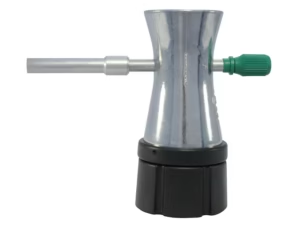
The Hornady Powder Trickler is the standard manual worm-gear trickler in Hornady’s reloading accessory line. It uses a rotating plastic auger driven by a knob to advance individual powder kernels from a reservoir tube to an output tip above the scale pan – the same mechanism and workflow as manual tricklers from Frankford Arsenal, Lyman, and RCBS across the budget and mid-tier categories. The operator turns the knob; the auger rotates; kernels advance to the scale pan one by one until the target charge weight is reached. No power required, no motor, no electronics.
At a street price around $20-35, the Hornady Powder Trickler occupies the same price band as the Frankford Arsenal Powder Trickler and Lyman Brass Smith Powder Trickler. This is a competitive space where the functional differences between products are modest and the choice often reduces to brand preference, ecosystem fit, and availability. The Hornady trickler’s natural home is the Hornady reloading ecosystem – the handloader who runs a Hornady press, Hornady dies, Hornady scales, and wants matched brand accessories throughout their bench setup.
This review covers the Hornady Powder Trickler as the conventional manual worm-gear product it is – not to be confused with the Hornady Vibratory Powder Trickler, which is a separate product using an electric vibration mechanism reviewed elsewhere in this equipment series. The standard Hornady Powder Trickler reviewed here is a manual, battery-free, hand-operated instrument.
Key Specifications
| Feature | Detail |
|---|---|
| Manufacturer | Hornady |
| Model | Powder Trickler |
| SKU | Not available at time of publication |
| UPC | Not available at time of publication |
| Mechanism | Manual worm-gear (auger) |
| Auger Material | Plastic |
| Body Material | Plastic |
| Output Tube | Adjustable height |
| Base | Plastic base with sufficient weight for normal operation |
| Powder Types | Ball, flake, and extruded stick powders |
| Power | None required |
| Hornady Ecosystem | Pairs with Hornady M2, Precision Lab, and Balance Beam scales |
| User Rating | Not available at time of publication |
| MSRP | Approximately $24.99-$29.99 |
| Approx. Street Price | $20-$35 depending on retailer |
Standard Worm-Gear Design and the Hornady’s Execution
The worm-gear powder trickler is the most common design in this product category, and the Hornady Powder Trickler executes it in the way that most handloaders expect: a transparent reservoir tube, a plastic auger threaded inside, a knob at one end, and an output tip at the other. Turn the knob clockwise; the auger rotates; kernels caught in the thread advance toward the tip and drop. The delivery rate is controlled by knob rotation speed – slow for one kernel at a time, faster for approach from further below the target weight.
The Hornady trickler’s execution of this design is consistent with what a $25 manual trickler should deliver. The auger is plastic, which is standard at this price tier. The tube interior is smooth enough for normal powder flow. The output tube adjusts for height to accommodate different scale pan configurations. The knob provides adequate grip for one-handed operation.
The design is simple enough that the operator’s technique is the primary variable in performance. Two operators using the same trickler will produce different charge-to-charge consistency based on how consistently they modulate knob rotation speed during the final approach to the target weight. The Hornady trickler is not a better or worse instrument than the Frankford Arsenal or Lyman Brass Smith at this price tier – they are functionally equivalent, and performance differences between them in the hand of a skilled operator are negligible.
What the Hornady trickler offers that neither the Frankford Arsenal nor the Lyman Brass Smith can provide is Hornady brand integration. For the handloader who has invested in Hornady’s Lock-N-Load ecosystem – Hornady Lock-N-Load AP press, Hornady Lock-N-Load Classic press, Hornady Lock-N-Load Iron Press, Hornady dies, Hornady M2 Digital Scale – the Hornady Powder Trickler completes a matched set. That coherence has no functional bearing on trickler performance, but it matters to buyers who prefer consistent brand identity across their equipment.
Build Quality and Design
The Hornady Powder Trickler is a plastic-construction tool at a plastic-construction price point. The reservoir tube, body housing, knob, and auger are all polymer components. The auger thread geometry is molded at the plastic injection step and maintains its dimensions adequately for the product’s expected service life under normal use.
The adjustable output tube allows height setting for the tip position above the scale pan. Set the tip 1-2mm above the pan surface – contact disturbs scale readings; excessive height causes kernel scatter. The height collar friction hold is adequate to maintain position during normal use.
The knob diameter and ribbing provide functional grip. After extended sessions, the bare plastic ribbing can cause minor discomfort. Operators who wrap the knob with grip tape or paracord address this without affecting function.
The base is plastic with sufficient mass to remain stable during normal single-handed knob operation. On very smooth bench surfaces, a non-slip mat under the base prevents sliding.
The Hornady trickler’s construction does not include any features that distinguish it from the category norm at this price: no dedicated anti-static treatment, no metal auger components, no precision-machined surfaces. It is a standard budget-tier worm-gear trickler from a trusted mainstream brand.
Setup and Operation
Place the Hornady trickler adjacent to the scale with the output tip positioned 1-2mm above the scale pan surface. Fill the reservoir tube to half to two-thirds capacity with the intended powder. Full fills increase column pressure on the auger, which can cause inconsistent delivery with some flake powders.
The trickle workflow: throw a charge from a powder measure set 0.3-0.5 grains below the target weight. Place the scale pan under the trickler tip. Use moderate knob rotation to deliver kernels toward the target weight. Slow to the minimum controllable rotation speed for the final 0.1-0.2 grains. Stop when the scale reads the target weight. Allow 2-3 seconds for digital scale readings to stabilize.
Ball powders – Winchester 231, Hodgdon Titegroup, Hodgdon HP-38, Alliant Bullseye, Hodgdon CFE Pistol, Alliant Power Pistol – advance smoothly through the auger with consistent delivery. Short flake powders like Alliant Unique are workable. Medium extruded rifle powders – Hodgdon Varget, Hodgdon H4895, IMR 4064, Alliant Reloder 15 – advance adequately with consistent technique. Long-grain slow extruded powders – Hodgdon H4350, Hodgdon H1000, Alliant Reloder 26 – are where the plastic auger’s limitations with coarse powder are most apparent: kernel bridging occasionally produces irregular delivery. Weigh every charge when using coarse powders.
The natural scale pairing within the Hornady ecosystem is the Hornady M2 Digital Bench Scale or Hornady Balance Beam Scale. The Hornady trickler’s output tube height accommodates both scale pan heights.
Where It Fits – Use Cases
Hornady Lock-N-Load ecosystem users who want matched brand accessories. A handloader who runs Hornady press, dies, and scales has a practical reason to complete their accessory set with Hornady’s own trickler rather than sourcing from a different brand.
Moderate-volume precision rifle loading where per-round scale verification is the charging method and session volumes are 30-80 rounds. For this use case – loading 308 Winchester hunting loads, developing 6.5 Creedmoor target loads, working up 7mm Remington Magnum hunting ammunition – the Hornady trickler’s manual worm-gear workflow is entirely practical.
Ball and flake pistol powder verification where the trickler is used periodically to verify charges rather than for per-round precision loading. Spot-checking a powder measure’s output for 9mm Luger or 45 ACP production loading does not require a premium trickler.
Budget-first complete setup where the buyer wants to keep total first-setup cost low. At $20-35, the Hornady trickler provides trickle-and-weigh capability without adding meaningful cost to a starter precision loading setup.
High-volume competition loading with extruded powder over 100+ rounds per session is where the manual plastic trickler’s limitations – hand fatigue from continuous knob rotation and plastic auger wear over time – become practical factors. At that volume and commitment level, a Redding No. 5 metal trickler for longevity, a CED motorized trickler for hands-free operation, or a fully automated dispenser are worth evaluating.
Competitive Analysis
Hornady Powder Trickler vs. Frankford Arsenal Powder Trickler: The Frankford Arsenal trickler is a direct functional equivalent at a typically lower price – $20-30 vs. $20-35 for the Hornady. Both are plastic worm-gear manual tricklers with adjustable output tubes. The Frankford Arsenal trickler has four dedicated MYR pages covering it from multiple angles; the Hornady trickler is the natural alternative for Hornady ecosystem users. There is no meaningful functional advantage for either over the other at equivalent price points. Choose the Hornady for Hornady ecosystem fit. Choose the Frankford Arsenal Trickler for brand-agnostic use or lower price.
Hornady Powder Trickler vs. Lyman Brass Smith Powder Trickler: Same category comparison. The Lyman Brass Smith trickler fits the Lyman Brass Smith case prep ecosystem. The Hornady trickler fits the Hornady Lock-N-Load ecosystem. Functionally equivalent at similar price points. Choose the Hornady for Hornady ecosystem integration. Choose the Lyman Brass Smith Trickler for Lyman Brass Smith accessory ecosystem integration.
Hornady Powder Trickler vs. Hornady Vibratory Powder Trickler: These are different Hornady products for different use cases. The standard Powder Trickler reviewed here is a manual battery-free worm-gear instrument for general trickler use. The Hornady Vibratory Powder Trickler uses AC-powered vibration that eliminates kernel cutting for coarse extruded powders, at a higher price and with a power requirement. Choose the Hornady Powder Trickler for manual operation, no power requirement, and general trickler use across powder types at a lower price. Choose the Hornady Vibratory Trickler specifically when kernel-cut-free delivery of coarse long-grain extruded powders in a dry shop is the priority and AC power is available.
Hornady Powder Trickler vs. Redding No. 5: The Redding No. 5 is a machined aluminum worm-gear trickler at $35-55, providing long-term consistency through metal auger construction that plastic augers do not match over thousands of loading cycles. The Hornady trickler is half the price with plastic construction. For moderate loading volume and Hornady ecosystem fit, the Hornady trickler is adequate. For high-volume loading over many years where plastic auger wear becomes a practical concern, the Redding No. 5’s metal construction is the long-service-life argument. Choose the Hornady Powder Trickler for Hornady ecosystem fit at budget pricing. Choose the Redding No. 5 for metal auger longevity at higher loading volumes.
Comparison Table
| Feature | Hornady Powder Trickler | Frankford Arsenal Trickler | Lyman Brass Smith Trickler | Redding No. 5 |
|---|---|---|---|---|
| Mechanism | Manual worm-gear | Manual worm-gear | Manual worm-gear | Manual worm-gear |
| Auger Material | Plastic | Plastic | Plastic | Machined aluminum |
| Output Tube Height | Adjustable | Fixed or limited | Adjustable | Adjustable |
| Power Required | None | None | None | None |
| Hornady Ecosystem Fit | Yes | No | No | No |
| Lyman Ecosystem Fit | No | No | Yes | No |
| Auger Wear Over Time | Moderate (plastic) | Moderate (plastic) | Moderate (plastic) | Very low (metal) |
| Best Application | Hornady ecosystem; moderate volume | General; budget | Lyman Brass Smith ecosystem | High-volume; Redding ecosystem |
| User Rating | N/A | ~4.2/5 | ~4.1/5 | ~4.6/5 |
| Price Range | $20-$35 | $20-$30 | $22-$32 | $35-$55 |
Troubleshooting
Trickler drops multiple kernels per turn with ball powder even at slow rotation. The tube is overfilled – reduce fill level to half capacity. Very fine ball powders like Hodgdon Titegroup can also flow past the auger thread at any rotation speed because of their small kernel size relative to the auger channel. For fine ball powder precision work, approach the final 0.1 grains with the slowest possible knob movement – fractions of a turn – rather than a continuous rotation.
Extruded powder bridges in the tube – no kernels advance. Tap the tube lightly against the bench to dislodge the bridge. Keep the fill level at half capacity with coarse extruded powders, and use a slightly faster, more decisive knob rotation to maintain kernel momentum through the auger. Bridging is most common at the beginning of a session when the powder column has settled during storage.
Output tube slips from set height. The friction collar has loosened. Tighten the collar more firmly. If slipping persists, clean the tube at the collar contact point – powder residue acting as a lubricant reduces the friction hold.
Scale fluctuates when taking readings during the trickle. The trickler and scale are on the same bench surface and vibration from knob rotation is transmitting to the scale pan. Place a folded cloth or non-slip mat under the trickler base to damp vibration transmission. Digital scales with fast update rates are particularly affected by this; balance beam scales are less sensitive.
Knob rotation is stiff. Powder has compacted in the auger channel. Remove the tube from the base, invert, and tap to dislodge powder. Clean the auger thread with a dry brush. Apply no lubricant to the auger – oil in the auger channel would contaminate powder charges.
Frequently Asked Questions
What is the difference between the Hornady Powder Trickler and the Hornady Vibratory Powder Trickler? They are fundamentally different products. The Hornady Powder Trickler reviewed here is a manual worm-gear instrument – the operator turns a knob to advance kernels, no power required. The Hornady Vibratory Powder Trickler uses AC-powered electric vibration to advance kernels without a rotating auger, eliminating the kernel-cutting risk that worm-gear tricklers present with coarse extruded powders. The Vibratory Trickler costs more and requires AC power. Choose the standard Hornady Powder Trickler for general trickler use at any bench without power requirements. Choose the Hornady Vibratory Trickler when kernel-cut-free delivery of coarse extruded powders in dry conditions is the specific application.
Does the Hornady Powder Trickler work with the Hornady M2 Digital Scale? Yes. The output tube height adjustment accommodates the Hornady M2 scale pan height. Position the trickler adjacent to the scale with the tip 1-2mm above the pan surface. The Hornady M2 and this trickler are the natural brand-matched trickle-and-weigh pairing within the Hornady ecosystem.
Is the Hornady Powder Trickler adequate for loading 308 Winchester precision loads with Hodgdon Varget? Yes. Hodgdon Varget is a short-grain extruded powder that advances through a plastic worm-gear trickler without significant bridging or cutting issues. For 308 Winchester loads at 41-44 grains, the Hornady trickler handles the final 0.3-0.5 grain trickle-to-weight step adequately. Technique – slow, consistent knob rotation for the final approach – is the primary variable in achieving 0.1-grain precision.
Should I buy the Hornady Powder Trickler or a Redding No. 5? If you load at moderate volume – 50-100 rounds per session – the Hornady trickler’s lower price is the argument. The Redding No. 5’s metal auger advantage becomes practically significant at high loading volumes where plastic auger wear accumulates over thousands of sessions. If you load precision rifle ammunition 150+ rounds per session multiple times per month for years, the Redding No. 5’s long-service-life construction is worth the premium. If you are just starting precision loading or load at moderate volume, the Hornady trickler is adequate and cost-appropriate.
Can the Hornady Powder Trickler be used alongside an automated dispenser as a secondary check tool? Yes. Some handloaders use an automated dispenser as the primary charging tool and a manual trickler for spot-checking or for charges that the dispenser drops slightly above or below target. The Hornady trickler in this secondary role requires no re-investment in a separate trickler brand – it works alongside any scale and any dispenser.
Conclusion
The Hornady Powder Trickler is a functional manual worm-gear trickler that delivers what a $20-35 product in this category should: reliable kernel advancement for ball and moderate extruded powders, adjustable tube height for different scale configurations, and straightforward operation that any handloader can learn in a single session. Its construction is plastic, consistent with its price tier and the category norm. Its service life under moderate use is adequate. Its limitations with coarse long-grain extruded powders and under high-volume regular use are shared with every plastic-auger trickler at this price point.
The Hornady Powder Trickler’s specific position in the market is as the natural trickler for Hornady Lock-N-Load ecosystem users – the matched-brand accessory that completes a Hornady bench setup without requiring an off-brand trickler. For brand-agnostic buyers, the Frankford Arsenal Powder Trickler is equivalent or cheaper; for Lyman Brass Smith ecosystem users, the Lyman Brass Smith Powder Trickler is the matched choice. The Hornady product is not better than these alternatives – it serves a different ecosystem.
Choose the Hornady Powder Trickler if you are in the Hornady Lock-N-Load reloading ecosystem and want a brand-matched trickler for your Hornady scale and press setup, or want a functional budget manual trickler at a price comparable to other options in the category.
Choose the Frankford Arsenal Powder Trickler instead if you want the lowest-cost functional manual worm-gear trickler without brand ecosystem preference.
Choose the Lyman Brass Smith Powder Trickler instead if you run Lyman Brass Smith case prep tools and want matched ecosystem integration.
Choose the Redding No. 5 instead if high-volume regular loading over many years makes metal auger longevity worth the additional price.
Choose the Hornady Vibratory Powder Trickler instead if kernel-cut-free delivery of coarse extruded powders in dry conditions is the specific application and AC power is available at your bench.
Disclaimer: Specifications and pricing in this article are drawn from manufacturer and retailer sources current at time of publication. Always verify current pricing before purchasing.