

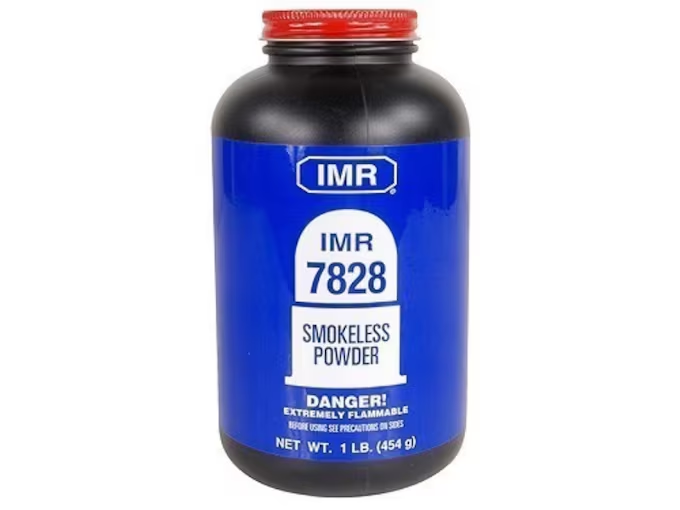
IMR 7828 stands as a cornerstone propellant in the world of magnum rifle reloading, representing one of the slowest-burning powders in the IMR (Improved Military Rifle) lineup. Originally designed to optimize the performance of large-capacity cartridges, IMR 7828 has maintained its status as a top-tier choice for shooters who prioritize high muzzle velocities and consistent pressure curves in long-range applications. As a magnum-class propellant, IMR 7828 is engineered to provide a sustained push against heavy projectiles, ensuring that the maximum amount of energy is transferred within the length of a standard or long rifle barrel.
Executive Summary
- Main Application: High-capacity magnum rifle cartridges and long-range hunting applications.
- Key Advantage: Exceptional velocity-to-pressure ratios when paired with heavy-for-caliber bullets.
- Burn Rate: Very slow, occupying the lower tier of the rifle powder burn rate spectrum.
- What This Guide Covers: A comprehensive technical breakdown of IMR 7828, environmental performance analysis, competitor comparisons, and optimized load data pathways for precision reloaders.
Best For: Experienced reloaders seeking maximum performance from magnum rifles and large-bore hunting platforms.
Powder Description & Technical Profile
IMR 7828 is a single-base, extruded (stick) propellant. Being a single-base powder, its primary energetic component is nitrocellulose, which contributes to a predictable and linear pressure progression during the combustion cycle. The physical geometry of IMR 7828 consists of long, cylindrical kernels that are significantly larger than standard rifle powders like IMR 4064 or IMR 4895. This large kernel size is intentional; it slows the surface area consumption during the initial ignition phase, allowing the pressure to peak later in the combustion process, which is ideal for “overbore” cartridges.
From an expert perspective, the “feel” of IMR 7828 during ignition is characterized by a progressive energy release. Unlike faster-burning powders that may produce a sharp, violent pressure spike, IMR 7828 provides a sustained acceleration. This behavior is critical for maintaining the structural integrity of the brass case while pushing heavy bullets, such as those used in 7mm Remington Magnum or 300 Winchester Magnum, to their full ballistic potential.
Pros & Cons
- Pros:
- Provides top-tier velocities in classic magnum calibers.
- Excellent case fill (load density), which often leads to improved shot-to-shot consistency.
- Chemical stability and long shelf life due to the single-base formulation.
- Proven track record in long-range competition and big-game hunting.
- Cons:
- Large kernel size can lead to inconsistent metering in some volumetric powder measures.
- Requires a large charge weight, which can lead to higher costs per round.
- Can be sensitive to extreme temperature shifts compared to newer, modernized “Enduron” or “Extreme” lines.
Technical Characteristics
The technical profile of IMR 7828 reveals its specialized nature. Because of its low bulk density and slow burn rate, it is rarely suitable for small or medium-capacity cases like 223 Remington or 308 Winchester. Instead, it thrives where there is room for 60-90 grains of propellant to work efficiently.
| Property | Specification |
| Manufacturer | IMR (Hodgdon Powder Company) |
| Powder Type | Extruded (Stick) |
| Base Type | Single-Base |
| Density (g/cc) | 0.880-0.910 |
| Burn Rate Category | Very Slow Magnum |
| Kernel Geometry | Long Cylindrical |
| Coating | Graphite and Stabilizers |
Burn Rate and Temperature Stability
Within the broader market of smokeless propellants, IMR 7828 sits firmly in the very slow-burning sector. It is slower than Hodgdon H4831 but faster than ultra-slow powders like Hodgdon Retumbo. This positioning makes it the “sweet spot” powder for standard magnum cases that are not quite large enough to benefit from 50 BMG-class powders but need more “oomph” than what a standard rifle powder can provide.
Temperature stability is a factor that every long-range shooter must account for when using IMR 7828. While IMR 7828 is remarkably stable under normal hunting conditions (20-80 degrees Fahrenheit), it can show variance in extreme cold or extreme heat. In high-heat environments (100+ degrees Fahrenheit), pressure can climb faster than expected, while sub-zero temperatures may result in a slight velocity drop. For hunters traveling from temperate climates to the sub-arctic or the desert, a slight adjustment in the load or verification of the zero is recommended.
Stability Table
| Powder | Sensitivity Type | FPS Variation (Per Degree F) |
| IMR 7828 | Moderate | 0.5-0.8 FPS |
| Hodgdon H4831 | Highly Stable | 0.2-0.4 FPS |
| Alliant Reloder 22 | Sensitive | 1.0-1.5 FPS |
Powder Comparison
When selecting a powder for a magnum build, shooters often compare IMR 7828 against its primary competitors. The choice usually boils down to the specific rifle’s barrel length and the weight of the projectile being utilized.
4-Way Analysis
- Hodgdon H4831: This is slightly faster than IMR 7828. It is a legendary powder for 270 Winchester, but when moving up to 7mm or 300 magnums with heavy bullets, IMR 7828 often yields higher top-end velocities.
- Alliant Reloder 22: This is one of the closest direct competitors to IMR 7828. While Reloder 22 can occasionally produce higher velocities, many reloaders find IMR 7828 to be more consistent across different lots of powder.
- Alliant Reloder 25: This is slightly slower than IMR 7828. It is better suited for ultra-magnums like the 300 RUM, whereas IMR 7828 is the king of the standard magnums.
- Hodgdon Retumbo: Significantly slower than IMR 7828. Retumbo is designed for the absolute largest cases. In a standard 7mm Remington Magnum, IMR 7828 will generally offer better case fill and efficiency.
Comparison Table
| Powder Name | Relative Burn Rate | Bulk Density (g/cc) | Primary Cartridges |
| Hodgdon H4831 | Fast-Magnum | 0.910 | 270 Winchester, 25-06 Remington |
| IMR 7828 | Standard-Magnum | 0.895 | 7mm Remington Magnum, 300 Winchester Magnum |
| Alliant Reloder 22 | Standard-Magnum | 0.915 | 300 Winchester Magnum, 6.5-284 Norma |
| Alliant Reloder 25 | Slow-Magnum | 0.920 | 300 Weatherby Magnum, 338 Lapua Magnum |
| Hodgdon Retumbo | Ultra-Slow | 0.910 | 300 RUM, 7mm STW |
Applications and Performance
IMR 7828 shines in bolt-action rifles where long barrels (24-26 inches) allow the slow-burning propellant to fully consume its energy. In semi-automatic actions, IMR 7828 is rarely the first choice because the slow burn rate can lead to high port pressures, which may cause excessive wear on the gas system or erratic cycling. However, in traditional magnum hunting rifles, its performance is nearly unmatched.
The fouling levels of IMR 7828 are considered moderate. As a traditional single-base powder, it does not contain the modern decoppering agents found in the Enduron series, but it burns quite cleanly when used at the upper end of its pressure range. If used in “light” loads with low pressure, the user may experience more soot or unburnt kernels. Metering with IMR 7828 can be a challenge for those using high-speed progressive presses; for the best accuracy, most precision reloaders prefer to throw a slightly light charge and trickle up to the final weight on a digital scale.
Recommended Cartridges and Applications
The versatility of IMR 7828 extends across a wide range of large-capacity cases. It is particularly effective when the goal is to push the heaviest available bullets for a given caliber.
| Cartridge | Primary Application |
| 243 Winchester | Long-range varminting with 100-115 grain bullets. |
| 270 Winchester | Maximum velocity hunting loads with 150 grain projectiles. |
| 7mm Remington Magnum | Heavy timber and open-country elk hunting with 160-175 grain bullets. |
| 300 Winchester Magnum | Precision long-range shooting and big-game hunting with 190-210 grain bullets. |
| 6.5-284 Norma | Competition-grade long-range target shooting. |
| 257 Weatherby Magnum | Ultra-high velocity plains hunting. |
| 300 Weatherby Magnum | Extreme distance big-game hunting. |
| 338 Winchester Magnum | Heavy bullet applications for dangerous game. |
Bullets
To extract the most performance from IMR 7828, it should be paired with bullets that have high sectional density and high ballistic coefficients.
| Brand | Model | Weight Range (Grains) |
| Sierra | MatchKing | 140-210 |
| Nosler | Partition | 150-200 |
| Barnes | TSX | 130-180 |
| Hornady | ELD-X | 143-212 |
| Berger | VLD Hunting | 140-210 |
Primers
Because IMR 7828 is used in large-capacity cases with significant powder charges, a Large Rifle Magnum primer is almost always required to ensure consistent ignition, especially in cold weather.
| Model | Type | Best Application |
| CCI 250 | Large Rifle Magnum | All-around magnum reliability. |
| Federal 215 | Large Rifle Magnum | Gold standard for heavy magnum charges. |
| Winchester WLRM | Large Rifle Magnum | Hot ignition for consistent burn. |
| Remington 9 1/2M | Large Rifle Magnum | Precision hunting loads. |
| RWS 5333 | Large Rifle Magnum | European precision and consistency. |
| Murom KVB-7M | Large Rifle Magnum | Harder cup for high-pressure loads. |
| Fiocchi 616 | Large Rifle Magnum | Reliable ignition for high-volume shooters. |
| CCI BR-2 | Large Rifle | Use only in smaller cases like 6.5-284 with IMR 7828. |
Conclusion and Expert Verdict
IMR 7828 remains a vital tool for the serious reloader. Its ability to provide high velocities while maintaining a predictable pressure curve makes it a favorite for those who push the limits of magnum rifle ballistics. While newer propellants offer specific advantages in temperature stability or copper cleaning, the sheer energetic efficiency of IMR 7828 ensures that it will remain a staple on reloading benches for decades to come. Whether you are building a dedicated 1000-yard target rifle or a 300 Winchester Magnum for a once-in-a-lifetime elk hunt, IMR 7828 provides the reliable power needed to succeed.
Expert Pro Tip: When working with the large kernels of IMR 7828, pay close attention to case neck tension. Because this powder occupies a large volume within the case, it can occasionally apply outward pressure on the base of the bullet. Ensuring consistent neck tension will prevent bullet “creep” and help maintain the precise seating depth required for sub-MOA accuracy in magnum rifles.


