Published: June 2026 | Last updated: May 2026
Disclaimer: Specifications and pricing in this article are drawn from manufacturer and retailer sources current at time of publication. Always verify current pricing before purchasing.
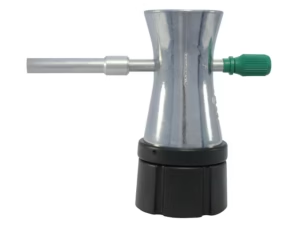
A vibratory powder trickler advances individual powder kernels using controlled vibration rather than a rotating worm gear. The vibrating tube or trough creates a directional oscillation that walks kernels along the trickler body toward the output tip at a rate controlled by the vibration intensity. The Hornady Vibratory Powder Trickler applies this mechanism to the trickler-and-scale workflow, offering a powder-delivery method that eliminates the kernel-cutting that can occur in worm-gear tricklers when coarse extruded powder kernels catch against the auger threads, and that provides smooth, controllable delivery of individual kernels onto the scale pan.
At a street price around $35-55, the Hornady Vibratory Powder Trickler sits in the same price tier as quality manual worm-gear tricklers from RCBS and Lyman. The choice between vibratory and worm-gear is primarily one of workflow preference and powder type – vibratory tricklers are generally regarded as gentler with long-grain extruded powders and provide a different tactile control experience than the knob-turn of a worm-gear unit. For a handloader who has used worm-gear tricklers and found kernel cutting or inconsistent delivery with slow rifle powders, the vibratory mechanism is a meaningful alternative worth evaluating.
The Hornady Vibratory Powder Trickler integrates with the Hornady scale and case prep ecosystem, pairing naturally with the Hornady M2 Digital Bench Scale, Hornady Precision Lab Digital Scale, and Hornady Balance Beam Scale for the trickler-and-scale workflow. It is aimed at the precision rifle handloader who loads with a scale-based charging approach and wants a trickler that handles a full range of powder types without the auger-based limitations of conventional worm-gear designs.
Key Specifications
| Feature | Detail |
|---|---|
| Manufacturer | Hornady |
| Model | Vibratory Powder Trickler |
| SKU | Not available at time of publication |
| UPC | Not available at time of publication |
| Mechanism | Vibratory – electromagnetic or motor-driven vibration advances kernels |
| Power | AC power required (wall adapter) |
| Output Tube | Adjustable height to accommodate different scale pan positions |
| Vibration Control | Variable speed/intensity control |
| Powder Types | Ball, flake, and extruded – including long-grain stick powders |
| Compatible Scales | Any grain-reading powder scale |
| Hornady Ecosystem Fit | Pairs with Hornady M2, Precision Lab, and Balance Beam scales |
| User Rating | Not available at time of publication |
| MSRP | Approximately $49.99-$59.99 |
| Approx. Street Price | $35-$55 depending on retailer |
Vibratory vs. Worm-Gear: The Mechanical Difference and When It Matters
A worm-gear trickler uses a rotating auger that physically contacts the powder and advances kernels by mechanical thread engagement. The operator turns a knob; the auger rotates; kernels are carried along the thread to the output tip. The mechanism is reliable and requires no power, but it has a specific failure mode with long-grain extruded powders: when a kernel bridges across the auger thread rather than riding along it, the rotating thread shears the kernel. The resulting fines and dust fall into the scale pan along with intact kernels, adding powder mass that does not represent a full kernel – a source of minor but real charge weight inconsistency in precision work.
A vibratory trickler does not mechanically contact the powder with a rotating component. Instead, the trickler body vibrates at a controlled frequency and amplitude, creating a directional wave that walks kernels along the tube toward the output tip. Kernels advance individually without being caught between thread crests. Long-grain extruded powders – Hodgdon H4350, Hodgdon H1000, Hodgdon Retumbo, Vihtavuori N160, Alliant Reloder 26, Alliant Reloder 33 – advance along the vibratory tube without the bridging-and-shearing failure mode of a worm-gear.
The practical difference is most significant with the slowest, coarsest extruded powders used in magnum rifle and long-range cartridges. A handloader loading 338 Lapua Magnum with Hodgdon Retumbo or 6.5 PRC with Alliant Reloder 26 who has experienced kernel cutting in a worm-gear trickler will see a difference when switching to vibratory delivery. With ball and flake powders, the difference is smaller – worm-gear tricklers handle those powder types cleanly, and the vibratory advantage is minimal.
The control difference is also worth noting. A worm-gear trickler is controlled by knob rotation – turn fast for more kernels, turn slowly for one at a time. A vibratory trickler is controlled by vibration intensity – increase intensity for more kernels, decrease for one at a time. Some operators find the vibration intensity dial more intuitive for the final few kernels of a precision charge; others prefer the knob’s tactile control. Neither is objectively superior – it is a workflow preference question.
Build Quality and Design
The Hornady Vibratory Powder Trickler requires AC power, which distinguishes it from the manual worm-gear tricklers from RCBS, Frankford Arsenal, and Lyman. The electromagnetic or motor-driven vibration mechanism needs a power source to generate the controlled oscillation. This means the trickler requires a bench outlet and introduces a cord into the workspace, but it also means the vibration intensity is consistently controllable – something that is impossible to achieve manually with a worm-gear trickler.
The vibration intensity control is the operator interface. A dial or slide adjusts the frequency or amplitude of the vibration, which controls the rate at which kernels advance along the tube. Setting a low intensity drops one or two kernels per second onto the scale pan; higher intensity drops a steady stream for faster approach to the target weight from a larger deficit. An experienced operator develops a workflow of using moderate intensity for the bulk approach and minimum intensity for the final 0.1-0.2 grain, similar to the fast-slow technique used with worm-gear tricklers.
The output tube height is adjustable, allowing the tip to be positioned 1-2mm above the scale pan – the correct clearance for controlled kernel placement without pan contact. This adjustment is set once per scale configuration and rarely changes unless the operator switches scales.
The tube body and housing are consistent with Hornady’s mid-tier accessory construction. The base is weighted or suction-footed for stability during operation – vibration transmitted into the bench surface is a real concern with vibratory tools, and a stable base that decouples the unit from the bench prevents the vibration from disturbing the scale reading mid-trickle. Position the trickler on a separate surface from the scale, or on a dedicated anti-vibration mat, for the cleanest scale readings during trickling.
Setup and Operation
Place the trickler adjacent to the scale – not on the same surface if possible. Connect the AC power adapter and place the output tube over the scale pan at the correct height. Set the intensity control to minimum before switching on.
Fill the tube with powder. Unlike a worm-gear trickler where a full tube increases head pressure on the auger, a vibratory trickler’s delivery rate is primarily governed by vibration intensity rather than powder column weight. Still, keep the tube at half to two-thirds capacity for the most consistent delivery rate at a given intensity setting.
The standard trickle-and-weigh workflow with this trickler begins after a powder measure has thrown a charge 0.3-0.5 grains below the target weight. Place the pan with the thrown charge on the scale and zero or tare if using a digital scale. Increase the trickler intensity to deliver kernels at a moderate rate until approaching within 0.5 grains of the target. Reduce intensity to minimum for the final approach, dropping one or two kernels at a time. When the scale reads the target weight, switch off the trickler and confirm the reading has stabilized.
With a digital scale like the Hornady M2 or Hornady Precision Lab, allow 2-3 seconds of stabilization after the trickler is off before confirming the final weight. Residual vibration from the trickler can affect the scale reading while the trickler is running. If the trickler and scale are on the same surface, stabilization time increases – this is the primary reason to separate their mounting surfaces.
Ball powders – Winchester 231, Hodgdon Titegroup, Hodgdon HP-38, Alliant Bullseye – advance freely through the vibratory tube. Short flake powders like Alliant Unique and Hodgdon Universal work well. Medium and slow extruded powders – Hodgdon Varget, Hodgdon H4350, IMR 4064, Hodgdon H4895, Alliant Reloder 17, Vihtavuori N550 – are where the vibratory mechanism shows its advantage over worm-gear designs in cleaner, cut-free delivery.
Where It Fits – Use Cases
Precision rifle loading with slow extruded stick powders is the vibratory trickler’s strongest application. A handloader working with Hodgdon H1000 for 7mm Remington Magnum, Hodgdon Retumbo for 300 Win Mag, Alliant Reloder 26 for 6.5 PRC, or Alliant Reloder 33 for 338 Lapua Magnum benefits from the vibratory mechanism’s kernel-cutting-free delivery. The last 0.3-0.5 grains of the charge arrive as intact kernels rather than a mix of whole kernels and sheared fragments.
Hornady scale ecosystem users who run an Hornady M2 Digital Bench Scale or Hornady Precision Lab Scale have the natural brand reason to match their trickler to their scale brand.
Handloaders who have experienced kernel cutting with a worm-gear trickler on specific coarse powders and want to eliminate that failure mode without moving to a fully automated dispenser system. The Hornady Vibratory Trickler provides the targeted fix for the kernel-cutting problem specifically.
Bench setups with a dedicated power outlet at the loading station. The AC power requirement is the practical prerequisite – a loading bench without a convenient outlet makes the vibratory trickler less practical than a manual worm-gear alternative.
High-volume pistol loading is not the target application. Per-round scale verification for 9mm Luger or 45 ACP production runs is not practical regardless of trickler type, and ball pistol powders do not suffer from the kernel-cutting issue that makes the vibratory mechanism advantageous.
Competitive Analysis
Hornady Vibratory Trickler vs. Frankford Arsenal Powder Trickler (worm-gear): The Frankford Arsenal trickler is a manual worm-gear unit at approximately $20-30 – roughly half the price of the Hornady vibratory unit. It handles ball and flake powders cleanly and works adequately with short-grain extruded powders. For a handloader who loads primarily ball powder or short extruded powders and has not experienced kernel-cutting issues, the Frankford Arsenal trickler is adequate at lower cost. For a handloader who loads coarse long-grain extruded powders and has experienced cutting issues, the vibratory mechanism justifies the price premium. Choose the Hornady Vibratory Trickler for coarse extruded powder applications and Hornady ecosystem fit. Choose the Frankford Arsenal Powder Trickler for budget-first trickler functionality with ball and moderate extruded powders.
Hornady Vibratory Trickler vs. Lyman Brass Smith Powder Trickler (worm-gear): The Lyman Brass Smith trickler is a manual worm-gear unit at approximately $22-32 with Brass Smith ecosystem integration. Same comparison as the Frankford Arsenal: adequate for ball and moderate extruded powders at lower cost, without the kernel-cut-free advantage of the vibratory mechanism for coarse stick powders. Choose the Hornady Vibratory Trickler for coarse extruded powders and Hornady ecosystem fit. Choose the Lyman Brass Smith Powder Trickler for Lyman Brass Smith ecosystem integration at lower cost.
Hornady Vibratory Trickler vs. Hornady Auto-Charge Pro: The Hornady Auto-Charge Pro is a fully automated scale-and-dispenser system that incorporates both the scale and the powder delivery in one unit, dispensing and weighing automatically to 0.1-grain accuracy. It costs approximately $250-300 – five to six times the price of the vibratory trickler. The Auto-Charge Pro eliminates the manual trickle step entirely; the vibratory trickler still requires the operator to watch the scale and control the vibration intensity manually. For a handloader who loads 50+ precision rifle rounds per session regularly, the Auto-Charge Pro’s time savings become compelling. For moderate-volume precision loading, the manual vibratory trickler workflow is practical and the cost difference is meaningful. Choose the Hornady Vibratory Trickler if you already own a quality scale and want manual trickler functionality at a low addition to your current setup. Choose the Hornady Auto-Charge Pro if automated precision dispensing and the time savings of a fully hands-off system justify the higher investment.
Hornady Vibratory Trickler vs. RCBS ChargeMaster Supreme: Same tier comparison as the Auto-Charge Pro. The ChargeMaster Supreme is a $380-420 automated system; the vibratory trickler is a $35-55 manual accessory. They are not competing products in any meaningful sense – one is a production-speed automation tool, the other is a precision finishing instrument. Choose the Hornady Vibratory Trickler as a scale companion for manual precision workflows. Consider the RCBS ChargeMaster Supreme when production volume makes the time cost of manual trickling significant.
Comparison Table
| Feature | Hornady Vibratory Trickler | Frankford Arsenal Trickler | Lyman Brass Smith Trickler | Hornady Auto-Charge Pro |
|---|---|---|---|---|
| Mechanism | Vibratory (electric) | Worm-gear (manual) | Worm-gear (manual) | Automated dispenser |
| Power Required | Yes – AC | No | No | Yes – AC |
| Kernel Cutting Risk | None – no auger contact | Low-moderate (coarse powder) | Low-moderate (coarse powder) | None (automated) |
| Intensity Control | Variable dial | Knob rotation speed | Knob rotation speed | Fully automated |
| Coarse Extruded Powder | Excellent | Marginal | Marginal | Excellent |
| Ball Powder | Excellent | Excellent | Excellent | Excellent |
| Hornady Ecosystem Integration | Yes | No | No | Yes |
| Best Application | Precision rifle; coarse extruded powder | General precision; ball/moderate powder | Lyman Brass Smith users | High-volume automated precision |
| User Rating | N/A | ~4.2/5 | ~4.1/5 | ~4.4/5 |
| Price Range | $35-$55 | $20-$30 | $22-$32 | $250-$300 |
Troubleshooting
Kernels do not advance along the tube even at high vibration intensity. The tube is overfilled – too much powder creates a column that dampens the vibration before it can walk kernels forward. Empty the tube to half capacity and retry. Also confirm the tube is seated at the correct vibration angle – if the tube is tilted downward toward the output, gravity assists kernel flow and less intensity is needed; tilted upward, more intensity is required. The correct angle is a slight forward tilt, typically preset by the unit’s design.
Kernels advance in bursts rather than individually at low intensity. The minimum intensity setting is still too high for single-kernel delivery with the powder type being used. Very light ball powders advance in small groups at any practical vibration setting because the kernels are small enough that individual delivery is not achievable through vibration control alone. With extruded stick powders, single-kernel delivery at minimum intensity is practical because the larger kernel size provides more spacing between advances. For ball powder precision work, accept 2-3 kernel bursts and approach the final weight from slightly further below.
Scale reading fluctuates during trickling – cannot confirm target weight while trickler is running. The trickler and scale are on the same surface. Even with a weighted base, vibration transmits through a shared bench surface and destabilizes the scale pan. Place the trickler on a separate surface from the scale – a folded towel, anti-vibration mat, or separate small board breaks the vibration path. The scale should stabilize within 2-3 seconds after the trickler is switched off.
Vibration intensity drifts – same setting produces different delivery rates between sessions. The AC power supply is producing inconsistent voltage, or the vibration motor has developed wear. Check that the power adapter is plugged into a stable outlet not shared with other high-draw equipment. If power is consistent and drift persists, the vibration motor or drive mechanism may need service. Contact Hornady customer service for the current service procedure.
Powder sticks to tube walls and does not advance cleanly. Static charge has built up in the tube. This is more common in very dry conditions with fine-grain powder. Ground the tube body with a light touch of a metal implement against the exterior, or increase bench humidity slightly. Some operators lightly coat the tube interior with a static-dissipating spray designed for use with powder; confirm any spray is safe for contact with powder before use.
Frequently Asked Questions
Is the Hornady Vibratory Powder Trickler compatible with digital scales from other brands? Yes. The trickler is a standalone tool – it drops powder onto any scale pan. It is not electronically coupled to any scale and does not require a specific scale brand to function. It pairs naturally with the Hornady M2 and Hornady Precision Lab Scale as brand-matched tools, but works equally well alongside an RCBS Rangemaster 2000, Lyman Accu-Touch 2000, Frankford Arsenal Platinum Series Scale, or any other grain-reading scale.
Does the vibratory mechanism damage powder kernels? The vibratory delivery is gentler on powder kernels than a worm-gear auger. Kernels walk along the tube through vibration-induced motion rather than being gripped and carried by a rotating thread. This is why the vibratory mechanism is specifically advantageous for large, fragile extruded kernels that can bridge and shear in a worm-gear. There is no mechanism in a vibratory trickler that would damage kernels under normal operation.
Can the Hornady Vibratory Trickler replace an automated dispenser for precision rifle loading? For moderate-volume precision loading – 50-100 rounds per session – the manual vibratory trickler paired with a quality scale is a practical workflow that most serious handloaders use effectively. For high-volume precision loading – 200+ rounds per session – the time cost of manual trickling each round becomes significant, and an automated system like the Hornady Auto-Charge Pro or RCBS ChargeMaster Supreme is worth evaluating. The trickler is the lower-cost entry point into precision per-round charge verification; the automated dispenser is the production-speed solution for high-volume use.
Why does the trickler require AC power when manual tricklers do not? The electromagnetic or motor-driven vibration mechanism requires a power source to generate the controlled oscillation. There is no practical way to produce controlled, adjustable vibration without a power source. The AC requirement is an inherent characteristic of vibratory tricklers across all brands, not a specific Hornady design choice. Manual worm-gear tricklers operate on hand power and require no electricity, which is their practical advantage for bench setups without convenient outlets.
What is the correct distance between the trickler output tip and the scale pan? The standard clearance is 1-2mm between the tip and the pan surface. Too high and kernels drop from a distance, bouncing off the pan and landing unpredictably. Too low and the tip contacts the pan, creating friction that disturbs the scale reading. Set the tip height once per scale configuration and confirm it does not change during a loading session. Vibratory tricklers can develop slight tip vibration that changes the effective height slightly; confirm tip clearance is maintained throughout the session.
Conclusion
The Hornady Vibratory Powder Trickler is a purpose-built solution for the specific failure mode of worm-gear tricklers with coarse extruded stick powders – kernel cutting during auger transport. For the precision rifle handloader who loads Hodgdon H1000, Hodgdon Retumbo, Alliant Reloder 33, or similar large-grain slow powders and has experienced cutting-related inconsistency in a worm-gear trickler, the vibratory mechanism directly addresses that problem. The variable intensity control provides the same fast-approach, slow-finish capability that experienced trickler users value, without the kernel damage risk.
The AC power requirement is the real constraint in evaluating this trickler. For a bench with a convenient outlet, it is a minor inconvenience. For a bench without one, it is a decisive limitation. Manual worm-gear tricklers from Frankford Arsenal and Lyman Brass Smith handle the majority of trickler applications adequately at lower cost and without power dependency. The Hornady Vibratory Trickler’s value is specific to the handloader who needs kernel-cut-free delivery of coarse extruded powders or who prefers the vibratory delivery mechanism for workflow reasons.
Choose the Hornady Vibratory Powder Trickler if you load precision rifle calibers with coarse slow extruded stick powders where kernel cutting in a worm-gear trickler has been an observed problem, have a bench outlet available, and run Hornady scales or prefer Hornady brand accessories as part of a matched ecosystem.
Choose the Frankford Arsenal Powder Trickler instead if you load primarily ball and moderate extruded powders where worm-gear cutting is not an issue, want to minimize cost, and do not need or want AC power dependency at the trickler station.
Choose the Lyman Brass Smith Powder Trickler instead if you run other Lyman Brass Smith case prep tools and want matched ecosystem integration at a manual worm-gear price point.
Choose the Hornady Auto-Charge Pro instead if you load high volumes of precision rifle ammunition per session and want fully automated dispensing and weighing that eliminates the manual trickle step entirely.
Disclaimer: Specifications and pricing in this article are drawn from manufacturer and retailer sources current at time of publication. Always verify current pricing before purchasing.