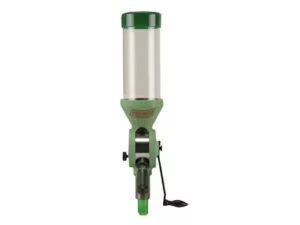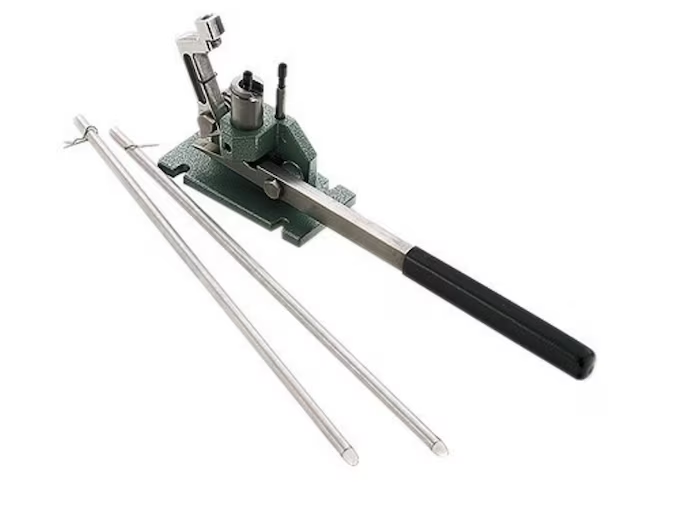
The RCBS Automatic Bench Priming Tool is a bench‑mounted, lever‑operated priming tool that uses primer tubes to feed small or large primers automatically into prepared cases. It is designed for reloaders who prefer to prime off‑press, want better feel and consistency than most on‑press priming systems, and need to handle medium to fairly high volumes without the hand fatigue of a handheld priming tool.
| Field | Value |
|---|---|
| Type | Bench‑mounted automatic priming tool (manual lever, tube‑fed) |
| Primary use | Off‑press seating of small and large primers into prepared cartridge cases |
| Brand | RCBS |
| Model | Automatic Bench Priming Tool |
| MPN | 9580 |
| Other SKUs | Brownells 749‑013‑915WB; most retailers list it as RCBS 9580 |
| Materials | Cast metal frame (typically aluminum alloy); steel handle and linkage; steel primer seating components; steel primer tubes; plastic primer tube shield and small guide parts; plastic/rubber handle grip |
| Dimensions (approximate) | Mounted height ~8–10 in; base footprint ~3 x 4 in; requires extra clearance above for primer tubes and around for handle swing |
| Weight | Approx. 2.5–3.5 lb |
| Power source | None – fully manual lever operation |
| Warranty | RCBS limited lifetime warranty for the original owner (defects in materials and workmanship) |
| Country of origin | Commonly listed as Made in USA (verify on current packaging) |
| MSRP | Historically around $150–$170 USD (check RCBS.com for current pricing) |
| Typical street price (approximate) | Roughly $110–$150 USD at major retailers, depending on sales and availability |
What’s In The Box
Included with the standard RCBS Automatic Bench Priming Tool (MPN 9580):
- RCBS Automatic Bench Priming Tool main body with bench‑mountable frame, linkage, and handle
- Primer seating assembly with adjustable seating punch
- Two primer rod / seating stem assemblies:
- One for small primers
- One for large primers
- Two primer feed tubes:
- One small‑primer tube (often color‑coded)
- One large‑primer tube (differently color‑coded)
- Primer tube pick‑up tips for loading primers into the tubes
- Clear plastic primer tube safety shield
- Basic instruction manual / setup guide
Not included but required for operation:
- RCBS‑style press shellholders for each cartridge family you intend to prime
- Bench mounting hardware (bolts, washers, nuts) if not supplied by the retailer
- Primer flip tray to orient primers before loading tubes
- Primers and prepared brass
- Solid reloading bench or mounting plate
RCBS currently sells this as a single tool package under MPN 9580. Any bundles that include shellholders, extra tubes, or flip trays are typically retailer‑created kits rather than separate RCBS part numbers.
Versions, Kits & Part Numbers
As of 2024, the RCBS Automatic Bench Priming Tool is the current tube‑fed bench priming station in the RCBS lineup. It is often compared with older RCBS bench priming tools and APS strip‑fed systems, but those are distinct products.
| Version | MPN | Included items | Notes |
|---|---|---|---|
| RCBS Automatic Bench Priming Tool | 9580 | Bench‑mounted priming tool with handle, small and large primer seating rods, small and large primer tubes, safety shield, and manual | Current production model using loose primers in tubes; uses standard RCBS press‑type shellholders (not included) |
| RCBS Bench Priming Tool (older style) | 09460 | Earlier bench priming design using primer tubes | Different ergonomics and feed system; sometimes still found at retailers or used |
| RCBS APS Bench Priming Tool | 88501 | Bench priming tool for APS plastic primer strips | Uses APS strips instead of tubes; APS system largely phased out and not compatible with 9580 |
Retailer SKUs (examples for 9580):
- Brownells: 749‑013‑915WB (mapped to RCBS 9580)
- MidwayUSA, Natchez, and others: typically list as “RCBS Automatic Bench Priming Tool” with MPN 9580
When ordering, verify that the listing clearly states “Automatic Bench Priming Tool” and shows primer tubes and a plastic shield in the product photos to avoid confusing it with the older bench or APS tools.
Build Quality & Design
The RCBS Automatic Bench Priming Tool follows the typical RCBS formula: a robust cast frame, steel linkage, and a straightforward mechanical design aimed at long service life in a home reloading shop.
- Materials and construction:
- Cast metal frame (commonly aluminum alloy) with RCBS green painted or powder‑coated finish
- Steel handle and linkage with a plastic or rubber grip
- Steel primer seating punch and internal components
- Steel primer tubes with a clear plastic safety shield and small plastic guide parts
- Rigidity and stability:
- Rigid frame with minimal flex when bolted to a solid bench
- Small base footprint but stable once mounted with two or three bolts
- Machining and finish quality:
- Steel parts are generally well‑machined; some users report minor burrs in the primer feed path that benefit from light deburring or polishing
- Primer tubes fit with a slip fit into the body; the plastic shield slides over them for added safety
- Fit of moving parts is snug but typically smooth after a short break‑in period
- Durability:
- Many users report thousands to tens of thousands of primers seated without major wear
- Wear points are mainly pivot pins, linkage joints, and the seating punch; all are steel and hold up well with light lubrication
- Plastic shield and small plastic guides can crack if abused but are not high‑stress components and are replaceable
Design strengths include solid leverage, good tactile feedback, and a positive mechanical stop for consistent seating depth. Weak points are the sensitivity of the primer feed to cleanliness and orientation, and the reliance on correctly dimensioned shellholders for perfect alignment.
Setup & Adjustment
Unlike handheld priming tools, the Automatic Bench Priming Tool must be securely mounted to a bench or plate and correctly configured for primer size and shellholder before use.
Bench and space requirements:
- Solid, non‑flexing bench or dedicated mounting plate
- Base footprint around 3 x 4 in, with room for full handle swing
- Vertical clearance of roughly 12–14 in above the bench to accommodate primer tubes and shield
- Typically mounted with 1/4″ or 5/16″ bolts, washers, and nuts through the base
Step‑by‑step setup overview:
- Unpack and inspect
- Verify that the main body, handle, small and large primer rods, small and large primer tubes, safety shield, and manual are present
- Check for obvious damage or missing parts
- Mount the tool
- Position the base near the bench edge so you can easily insert and remove cases
- Mark and drill mounting holes, then bolt the tool down firmly to eliminate wobble
- Install handle and linkage (if not pre‑installed)
- Attach the handle to the linkage pivot according to the manual
- Ensure pivot pins are fully seated and secured with clips if supplied
- Install the shellholder
- Insert the appropriate RCBS‑style press shellholder into the shellholder slot
- Confirm it is fully seated and oriented correctly; partial seating can cause misalignment and crushed primers
- Configure for primer size
- Install the small or large primer seating rod to match your primer size
- Install the matching small or large primer tube
- Adjust primer seating depth
- Follow the manual to set the mechanical stop or seating punch height
- Most users aim for primers seated 0.003–0.005″ below flush
- Test with a few sized, empty cases and spent primers before using live primers
- Load primer tubes
- Use a flip tray to orient primers anvil side up
- Use the pick‑up tip to load primers into the tube (typically 50–100 at a time)
- Insert the loaded tube into the tool and slide the plastic shield over it
- Prime test cases
- Cycle the handle slowly to feed and seat primers
- Check seating depth and feel; make small adjustments as needed
Typical first‑time mistakes:
- Shellholder not fully seated: leads to tilted or crushed primers and inconsistent seating depth.
- Wrong primer rod/tube installed: trying to seat small primers with the large setup (or vice versa) causes misfeeds and damage.
- Primer tube not fully engaged: results in no‑feed or double‑feed conditions.
- Insufficient bench rigidity: a flexy bench makes seating feel vague and can cause variation in depth.
- No initial cleaning: factory oil or small burrs in the feed path can cause early hang‑ups; many users lightly clean and inspect before first use.
Experienced reloaders often recommend lightly deburring the primer slide or feed area if any rough spots are felt, keeping the primer path absolutely clean and dry, and developing a consistent lever stroke to maximize uniformity.
Daily Use & Performance
In day‑to‑day use, the Automatic Bench Priming Tool is intended as a dedicated priming station: you bring prepped, sized, and cleaned brass to the tool, then run them through in batches while feeding primers from the tubes.
- Handling and ergonomics:
- Vertical handle and bench mount allow comfortable seated operation
- Leverage is generous, so even tight primer pockets require modest effort
- Much less hand fatigue than handheld priming tools for batches of hundreds of cases
- Smoothness and control:
- Once broken in and kept clean, the lever stroke is smooth with a distinct “bottoming out” feel when the primer seats
- Good tactile feedback helps detect tight or loose primer pockets and avoid crushed primers
- Speed relative to other options:
- Faster and more consistent than priming one case at a time on a single‑stage press
- Slower than a well‑tuned progressive press for very high‑volume pistol work
- Efficient for medium to high volume batch priming when you are willing to load tubes
- Consistency and repeatability:
- Capable of very uniform seating depth when the stop is properly set and the operator uses a consistent stroke
- Widely used by precision rifle reloaders who want slightly below‑flush, uniform primers
- Pistol vs rifle, small vs large primers:
- Pistol: short cases are easy to handle and throughput is high; ideal for mid‑volume pistol reloaders who prefer off‑press priming.
- Rifle: works well with longer cases; the feel helps identify cases with tight or loose pockets, which is useful for match ammo.
- Small vs large primers: both sizes work well when matched with the correct rods and tubes; small primers are slightly more sensitive to debris or burrs in the feed path.
Overall, the tool delivers what most reloaders expect from a bench priming station: consistent seating, good feel, and reduced fatigue, at the cost of having to load primer tubes and dedicate bench space.
Compatibility & Use Cases
The RCBS Automatic Bench Priming Tool is a stand‑alone priming station that uses standard press‑type shellholders and loose primers in tubes. It does not mount in a press or share parts with APS strip systems.
Operations it handles well:
- Off‑press priming for both pistol and rifle cartridges
- Batch priming of hundreds of cases with consistent seating depth
- Priming for precision rifle loads where tactile feedback is important
- Medium to high volume reloading where handheld priming becomes tiring
Compatibility:
- Thread standards:
- Not threaded like a die; mounts via bolts through the base into the bench
- Shellholders:
- Designed for RCBS press‑type shellholders
- Many users successfully use other brands (Lee, Hornady, Lyman) if they match RCBS dimensions, but off‑spec shellholders can affect alignment and seating depth
- Primer sizes:
- Supports standard small and large primers (including magnum) via separate rods and tubes
- Not intended for oversized primers such as .50 BMG or for Berdan‑primed cases
- Cartridge ranges:
- Works with most common centerfire pistol and rifle cartridges that use standard shellholders: 9mm, .38/.357, .40 S&W, .45 ACP, .223/5.56, .308, .30‑06, and many others
- Very long or very short wildcats may require extra care, but if a shellholder exists and the case fits under the punch, it generally works
- Other brands and systems:
- Not compatible with RCBS APS primer strips or strip‑fed tools
- Independent of any specific press brand; can be used alongside any press setup
Known incompatibilities and workarounds:
- Some non‑RCBS shellholders may sit slightly high or low, causing inconsistent seating; switching to RCBS shellholders or carefully stoning the shellholder top is a common workaround.
- Very tight primer pockets (e.g., some military brass) may feel stiff; many users swage or uniform primer pockets before priming.
Maintenance
- Cleaning:
- Regularly brush or blow out powder, brass shavings, and dirt from the primer feed path, shellholder area, and seating punch
- Keep the primer path dry and free of oil to avoid contaminating primers
- Wipe the exterior surfaces as needed to remove grime
- Lubrication:
- Apply a small amount of light oil to pivot points and linkage joints
- Wipe off excess oil to avoid attracting dirt and to keep it away from primers
- Frequency:
- Quick inspection and wipe‑down every session
- More thorough cleaning and inspection every few thousand primers or whenever misfeeds occur
Replacement parts and support:
- RCBS offers replacement primer tubes, seating rods, plastic shields, springs, pins, and other small parts
- Part numbers are listed in the RCBS manual and parts diagram for MPN 9580; parts can be ordered directly from RCBS or through major retailers
- RCBS has a strong reputation for responsive customer service and often replaces broken or missing parts under their lifetime warranty, subject to normal limitations
Final Thoughts
The RCBS Automatic Bench Priming Tool is best suited to reloaders who want a dedicated, bench‑mounted priming station with consistent seating depth and good tactile feedback. It shines for medium to high volume pistol and rifle work, and for shooters who prefer to prime off‑press to keep their main press operations cleaner and simpler. Strengths include solid construction, reduced hand fatigue compared to handheld tools, and a shielded tube system that many users feel is safer than open primer trays. Limitations are the need to load primer tubes, sensitivity of the feed system to cleanliness and setup, and the requirement for permanent bench space.
If you want deeper analysis of how it stacks up against other priming options, see the main review article on the RCBS Automatic Bench Priming Tool. For a closer look at long‑term user experiences, common complaints, and real‑world tips, check out the dedicated real‑world feedback article. Together, those pieces complement this setup and specs overview so you can decide whether this tool fits your bench and your volume of reloading.