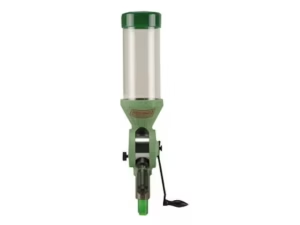
Common Complaints Reported by Reloaders
- Primer feed can be finicky if the tubes or feed path are not perfectly clean, leading to occasional hang‑ups or skipped primers.
- Some users experience crushed or sideways primers during initial setup, usually traced to mis‑seated shellholders, wrong primer rod/tube, or an overly aggressive lever stroke.
- Loading primer tubes is slower and more tedious than dumping primers into a tray‑fed hand primer, especially for small batches.
- Small primers are more prone to misfeeds than large primers if there is any debris, oil, or burrs in the feed system.
- A few owners report minor burrs or rough machining in the primer slide or feed area out of the box, requiring light deburring or polishing for best performance.
- Plastic primer tube shields can crack if dropped, overtightened, or struck accidentally on a crowded bench.
- The tool demands a solid bench; mounted on a flexy surface, the seating feel becomes vague and depth can vary.
- It is not as fast as priming on a well‑tuned progressive press for very high‑volume pistol shooters, which some users only realize after purchase.
Positive Notes & Strong Points Mentioned by Users
- Many reloaders praise the tactile feedback; they can clearly feel primers bottom out and detect tight or loose pockets.
- Once adjusted and broken in, it delivers very consistent, slightly below‑flush primer seating suitable for precision rifle ammo.
- Bench‑mounted leverage dramatically reduces hand fatigue compared to handheld priming tools, especially on runs of several hundred cases.
- Construction is generally regarded as solid and durable, with the cast frame and steel linkage holding up well over years of use.
- Works well for both pistol and rifle cartridges, allowing one priming station for most of a reloader’s needs.
- The shielded primer tube system gives some users more confidence about safety than open primer trays.
- RCBS customer service receives frequent praise for quickly supplying replacement tubes, shields, and small parts, often at low or no cost.
- Overall value is considered good for a dedicated bench priming tool, especially for those who prime off‑press by choice.
Sample User Quotes
“After I cleaned out the factory oil and knocked down a couple of tiny burrs in the feed slide, this thing started running like a champ. I can feel every primer seat and it’s way more consistent than my press priming ever was.”
“Loading the tubes is the slow part, no doubt, but once they’re full I can sit and prime a few hundred .223 cases without my hands cramping up like they did with my old hand primer.”
“I had some crushed small rifle primers at first, but it turned out my shellholder wasn’t fully seated and I was yanking the handle too fast. After slowing down and switching to an RCBS shellholder, the problem disappeared.”
“For my match .308 loads, this bench primer is all I use. The feel is excellent and I can tell immediately if a primer pocket is too loose and that case needs to be culled.”
“It’s not as fast as my progressive press for bulk 9mm, but I actually prefer priming rifle brass on this tool. The extra control is worth the extra step for me.”
“The only part I’ve broken in five years was the plastic tube shield when I knocked it off the bench. RCBS sent me a new one without any drama, which is why I keep buying their stuff.”
“There is definitely a learning curve. If you expect to bolt it down and run 100% perfect from the first primer, you’ll be disappointed. Give it an evening to dial in and it rewards you with very uniform seating.”
Deeper Analysis of User Feedback
Looking across forum threads and retailer reviews, a pattern emerges: most negative comments come from early experiences, while long‑term owners tend to be satisfied once they understand the tool’s quirks. The primer feed system is the focal point of both praise and criticism. When tubes are clean, straight, and properly seated, and the feed path is free of burrs, the tool runs smoothly. When any of those conditions are off, misfeeds, crushed primers, or inconsistent seating quickly appear.
Several experienced reloaders recommend a short “prep session” before serious use: disassemble the feed slide, inspect for rough edges, and lightly deburr or polish any problem spots. They also stress keeping oil away from the primer path and using canned air or a small brush to clear powder and brass dust regularly. Users who follow these practices report far fewer issues than those who simply bolt the tool down and start priming.
Bench rigidity is another recurring theme. On a solid bench or steel mounting plate, the seating feel is crisp and repeatable. On a light or wobbly bench, the handle feel becomes mushy, making it harder to sense when primers are fully seated. Some owners solved this by adding a dedicated mounting plate or reinforcing their bench, after which their opinion of the tool improved significantly.
The tube‑loading step divides users. High‑volume pistol shooters who are used to progressive presses often find tube loading tedious and see little benefit in moving priming off‑press. In contrast, precision rifle shooters and mid‑volume reloaders tend to accept tube loading as part of the workflow, viewing it as a fair trade for better control and reduced hand strain. A few users keep multiple tubes pre‑loaded to minimize downtime during long sessions.
Shellholder choice also matters more than some expect. Reports of crushed or tilted primers are disproportionately associated with off‑brand or worn shellholders. Switching to new RCBS shellholders often resolves alignment problems. This reinforces the idea that the tool assumes shellholders are within RCBS dimensional tolerances; if they are not, the user may blame the priming tool for what is essentially a shellholder issue.
Safety feedback is generally positive. While isolated accounts of primer tube detonations exist, they are rare and typically linked to debris or misaligned primers. Users appreciate the clear plastic shield and the fact that the primer column is enclosed rather than sitting in an open tray near their face. Many consider this a safer arrangement, especially when priming large batches of rifle brass with harder primers.
Overall satisfaction tends to be highest among reloaders who:
- Prime off‑press by preference, not necessity.
- Are comfortable doing minor deburring and setup tweaks.
- Have a solid bench and good shellholders.
- Load enough volume that hand fatigue from handheld primers is a real concern.
Final Thoughts
Taken as a whole, real‑world feedback on the RCBS Automatic Bench Priming Tool is broadly positive but acknowledges a learning curve. Users who expect plug‑and‑play perfection sometimes run into feed issues, crushed primers, or frustration with tube loading. Those who are willing to spend an evening mounting it solidly, cleaning out factory oil, checking for burrs, and dialing in shellholder and seating depth generally end up with a reliable, consistent priming station that greatly reduces hand fatigue and offers excellent tactile feedback.
If you are considering this tool, start with the setup and specs article on the RCBS Automatic Bench Priming Tool to understand exactly what is included, how to mount it, and how to adjust it correctly. Then read the main review article for a structured comparison against hand primers, progressive press priming, and competing bench tools. Combined with the user experiences summarized here, those resources should give you a clear picture of whether the RCBS Automatic Bench Priming Tool fits your volume, workflow, and expectations.