

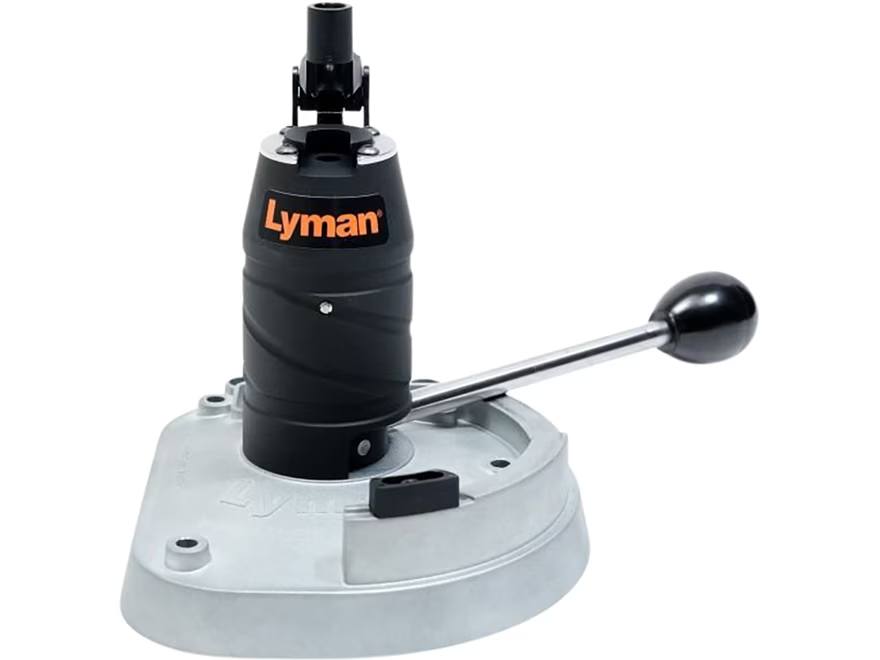
The Lyman Accu-Prime Auto-Load Bench Priming Tool represents a sophisticated bridge between the slow, tactile nature of hand-priming and the high-speed, often cumbersome nature of press-mounted priming systems. Designed for the reloader who demands both precision and volume, the Lyman Accu-Prime Auto-Load Bench Priming Tool is engineered to remove the physical strain of hand-held units while maintaining a level of “feel” that is often lost in progressive press setups. In the hierarchy of reloading equipment, the Lyman Accu-Prime Auto-Load Bench Priming Tool is positioned as a dedicated bench-top solution, intended to stay permanently mounted to a workspace to provide a stable, repeatable platform for seating primers to a consistent depth.
- Tool Category – Dedicated Bench-Top Priming System
- Operation Type – Manual Lever-Action with Gravity-Fed Tray
- Mechanical Standout – Universal Shellholder Compatibility and Large/Small Primer Integrated Feed
Best For: High-volume precision reloaders and competitive shooters who prefer to separate the priming process from the main press to ensure zero contamination and perfect seating depth without the hand fatigue associated with manual squeeze tools.
Technical Specifications & Market Pricing
The construction of the Lyman Accu-Prime Auto-Load Bench Priming Tool focuses on a heavy-duty casting that provides the necessary rigidity for uniform primer seating. Unlike plastic-heavy budget options, this tool uses metal components in high-stress areas to ensure that the leverage applied by the user translates directly into the primer pocket without frame flex.
| Model | MPN | Materials | Weight (lbs) | MSRP | Approx. Street Price |
| Lyman Accu-Prime Auto-Load Bench Priming Tool | 7702100 | Cast Aluminum Body / Steel Linkage | 2.4-lbs | $94.95 | $78.00-85.00 |
Pricing Analysis
The Lyman Accu-Prime Auto-Load Bench Priming Tool sits in the mid-to-high tier of the priming market. While it is more expensive than basic handheld units, its value retention is significantly higher due to its robust metal construction. The “Street Price” typically fluctuates based on the inclusion of shellholder sets, but even at its MSRP, it remains a cost-effective alternative to high-end boutique priming tools that can cost upwards of $200. Reloader interest in the Lyman Accu-Prime Auto-Load Bench Priming Tool often stems from its ability to use standard shellholders from most major manufacturers, saving the user from having to purchase a proprietary set.
Build Quality, Materials, and Ergonomics
Material Science and Structural Integrity
The frame of the Lyman Accu-Prime Auto-Load Bench Priming Tool is composed of a high-strength cast alloy, chosen for its ability to withstand the repetitive compression forces of primer seating without succumbing to metal fatigue. The internal linkage system utilizes Grade 8 steel pins and high-carbon steel arms. This choice of materials is critical; in lesser tools, the “pivot points” are often the first to wear out, leading to a “sloppy” feel where the primer is no longer seated perfectly square. The Lyman Accu-Prime Auto-Load Bench Priming Tool avoids this through tight tolerances in the steel-to-alloy junctions.
The primer tray itself is made from a durable, static-dissipative polymer. This is a safety feature as much as a functional one, as it reduces the risk of a static spark in dry reloading environments. The clear cover allows the user to monitor the primer supply without interrupting the workflow, ensuring that the “run-dry” scenario – where a reloader inadvertently processes brass without a primer – is minimized.
Ergonomics and Hand Fatigue
One of the primary selling points of the Lyman Accu-Prime Auto-Load Bench Priming Tool is its ergonomic advantage over hand-held tools. When using a hand-priming tool, the small muscles in the palm and thumb take the brunt of the work. After 200 rounds of 30-06 Springfield or 45 ACP, most users experience significant cramping. The Lyman Accu-Prime Auto-Load Bench Priming Tool transfers this workload to the larger muscle groups of the arm and shoulder.
The handle arc is designed to provide maximum “mechanical advantage” at the very bottom of the stroke – the exact moment the primer meets the base of the pocket. This tactile feedback is essential for precision loaders who want to “feel” the primer “crush” (the slight compression of the primer pellet against the anvil). The lever is long enough to provide ample leverage for stubborn military primer pockets (like those found in 7.62×51 NATO) but short enough that the stroke remains fast and efficient.
Comprehensive Setup, Calibration, and Operation
Detailed Setup and Mounting
Setting up the Lyman Accu-Prime Auto-Load Bench Priming Tool requires a stable mounting surface. For best results, it should be bolted directly to a thick hardwood or steel-reinforced bench. The tool features two mounting holes designed for 1/4-inch bolts.
- Bench Placement: Position the Lyman Accu-Prime Auto-Load Bench Priming Tool near the edge of the bench to allow the handle to move through its full range of motion without hitting the bench frame.
- Shellholder Installation: The Lyman Accu-Prime Auto-Load Bench Priming Tool accepts standard press-style shellholders. Slide the shellholder into the top slot and ensure it is centered over the priming pin.
- Primer Tray Preparation: Select the appropriate primer tray (Large or Small) and the corresponding priming pin. The Lyman Accu-Prime Auto-Load Bench Priming Tool comes with both, making it versatile for everything from 223 Remington to 300 Winchester Magnum.
- Loading Primers: Pour the primers onto the textured surface of the tray and shake gently in a horizontal motion. This “flips” the primers so they are all oriented anvil-side up. Snap the clear cover into place.
The Learning Curve
While the Lyman Accu-Prime Auto-Load Bench Priming Tool is largely “plug-and-play,” there is a brief period of calibration required to understand the sensitivity of the feed system. Users must learn the rhythm of the gravity feed; moving the handle too violently can occasionally cause a primer to flip in the channel. A smooth, deliberate cadence is the key to achieving the 300-400 round-per-hour capability of the Lyman Accu-Prime Auto-Load Bench Priming Tool.
Maintenance and Longevity
Maintenance for the Lyman Accu-Prime Auto-Load Bench Priming Tool is minimal but necessary. A single drop of high-quality synthetic oil on the main pivot pins every 1,000 rounds will prevent galling. The priming pins should be kept clean and dry; any oil or grease on the tip of the pin can contaminate the primer compound, leading to a “dead” round. Periodically check the primer tray for dust or debris, as small brass shavings can migrate into the feed channel and cause jams.
Internal Brand Hierarchy
Within the Lyman ecosystem, the Lyman Accu-Prime Auto-Load Bench Priming Tool occupies a specialized niche. It is a significant upgrade from the Lyman Accu-Prime Manual Bench Priming Tool, which requires the user to place each primer individually on the punch. While the manual version is excellent for ultra-low volume load development, the Lyman Accu-Prime Auto-Load Bench Priming Tool is the superior choice for anyone loading more than 50 rounds at a time.
Conversely, some users might look toward the Lyman E-ZEE Prime Universal Hand Priming Tool if they value portability. However, the bench-mounted Lyman Accu-Prime Auto-Load Bench Priming Tool offers a level of stability and physical ease that no handheld tool can match. By choosing the Lyman Accu-Prime Auto-Load Bench Priming Tool, the reloader is prioritizing consistency and bench ergonomics over the ability to prime cases while sitting on a sofa.
Competitive Market Analysis
The market for bench-mounted priming tools is highly competitive. The Lyman Accu-Prime Auto-Load Bench Priming Tool must go head-to-head with some of the most established names in the industry.
- RCBS Automatic Bench Priming Tool: This is perhaps the closest rival. The RCBS unit uses a tube-feed system rather than a tray. While tubes are arguably safer in the event of a mass detonation, they are slower to load. The Lyman Accu-Prime Auto-Load Bench Priming Tool wins on “setup speed” due to the tray design.
- Forster Co-Ax Bench Priming Tool: The Forster is a masterpiece of machining and uses a unique “jaw” system to hold the case rather than shellholders. It is more precise but significantly more expensive and slower to operate than the Lyman Accu-Prime Auto-Load Bench Priming Tool.
- Hornady Versa-Prime Bench Priming Tool: The Hornady offers a similar tray-fed experience. The Lyman Accu-Prime Auto-Load Bench Priming Tool distinguishes itself through its specific linkage geometry, which many users find provides a more linear feel during the seating process.
- Lee Auto Bench Priming Tool: The Lee is the budget alternative. It is lighter and uses proprietary shellholders. While functional, the Lyman Accu-Prime Auto-Load Bench Priming Tool feels more substantial and offers better long-term durability due to its cast-metal construction versus Lee’s heavier reliance on polymers.
Comparison Table
| Feature | Lyman Accu-Prime | RCBS Automatic | Forster Co-Ax | Hornady Versa-Prime |
| Primary Material | Cast Alloy | Cast Iron | Steel/Alloy | Cast Alloy |
| Feed System | Gravity Tray | Tube | Manual/Tube | Gravity Tray |
| Versatility | High (Std Shellholders) | Medium (Std Shellholders) | Ultra-High (Jaws) | High (Std Shellholders) |
| Price Class | Mid-Range | Mid-Range | Premium | Mid-Range |
| Operation Speed | Fast | Moderate | Slow | Fast |
Real-World Feedback & Troubleshooting
Consolidated Sentiment
Reloaders who use the Lyman Accu-Prime Auto-Load Bench Priming Tool consistently praise its “seating feel.” Unlike priming on a press, where the mechanical advantage of the ram can mask the resistance of the primer, the Lyman Accu-Prime Auto-Load Bench Priming Tool allows for very granular control. However, a common critique involves the “primer flip” phenomenon. If the tray is not seated perfectly level, or if the user is too aggressive with the handle, a primer can occasionally turn sideways in the feed gate.
Troubleshooting Known Quirks
- The “Sideways Primer”: This usually happens when the tool is mounted on a bench that is not perfectly level. If you experience frequent flips, use a shim under the front of the Lyman Accu-Prime Auto-Load Bench Priming Tool to ensure the tray has a slight rearward or perfectly level tilt.
- Short-Seating: If primers are not seating deep enough, check the bottom of the shellholder. Some brands of shellholders have thicker bases than others. If the shellholder base is too thick, the priming pin of the Lyman Accu-Prime Auto-Load Bench Priming Tool cannot reach its full extension. Stick to Lyman or RCBS shellholders for the best compatibility.
- Feed Stutter: If primers stop flowing from the tray, it is usually due to static electricity. Wiping the tray and the clear cover with a used dryer sheet can neutralize the static and allow the primers to slide smoothly down the channel.
FAQ (Extended)
1. Does the Lyman Accu-Prime Auto-Load Bench Priming Tool require special shellholders?
No, the Lyman Accu-Prime Auto-Load Bench Priming Tool is designed to work with most standard press-style shellholders from brands like Lyman, RCBS, Hornady, and Redding.
2. Can I use this tool for large magnum primers?
Yes, the Lyman Accu-Prime Auto-Load Bench Priming Tool includes separate assemblies for both large and small primers, making it suitable for everything from small pistol to large magnum rifle primers.
3. Is the primer tray safe?
The tray is made of static-dissipative plastic, but as with all priming tools, you should never force a primer if you feel unusual resistance.
4. How does the “feel” compare to the Frankford Arsenal Platinum Series Perfect Seat Hand Priming Tool?
While the Frankford Arsenal Platinum Series Perfect Seat Hand Priming Tool offers adjustable depth stops, the Lyman Accu-Prime Auto-Load Bench Priming Tool offers better leverage and less physical strain for long sessions.
5. Can I mount this on an Inline Fabrication UltraMount?
Yes, many users mount the Lyman Accu-Prime Auto-Load Bench Priming Tool on quick-change plates from companies like Inline Fabrication to save bench space.
6. Does it work with military brass that has crimped primer pockets?
It will seat them, but it is highly recommended to use a tool like the Dillon Precision Super Swage 600 Primer Pocket Swager first to remove the crimp.
7. How fast can I prime cases with this tool?
With a smooth rhythm, a reloader can comfortably prime 300-400 cases per hour without significant fatigue.
8. What happens if a primer detonates in the tool?
The design of the Lyman Accu-Prime Auto-Load Bench Priming Tool is intended to direct the blast upwards and away from the user, but you should always wear safety glasses.
9. Why choose the Lyman over the RCBS bench tool?
The main reason is the tray-feed system. Loading an RCBS tube takes time and a separate tool, whereas the Lyman Accu-Prime Auto-Load Bench Priming Tool allows you to pour primers directly from the box.
10. Is it worth the upgrade from a hand-priming tool?
If you load more than 1,000 rounds per year, the ergonomic benefits and speed of the Lyman Accu-Prime Auto-Load Bench Priming Tool make it a worthwhile investment for your physical health and reloading efficiency.
Conclusion & Expert Verdict
The Lyman Accu-Prime Auto-Load Bench Priming Tool is a stalwart of the reloading bench, offering a nearly perfect balance of speed, durability, and tactile feedback. By removing the priming process from the reloading press, you gain a level of quality control that is difficult to achieve otherwise. It turns a chore into a precise, manageable task. Whether you are loading 6.5 Creedmoor for a long-range match or mass-producing 9mm Luger for the range, the Lyman Accu-Prime Auto-Load Bench Priming Tool provides the consistency that accurate ammunition requires.
Expert Pro Tip: For the absolute smoothest operation of the Lyman Accu-Prime Auto-Load Bench Priming Tool, use a piece of 600-grit sandpaper to lightly polish the sides of the priming punches. Removing the minor factory machining marks reduces friction in the guide channel, providing an even more sensitive “feel” when the primer seats. Additionally, always keep a can of compressed air nearby to blow out the shellholder slot; even a tiny flake of brass can throw off your seating depth by 0.002-inches.
