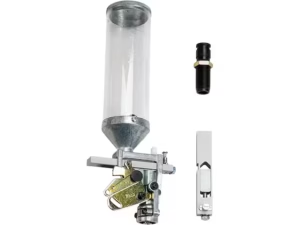
The Hornady High Speed Trimmer 50190 is a bench-mounted, powered case trimmer designed for fast, repeatable trimming of metallic cartridge cases, primarily rifle brass. It combines a heavy metal trimmer body with an AC motor to spin a steel cutter at high RPM, letting you process large batches of brass far faster than with a manual, hand-crank trimmer. It is aimed at reloaders who routinely trim hundreds of cases per session and want “good enough” length consistency for hunting, service rifle, and general target loads without stepping up to very expensive shoulder-indexed systems.
| Field | Value |
|---|---|
| Type | Bench-mounted, powered high-speed case trimmer |
| Primary use | Rapid trimming of metallic cartridge cases (primarily rifle) to consistent length |
| Brand | Hornady |
| Model | High Speed Trimmer |
| MPN | 50190 |
| Other SKUs / identifiers | Often listed as “Hornady High Speed Case Trimmer 50190”; UPC commonly shown as 090255501902 (verify with seller) |
| Materials | Cast/machined metal body (likely aluminum or zinc alloy), steel spindle and multi-flute cutter, steel collet and collet nut, metal motor housing with plastic end caps and switch |
| Dimensions (approximate) | Overall length ~12–14 in; height ~5–6 in; depth ~6–7 in (plan bench space accordingly) |
| Weight | Approx. 6–8 lb including motor and trimmer body |
| Power source | Plug-in AC motor, 110–120 V, 60 Hz (North America), on/off switch on motor housing |
| Warranty | Hornady lifetime warranty on tools against defects for original owner; motor typically covered as an electrical component – details may vary |
| Country of origin | Hornady is US-based; tool is generally Made in USA with a motor that may be imported (check product label) |
| MSRP | Roughly $350–$400 (historical range) |
| Typical street price (approximate) | Commonly $280–$340 USD depending on retailer and sales |
What’s In The Box
Included with the standard Hornady High Speed Trimmer 50190 (MPN 50190):
- High Speed Trimmer main body with integrated spindle and cutter head
- Electric motor assembly with mounting bracket (pre-attached or attachable to the trimmer body)
- Collet-style case holding system (collet and collet nut)
- Power cord attached to the motor with on/off switch on the housing
- Cast base / feet for bench mounting
- Owner’s manual and basic setup instructions
Not included but required or commonly needed for operation:
- Bench mounting hardware (bolts, washers, and nuts—typically 1/4″ or 5/16″, sized to the base holes)
- Calipers or a case length gauge to set and verify trim length
- Sized brass cases to use as setup references
- Case lube (optional but helpful for some brass and heavy trimming to reduce chatter)
- Separate deburring/chamfer tools (internal and external)
- Tray, box, or dust collection method for brass shavings
There is no widely sold “kit” version that bundles pilots, shellholders, or other prep tools. The Hornady High Speed Trimmer 50190 is sold as a self-contained powered trimmer unit, and you supply the rest of your case prep workflow.
Versions, Kits & Part Numbers
As of 2024, Hornady offers one primary powered bench trimmer under this name. It is distinct from the manual Cam-Lock trimmer and from the Lock-N-Load Power Case Prep Center.
| Version | MPN | Included items | Notes |
|---|---|---|---|
| Hornady High Speed Trimmer 50190 | 50190 | Powered bench-mounted trimmer with motor, collet system, cutter head, and base | Sometimes listed as “High Speed Case Trimmer.” No major “Gen 2” version is documented; running changes are minor. |
Related Hornady tools often confused with 50190:
- Hornady Cam-Lock Trimmer – manual hand-crank trimmer (MPN 050140), no motor.
- Hornady Lock-N-Load Power Case Prep Center – multi-station prep center with integrated trimmer (MPN 050012), different design and use case.
Retailer SKUs (examples):
- Commonly listed as “Hornady 50190 High Speed Case Trimmer”
- UPC often shown as 090255501902 (verify on the physical box or with Hornady if critical)
Discontinued / older versions: No clearly distinct earlier generations with different part numbers are documented. Any small changes in finish, motor style, or hardware are running updates, not separate models.
Build Quality & Design
The Hornady High Speed Trimmer 50190 is built as a heavy, single-purpose bench tool with a focus on throughput and durability rather than cosmetic perfection.
- Materials and construction:
- Cast or machined metal body with machined bearing surfaces for the spindle and collet.
- Steel spindle and multi-flute steel cutter head for long service life.
- Steel collet and collet nut hold the case by the rim.
- Compact AC motor bolted to the trimmer body and coupled to the spindle.
- Hornady red painted or powder-coated finish on the body.
- Rigidity and stability:
- Heavy casting and short overhangs provide good rigidity when bolted to a solid bench.
- Minimal flex is reported when properly mounted; vibration is usually tied to bench stiffness and motor alignment.
- Base is designed for through-bolting; clamps alone are not ideal for long-term use.
- Machining and finish quality:
- Machining is functional and appropriate for general reloading, but not “toolroom-jewel” level.
- Collet threads are generally smooth but can feel a bit coarse until broken in.
- Some users note minor runout or vibration at high speed if the motor/coupling alignment is slightly off.
- Paint holds up reasonably well, with normal wear around the collet and base over time.
- Durability:
- Many users report multi-year service trimming thousands of cases.
- The motor and coupling are the most common long-term concerns; a minority of users report overheating or eventual failure.
- Cutter edge holds up well under normal use but will eventually need sharpening or replacement for heavy users.
Overall, the design favors robustness and speed. It is not a benchrest-grade, shoulder-indexed lathe, but for bulk rifle brass it offers a solid, workmanlike build that stands up to regular use.
Setup & Adjustment
Unlike small hand tools, the Hornady High Speed Trimmer 50190 must be firmly mounted and carefully aligned to deliver smooth, consistent trimming. Plan to spend some time on initial setup; once dialed in, adjustments are infrequent.
Bench and space requirements:
- Requires a solid, non-flexing bench; flimsy tops increase vibration and noise.
- Allow roughly a 14″ x 8″ footprint including working room in front of the collet and space for brass and shavings.
- Mount with 2–4 bolts through the base; washers help spread the load and keep the casting from digging into softer benches.
Step-by-step setup:
Unpack and inspect components
- Verify that the motor, trimmer body, collet, and cutter are present and undamaged.
- Rotate the spindle by hand to confirm it turns freely without grinding.
Attach and align the motor (if not pre-installed)
- Align the motor shaft with the trimmer spindle coupling per the manual.
- Tighten set screws or mounting bolts evenly so the coupling runs true.
- Briefly power on to check for smooth rotation and minimal vibration; re-align if needed.
Bench mount the trimmer
- Position the unit so you have clear access to the collet nut and room for brass bins.
- Mark and drill bench holes to match the base pattern.
- Bolt the trimmer down firmly using appropriate hardware and lock washers or nyloc nuts.
Install and verify the cutter
- Ensure the cutter head is properly seated and secured on the spindle.
- With the motor off, spin the spindle by hand to confirm there is no rubbing or interference.
Set initial trim length
- Size a few cases and measure them with calipers.
- Insert a case into the collet, lightly tighten the collet nut, and slide the case fully home.
- With the motor off, move the cutter head/stop along the spindle until it just kisses the case mouth.
- Lock the adjustment, then fine-tune by trimming a test case and measuring until you hit your desired trim-to length.
Lock adjustments and record settings
- Tighten the lock screws on the cutter head/stop once you are satisfied with length.
- Note your trim length and any reference marks so you can return to this setting later.
Typical first-time mistakes:
- Poor bench rigidity: Mounting to a thin or wobbly surface leads to vibration, noise, and inconsistent cuts.
- Over-tightening the collet: Can mar case rims and slows insertion/removal, increasing hand fatigue.
- Incorrect trim length setup: Setting the cutter too deep and over-trimming brass; always verify with calipers before running a big batch.
- Motor misalignment: If the motor shaft and spindle are not in line, you’ll feel wobble and see chatter marks on case mouths.
- No chip management: Brass shavings build up quickly; without a tray or vacuum they can interfere with the collet and cutter.
Taking the time to mount the trimmer solidly, align the motor, and confirm trim length with several test cases will pay off in smoother operation and more consistent results.
Daily Use & Performance
Once set up, day-to-day use is straightforward: insert a sized case, snug the collet, power the motor, feed the case into the cutter until you feel it clean up the mouth, then back out, stop the motor if desired, loosen the collet, and repeat. The high-speed motor is the main advantage over manual trimmers, especially for large batches of common rifle brass.
- Handling and ergonomics:
- Controls are simple – on/off switch and the collet nut.
- Collet operation is repetitive; long sessions can tire your hand if you over-tighten.
- Cases feed straight into the cutter; there is no complex indexing or pilot swapping.
- Smoothness and speed:
- When properly aligned and mounted, the spindle runs smoothly with modest vibration.
- Users commonly trim hundreds of cases per session, with a major time savings vs. hand-crank trimmers.
- Light, steady feed pressure minimizes chatter; forcing the case into the cutter can cause rougher mouths.
- Consistency and repeatability:
- Real-world variation is typically ±0.001–0.003″ once dialed in, adequate for most hunting and general target ammo.
- Consistency depends on uniform collet tension, consistent case sizing, and a sharp cutter.
- Not usually the first choice for extreme precision or benchrest shooters chasing ultra-tight tolerances.
- Pistol vs rifle, small vs large cases:
- Rifle brass: Ideal for .223/5.56, .308, .30-06, 6.5 Creedmoor, and similar cases that need regular trimming.
- Pistol brass: Seldom trimmed; the tool is rarely used for pistol cases.
- Very short cases can be awkward to handle; very long wildcats may exceed spindle travel.
Noise level is higher than manual trimmers but typical for a small AC motor. Many reloaders wear hearing protection during long trimming sessions, especially in smaller rooms.
Compatibility & Use Cases
The Hornady High Speed Trimmer 50190 is a stand-alone bench tool that does one job: trim cases to length. It does not mount in a press or share tooling with die systems, but trimmed brass is, of course, compatible with any press and die brand.
Operations it handles well:
- Bulk trimming of common rifle calibers for AR shooters, hunters, and general target shooters.
- Processing large lots of once-fired brass where speed matters more than benchrest-grade precision.
- Dedicated trimming station separate from your main press, keeping brass prep off the loading press.
Compatibility details:
- Thread standards:
- Uses its own spindle and cutter system; it does not use 7/8-14 press threads or standard die bodies.
- Cutter head and collet are proprietary to this design.
- Case holding:
- Collet holds the case by the rim; no press shellholders are used.
- Designed to cover a wide range of common rifle case rims with a single collet.
- Very unusual or very small/large rims may not grip optimally; test fit before committing to big runs.
- Cartridge range:
- Suitable for most standard rifle cases from 223 Rem up through 30-06 and similar lengths within spindle travel.
- Extremely short or extremely long wildcats may require alternative trimming solutions.
- Other brands and systems:
- Does not integrate with Dillon toolheads, Hornady Lock-N-Load bushings, or other quick-change press systems.
- Trimmed brass works with any brand of dies and presses once case length is correct.
Known incompatibilities and workarounds:
- Oddball case rims or heavily modified brass may not seat well in the collet; some users experiment with shims or light modifications, but these are not factory-endorsed.
- Shooters chasing sub-0.001″ length variation often prefer shoulder-indexed trimmers (Giraud, Henderson, Wilson) for their match brass.
Maintenance
- Cleaning after use:
- Brush or vacuum brass shavings from the cutter area, collet, and base after each session.
- Wipe exposed metal surfaces with a lightly oiled cloth to prevent corrosion (avoid the cutter edge and collet interior).
- Keep the motor vents clear of chips and dust.
- Periodic checks:
- Every few thousand cases, check motor mounting bolts and spindle coupling set screws for tightness.
- Inspect the cutter edge; sharpen or replace if cuts become rough or require more pressure.
- Lightly lubricate spindle bearings or bushings as recommended in the manual, avoiding excess oil near the cutter.
- Clean and lightly oil collet threads to prevent galling, but keep oil off case contact surfaces.
- Electrical components:
- Inspect the power cord and on/off switch periodically for damage or intermittent operation.
- If the motor overheats or fails, contact Hornady customer service; replacement motors and switches are typically available.
Replacement parts and support: Hornady generally supports their tools well. Replacement cutters, collets, collet nuts, motors, and small hardware can usually be obtained by contacting Hornady with the tool MPN (50190) and a description of the needed part.
Final Thoughts
The Hornady High Speed Trimmer 50190 is best suited to reloaders who process a lot of rifle brass and want to move beyond slow, hand-crank trimmers without jumping into very expensive shoulder-indexed systems. Its strengths are speed, solid construction, and “good enough” length consistency for most hunting and general target ammo. Limitations include motor noise, some unit-to-unit variation in vibration, and the fact that it is not a benchrest-grade, shoulder-indexed design and does not chamfer or deburr in one pass.
If you want deeper analysis of how it stacks up against alternatives and whether it fits your style of shooting, see the main review article for the Hornady High Speed Trimmer 50190. For a more opinion-driven look based on user experiences, forum posts, and retailer reviews, check the dedicated real-world feedback article. Together, those pieces and this setup guide should give you a complete picture before you commit bench space and budget to this trimmer.