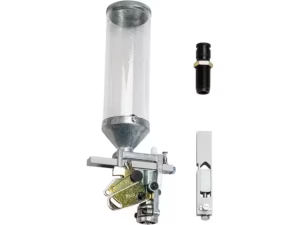
Common Complaints Reported by Reloaders
- Tube rotation can be rough or not as smooth as higher‑end tricklers.
- Some units have noticeable play or wobble in the tube.
- Powder can occasionally bridge in the tube, especially with long extruded powders.
- Finish or paint can chip or scratch easily with heavy bench use.
- Overall feel is not as refined or precise as more expensive tricklers.
- Reservoir capacity is relatively small and needs refilling more often during large batches.
- Height and reach may not be ideal for all scales without shimming or repositioning.
- Static cling in very dry environments can cause kernels to stick in the tube or at the outlet.
- A few users feel the base could be heavier, especially when turning the knob quickly.
Positive Notes & Strong Points Mentioned by Users
- Very affordable compared to many competitors and far cheaper than electronic dispensers.
- Heavy base provides good stability and resists tipping in normal use.
- Simple, reliable design with no electronics to fail or drift.
- Works well with both beam and digital scales from a wide range of brands.
- Capable of single‑kernel control with some practice and a decent scale.
- Good value for occasional or budget‑minded reloaders who still care about precise charges.
- Compact size makes it easy to store, move, or keep on a crowded bench.
- Durability is adequate for years of normal use; most wear is cosmetic.
- Often recommended as a “first trickler” before deciding whether to upgrade to a premium model.
Sample User Quotes
“rangehand_77: It’s not fancy, but it does exactly what I need – lets me sneak up on my rifle charges one kernel at a time.”
“midwest_loader: The tube feels a little loose compared to my buddy’s RCBS, but for the price I can’t complain. It gets the job done.”
“precision_plinker: With ball powder it’s almost too fast, but once I slowed down my hand it became very consistent.”
“oldschoolreloader: I’ve used this trickler for several years with a beam scale. No issues other than a few chips in the paint.”
“budget_bencher: I was looking at electronic dispensers, but this plus a good scale turned out to be a much cheaper way to get accurate charges.”
“slowfire_45: I did have to shim it up on a block to line up with my digital scale, but once I found the sweet spot it’s been very repeatable.”
“mountainmarksman: Threads were gritty out of the box, but after a little use and a touch of dry lube on the outside threads it smoothed right out.”
“benchrest_hobbyist: It’s not in the same league as my high‑end gear, but for load development on a second bench it’s perfectly serviceable.”
Practical Takeaways from User Experience
Looking across forum threads and retailer reviews, a consistent picture emerges. Most reloaders buy the Frankford Arsenal Powder Trickler because of its low price and simple design. They are generally aware that it is not a premium tool, and they judge it on whether it reliably meters powder into the pan, not on cosmetic perfection. On that basic task, feedback is largely positive: once positioned correctly, it trickles powder with enough control to hit ±0.1 grain on a decent scale.
The most common annoyance is the feel of the tube. Some units are smooth from day one, while others feel gritty or slightly loose. Users often report that this improves after a few sessions, or with a tiny amount of dry lubricant on the external threads (kept away from the powder path). A few owners mention that the base will walk a bit on slick benches when they spin the knob quickly; placing it on a rubber mat or non‑slip liner is a simple and widely used fix.
Height and reach are another recurring theme. Because the trickler has a fixed base and limited adjustment via the threaded tube, it does not naturally line up with every scale and pan combination. Many reloaders simply set it on a block of wood, a reloading block, or a stack of coasters to get the outlet where they want it. Once that is dialed in, they tend to leave the setup alone and report no further issues.
Performance with different powders is about what you would expect from a basic trickler. With ball or spherical powders, users say it can dispense very quickly; overshooting is easy until you learn to slow your hand down and use partial turns. With short‑cut extruded powders, most people find it easy to get single‑kernel control. Long extruded powders and some flakes can bridge in the tube, but a light tap or a brief reverse turn usually clears the obstruction. None of these behaviors are unique to this model; they are typical of manual tricklers in this price range.
On durability, feedback is quietly positive. There are very few reports of outright failure. Instead, users talk about chipped paint, cosmetic wear, and the occasional loose knob. For a tool that often costs less than a box of match bullets, most owners are satisfied if it lasts several years of regular use, and many report exactly that. When problems do occur, some reloaders mention that Frankford Arsenal customer service was willing to replace or address the issue under their limited lifetime warranty.
Comparisons to higher‑end tricklers are predictable. Those who own RCBS, Lyman, or Hornady units usually describe them as smoother, heavier, and more refined. However, even these users often keep the Frankford trickler on the bench as a backup or for a secondary scale. The general sentiment is that you pay more for nicer machining and ergonomics, not necessarily for dramatically better charge accuracy. For many hobbyists, the Frankford unit hits a sweet spot between cost and function.
Where the trickler clearly does not shine is in very high‑volume workflows. Competitive pistol shooters running thousands of rounds a month rarely rely on any manual trickler; they lean on progressive presses and high‑quality measures or electronic dispensers. In that context, the Frankford trickler is more of a niche tool for load development, precision rifle, or careful handgun work where every charge is weighed and time per round is less critical.
Final Thoughts
Taken as a whole, real‑world feedback on the Frankford Arsenal Powder Trickler is solidly positive, with expectations properly set. It is a budget tool that behaves like a budget tool: the finish is basic, the tube may feel a little rough at first, and you might need a shim or non‑slip mat to make it feel “just right” on your bench. In return, you get a compact, metal‑bodied trickler that works with almost any scale, meters powder reliably, and usually keeps doing so for years with minimal maintenance.
If you are a beginner or intermediate reloader who weighs individual charges and wants more control than a powder measure alone can provide, this trickler is an easy, low‑risk upgrade. Precision shooters who already own premium gear may still find it useful as a backup or travel tool, but those chasing the smoothest possible feel or fully automated workflows will likely prefer higher‑end tricklers or electronic dispensers. For a structured look at specs, setup, and maintenance, see our Frankford Arsenal Powder Trickler setup guide. For a broader analysis of pros, cons, and alternatives, check the main Frankford Arsenal Powder Trickler review.