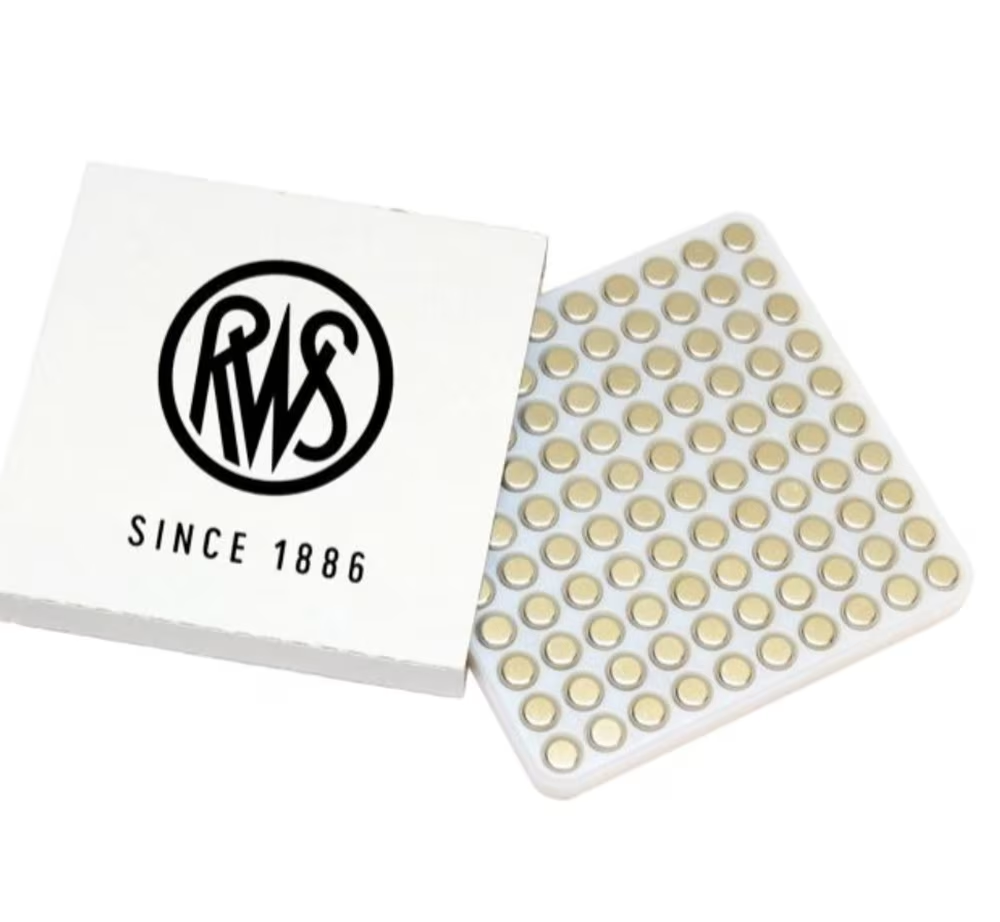
The RWS 4033 is a premium small rifle primer manufactured in Germany by RWS (RUAG Ammotec), designed specifically for the discerning reloader who prioritizes ignition consistency and extreme accuracy. As a cornerstone of the European precision shooting community, the RWS 4033 has built a formidable reputation for maintaining stable velocities across a wide variety of small-bore rifle cartridges. Known for its distinct nickel-plated silver appearance, the RWS 4033 utilizes the proprietary SINOXID priming compound, which is highly regarded for its non-corrosive and non-mercuric properties, as well as its long-term stability in diverse environmental conditions.
- Primer Type: Small Rifle Standard
- Key Advantage: Exceptional manufacturing tolerances and a highly stable SINOXID priming mix.
- Primary Match: Precision benchrest shooting, varmint hunting, and high-accuracy 223 Remington loads.
Best For: Handloaders who require match-grade reliability for small-capacity rifle cases and competitive shooters who prioritize low extreme spread (ES) and standard deviation (SD) in their chronographed strings.
Technical Specifications
| Feature | Specification |
| Manufacturer | RWS (RUAG Ammotec) |
| Primer Size | Small Rifle |
| Cup Material | Nickel-Plated Brass |
| Cup Diameter | 4.45 mm |
| Priming Compound | SINOXID (Non-Corrosive) |
| Packaging | 100 per tray / 1000 per brick |
| Country of Origin | Germany |
Positioning and Brand Heritage
The RWS 4033 sits at the top of the European hierarchy of small rifle ignition components. Within the RWS product lineup, which includes specialized options like the RWS 4031 for pistol and the RWS 4047 for magnum pistol, the RWS 4033 is the primary choice for rifle applications. RWS primers have been produced for over a century in Fürth, Germany, under the parentage of Dynamit Nobel, a name synonymous with high-energy chemistry and explosive precision.
The RWS 4033 is positioned as a “Standard” small rifle primer, but its performance often overlaps with what American manufacturers label as “Match” or “Benchrest” grade. The SINOXID compound used in the RWS 4033 was one of the first successful non-corrosive priming mixtures ever developed, and RWS has spent decades refining the blend to ensure that it remains insensitive to temperature fluctuations ranging from -60 to +60 degrees Celsius. This level of engineering ensures that a hunter in the Alpine winters or a target shooter in the summer heat will experience the same ignition delay and flame intensity from their RWS 4033 primers.
Compatibility and Safety Constraints
When integrating the RWS 4033 into a reloading regimen, it is important to understand the mechanical properties of its nickel-plated cup. While the RWS 4033 is generally robust enough for many modern cartridges, it is categorized as a standard small rifle primer. This means its cup is slightly more sensitive than specialized mil-spec or magnum primers. Shooters utilizing the RWS 4033 in semi-automatic rifles with free-floating firing pins, such as the AR-15, must exercise caution. While the nickel plating adds some surface hardness, the RWS 4033 is not specifically a “hard cup” military primer, and improper seating could theoretically lead to a slam-fire in specific high-energy bolt-cycling scenarios.
For the highest level of safety and performance, the RWS 4033 must be seated 0.003-0.005 inches below flush. Because RWS primers are manufactured to very tight metric tolerances, they can occasionally feel “tight” when being seated into American-made brass cases that follow slightly different manufacturing standards. Proper seating ensures that the anvil is correctly pre-tensioned against the compound. If the RWS 4033 is seated too shallow, the firing pin’s energy will be partially absorbed by the movement of the primer, potentially resulting in a “light strike” or a hang-fire.
Any primer substitution requires a 10% reduction in powder charge. The RWS 4033 has a specific brisance profile that may generate higher pressures than other standard primers. Always reduce your current load by 10% and work back up to your target velocity while watching for signs of overpressure on the primer face and case head.
Recommended Cartridges and Applications
| Cartridge | Primary Application |
| 223 Remington | Match-grade target shooting and high-velocity varminting. |
| 22 Hornet | Gentle ignition for thin-walled small-capacity cases. |
| 222 Remington | Classic benchrest accuracy and precision field work. |
| 30 Carbine | Reliable ignition for vintage and modern carbine platforms. |
| 6mm BR | Extreme precision for competitive benchrest stages. |
| 22 Nosler | Reliable ignition in specialized high-throughput rifles. |
| 224 Valkyrie | Consistent long-range performance with lighter projectile loads. |
| 6.5 Grendel | Optimized for accuracy in small-pocket hunting loads. |
The RWS 4033 is an ideal candidate for cartridges like the 222 Remington, where the case volume is small enough that a magnum-level primer would be overkill and potentially disruptive to the powder column. In the 223 Remington, the RWS 4033 is a favorite among European shooters for its ability to produce clean, vertical strings at distance.
Powder Pairings
Because the RWS 4033 provides a highly uniform but moderate-intensity flame, it pairs best with Single-Base extruded powders that are easy to ignite. These powders do not require the massive thermal output of a magnum primer, and the consistent spark of the RWS 4033 allows the pressure curve to develop without excessive turbulence.
In the world of precision 223 loads, the RWS 4033 is a legendary companion for Vihtavuori N133. This combination is a staple of competitive benchrest shooting, as both components are produced to exacting European standards. For slightly heavier projectiles, pairing the RWS 4033 with Hodgdon Varget or Vihtavuori N140 results in exceptionally stable velocities that resist temperature changes.
While the RWS 4033 is not a magnum primer, it can effectively ignite many Spherical powders in smaller cases. When loading for the 30 Carbine, the RWS 4033 provides the necessary start for powders like Accurate 2230 or Alliant Reloder 15, provided the charge weight is within standard parameters. However, for extremely large charges of ball powder or in ultra-cold hunting environments, one might consider moving to a magnum option.
Comparison and Alternatives
The RWS 4033 competes directly with the highest-tier small rifle primers on the global market. Understanding its characteristics relative to its peers is essential for making an informed choice.
- CCI 400: The American standard for general-purpose small rifle reloading. The RWS 4033 is generally considered more consistent but is often more expensive.
- Federal 205: A very popular precision primer. The RWS 4033 cup is often cited as being slightly harder than the Federal 205, making it a bit more resistant to cratering.
- Winchester WSR: A hotter standard primer. The RWS 4033 focuses more on uniformity of the flame rather than sheer flame length.
- CCI BR-4: The benchrest benchmark from CCI. These two are very comparable in target performance, with the RWS 4033 being the preferred choice in many European international matches.
- Remington 7-1/2: Known for a thick cup and hot output. The RWS 4033 is typically viewed as a “milder” match option compared to the Remington.
- CCI No 41: A military-grade primer with a much harder cup. For tactical AR-15 builds, the CCI No 41 is safer, whereas the RWS 4033 is better for pure accuracy.
- RWS 5341: The large rifle counterpart. If you have had success with the 5341 in your 308 Winchester, the RWS 4033 provides the same family of performance for your small-bore rifles.
- RWS 5333: The magnum large rifle version. This primer represents the higher intensity end of the RWS line, which contrasts with the precision-focus of the RWS 4033.
FAQ
Is the RWS 4033 a magnum primer?
No, the RWS 4033 is a standard small rifle primer. It is designed for standard pressure cartridges and easily ignited powders. For magnum-specific small rifle needs, one would typically look toward a primer with a higher priming compound volume.
Can I use the RWS 4033 in an AR-15?
Yes, the RWS 4033 is used by many precision AR-15 shooters. However, because it does not have the “mil-spec” sensitivity rating of a primer like the CCI No 41, you should ensure your rifle’s firing pin is within specification and that the primer is seated at least 0.003 inches below flush.
Why are RWS 4033 primers silver in color?
The RWS 4033 features a nickel-plated brass cup. This plating serves two purposes: it provides a smoother surface for consistent feeding and seating, and it offers superior corrosion resistance compared to plain brass primers.
How does the SINOXID compound in the RWS 4033 benefit my barrel?
SINOXID is a non-corrosive priming mixture. Unlike old-fashioned primers that left behind salts that could rust a barrel, the residue from an RWS 4033 is chemically stable and will not damage your firearm’s bore or action.
Are RWS 4033 primers hard to find in the United States?
Availability of the RWS 4033 can fluctuate based on import batches. They are highly sought after by precision shooters, so they often sell out quickly when they become available through specialized reloading retailers.
Can I use RWS 4033 in place of CCI 400?
Mechanically, they fit the same pockets. However, because of the different explosive formulations, you must perform a load development work-up. Never assume that the pressure generated by an RWS 4033 will be identical to that of a CCI primer.
Conclusion & Expert Verdict
The RWS 4033 stands as a testament to German engineering excellence in the field of ammunition components. It is a specialized tool for the reloader who views their ammunition as an extension of a precision instrument. While it may come at a premium price compared to domestic options, the peace of mind provided by its century-long lineage and ultra-consistent SINOXID compound is invaluable for those chasing the perfect five-shot group. Whether you are loading for a vintage 222 Remington or a modern match-grade 223 Remington, the RWS 4033 delivers the stability and reliability required to reach the winner’s podium.
Expert Pro Tip: If you are using the RWS 4033 for long-range target shooting, try batch-sorting your primers by weight. Because the manufacturing tolerances of RWS are already so tight, weight-sorting will yield very few outliers, but the process allows you to identify the most uniform primers for your “money loads” at 600 or 1000 yards. This technique, combined with a precision powder like Vihtavuori N133, is the gold standard for reducing vertical stringing.