Published: February 2026 | Last updated: April 2026
Disclaimer: Specifications and pricing in this article are drawn from manufacturer and retailer sources current at time of publication. Always verify current pricing before purchasing.
The Lee Auto Bench Priming Tool is Lee Precision’s bench-mounted approach to the same problem their hand priming tool addresses: seating primers consistently and safely without directly handling them. At $35.99 – slightly less than the Lee New Auto Prime Hand Priming Kit reviewed alongside it – the Auto Bench Prime offers a lever-actuated bench-mounted design that Lee claims allows primers to go from box to seated case without ever being touched by hand.
A 3.7-star average from 291 reviews puts it in a more honest position than the Lee New Auto Prime hand tool’s 3.2 – better by half a star, and with nearly four times the review sample. That larger sample is more statistically reliable, and the 3.7 tells a story that sits between “works well enough for what it is” and “has real limitations that affect a significant portion of users.” Understanding which side of that line your application falls on is what this review is for.
The Lee Auto Bench Prime occupies an unusual position in the priming tool market: it costs less than most of the competition, it mounts to the bench rather than operating from the hand, and it’s specifically designed around Lee’s own shellholder system. Those characteristics make it a natural fit for certain setups and a poor match for others.
Key Specifications
| Field | Value |
|---|---|
| Manufacturer | Lee Precision |
| Model | Auto Bench Priming Tool |
| SKU | 978504 |
| UPC | 734307907006 |
| Operation | Bench-mounted, lever-actuated |
| Primer Feed | Automatic – primers not touched from box to case |
| Shellholders | Lee shellholder compatible (sold separately) |
| Primer Size | Small and large (shellholder-dependent) |
| Rating | 3.7 / 5.0 (291 reviews) |
| MSRP | $35.99 |
| Approx. Street Price | $30.00 – $35.99 |
Note that shellholders are not included with the Lee Auto Bench Priming Tool. If you’re coming from the Lee New Auto Prime Kit, your existing Lee shellholders carry over directly. If you’re starting fresh, factor in the additional cost of appropriate shellholders for your calibers – Lee shellholders are inexpensive individually, but you’ll need at least one for each case head diameter you’re loading.
Bench-Mounted vs. Hand Priming: The Core Tradeoff
Before evaluating the Lee Auto Bench Prime specifically, it’s worth addressing why someone would choose a bench-mounted priming tool over a hand tool – or vice versa. The two approaches optimize for different things.
Hand priming tools – like the Lee New Auto Prime, RCBS Hand Priming Tool, Frankford Arsenal Perfect Seat, or K-M Primer Deluxe – put the priming operation in your palm. The tactile feedback of each primer seating is direct and immediate. A primer that bottoms out correctly feels different from one that seats too deep, too shallow, or canted – and you feel it as it happens. This tactile sensitivity is why precision rifle reloaders often prefer hand tools for primer seating even if it’s slower.
Bench-mounted priming tools trade some of that tactile sensitivity for ergonomic advantages. The lever action distributes the seating force through a mechanical advantage that reduces hand fatigue over long sessions. The tool stays in one position on the bench, which some reloaders find more comfortable than cycling a hand tool for extended priming operations. And for reloaders who prioritize throughput over individual charge precision – volume pistol loading, for example – the bench-mounted rhythm can be faster per case once the setup is dialed in.
The Lee Auto Bench Prime is designed around the second approach. Whether it executes that approach well enough to justify its place in a serious reloading setup is the question.
Design and Build Quality
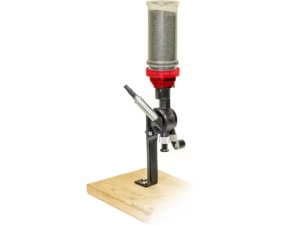
The Lee Auto Bench Priming Tool uses a lever-actuated mechanism mounted to a base that secures to the bench via a standard C-clamp or bolt-through arrangement. The shellholder fits into the ram, the primer feed system drops a primer into position for each stroke, and the lever drives the case down onto the primer or – depending on orientation – drives the primer up into the case.
The construction is polymer-dominated, consistent with Lee’s approach across their priming tool lineup. The lever mechanism and ram are the load-bearing components and use more robust materials, but the primer feed system and housing are primarily plastic. This is where the durability concerns in the review record originate – the same polymer components that show wear in the hand tool also appear in the bench version, though the lever mechanism means less stress on the plastic housing per seating operation compared to the repetitive hand-squeeze of the hand tool.
The primer feed design carries Lee’s core claim: primers load into the feed system from the tray and are delivered to the seating position without requiring the operator to handle individual primers. In practice, this works as described when the feed mechanism is functioning correctly – which most of the time it does. The portion of the negative reviews that involves primers not feeding, feeding inverted, or bridging in the feed path is the mechanism not working as described, and this failure mode appears often enough in the 291-review record to treat as a real characteristic rather than an outlier.
The Shellholder Question
The Lee Auto Bench Prime uses the same Lee-format shellholders as the Lee New Auto Prime hand tool, the Lee Classic Turret Press, and other Lee equipment. If your bench already runs Lee tooling, you’re set. If your press is an RCBS, Redding, Hornady, or Lyman and you’ve invested in shellholders for that platform, those shellholders are not compatible with the Lee bench primer. You’d be starting a separate Lee shellholder inventory alongside your existing one, which adds a hidden cost that doesn’t show up in the $35.99 price tag.
This is not a small consideration. Lee shellholders run $5-10 each, and if you load 10+ calibers, the investment in a second shellholder system adds up to real money against a tool that already comes without them included.
Setup and Operation
Bench mounting. The Lee Auto Bench Prime mounts using a standard bench clamp or bolts directly to the bench surface. Stability during operation is important – a bench primer that rocks or shifts during the lever stroke produces inconsistent seating. Secure the tool firmly before use and check the mounting between sessions, particularly if you share the bench with other equipment that creates vibration.
Loading the primer feed. Use Lee’s safety prime tray to orient primers anvil-up before loading them into the feed system. This step is mandatory for safe operation, not optional. Load a moderate number of primers at a time – 20-25 maximum rather than filling the feed tube completely. A full tube creates column pressure that contributes to bridging and feed failures, particularly with large rifle primers that have tighter clearance in the feed path than small pistol primers.
Shellholder setup. Select the Lee shellholder appropriate for your case head diameter. With the shellholder seated in the ram, verify that the ram travel is smooth and complete through the full priming stroke. A partial stroke will not fully seat the primer and can create a primer seated proud of the case head – a safety condition to avoid.
Priming stroke technique. Unlike a hand tool where squeeze pressure is variable, the bench-mounted lever provides consistent mechanical travel when operated correctly. Bring the lever through a complete, smooth stroke on every case – not a partial stroke, not a fast jerk. The seating depth is set by the tool’s stop mechanism, which means consistent strokes should produce consistent seating depth. When the seating stop triggers, release the lever – don’t attempt to compress further, which can over-seat the primer.
Post-seating inspection. After each case is primed, visually check the primer before moving to the next case. The primer should be seated flush to 0.003-0.005 inches below the case head surface. A primer seated proud of flush is a safety concern in any case that goes to the chamber. Given the feed mechanism’s occasional tendency to deliver primers in unusual orientations, this visual check is not optional on the Lee tool – make it part of the rhythm.
Primer Safety Considerations
Priming is the reloading step that involves the most acute safety exposure. Primers are the energetic component in a round, and a primer that fires during seating – from excessive force, from an inverted primer encountering the anvil in the wrong orientation, or from debris in a dirty primer pocket creating unexpected resistance – produces a flash and noise at the bench that can cause injury.
The Lee Auto Bench Prime’s claim that primers go from box to case without being touched is meaningful from a safety standpoint: minimizing direct primer handling reduces the risk of static discharge, contamination, and primer deformation from handling. The safety prime tray system is a genuine safety feature when used correctly.
What the safety prime tray cannot fully prevent is the occasional inverted primer reaching the seating position through the feed mechanism. If a primer reaches the pocket anvil-up rather than anvil-down, the seating stroke creates an unusual force condition. Always inspect the primer in the feed position before actuating the seating stroke if you have any reason to suspect a mis-oriented primer is present. When in doubt, remove the primer from the feed position and reload the tray more carefully.
For 5.56 NATO, 7.62×51 NATO, and other military brass with crimped primer pockets, remove the crimp completely before using this or any priming tool. The additional resistance of an un-swaged crimp concentrates the seating force in a way that the Lee bench primer’s lever mechanism will drive through – but the primer may deform, cock, or the pocket may be damaged in the process. Swage or ream military brass before priming.
Where the Lee Auto Bench Prime Fits
Volume Pistol Loading
The Auto Bench Prime’s best application is moderate-volume pistol loading where you’re priming 50-150 cases of 9mm Luger, 45 ACP, 38 Special, or 357 Magnum in a session. Pistol brass tends to have more consistent primer pockets than once-fired commercial rifle brass or military surplus, the small pistol primers feed more cleanly through the Lee mechanism than large rifle primers, and the volume justifies the bench setup time.
The lever rhythm for pistol brass is faster than the hand squeeze cycle once you’re in a production flow. Place the case, stroke the lever, visually confirm, set the case aside – at that cadence, 100 cases takes under 10 minutes with this tool when the feed is running cleanly.
Moderate Rifle Reloading
For 308 Winchester, 30-06 Springfield, 6.5 Creedmoor, or similar with large rifle primers, the Lee Auto Bench Prime works adequately when the brass is well-prepped. Large rifle primers are more likely to bridge or feed inconsistently than small pistol primers in the Lee feed mechanism, so expect to manage the feed more actively with periodic checks during a rifle priming session.
Where It Falls Short
For precision rifle reloading where individual primer seating depth is a controlled variable – benchrest, long-range competition, load development for tight-group work – the Lee bench primer’s polymer construction and feed-mechanism variability make it a tool to reconsider. The tactile feedback through a lever mechanism is already less direct than a hand tool. Combine that with the feeding inconsistency that affects a meaningful portion of users and you’re working against the precision goals of that application. The RCBS Automatic Bench Priming Tool or a quality hand tool like the K-M Primer Deluxe is a better fit for that use case.
For a Lee turret or single-stage press user who already has Lee shellholders and wants a dedicated priming station without switching shellholders between the press and the primer tool, the Auto Bench Prime integrates naturally into a Lee-centric bench without additional tooling investment. That’s a genuine practical advantage for that specific setup.
How It Compares Within the Lee Priming Lineup
Lee offers two priming tool formats at adjacent price points, which invites a direct comparison.
| Feature | Lee Auto Bench Prime | Lee New Auto Prime Kit |
|---|---|---|
| Operation | Bench-mounted lever | Hand-squeeze portable |
| Shellholders | Not included | 8 included |
| Storage Box | No | Yes |
| Price | $35.99 | $37.99 |
| Rating | 3.7 / 5 (291 reviews) | 3.2 / 5 (76 reviews) |
| Best For | Bench-based volume | Portable / first setup |
The Auto Bench Prime has a better review score and four times the review sample. It costs slightly less than the kit. It doesn’t include shellholders. For a reloader choosing between the two Lee options: if you already have Lee shellholders, the Auto Bench Prime is the better choice on rating and price. If you’re starting from zero and need a complete kit, the New Auto Prime Kit’s included shellholders and storage box offset the higher price and lower rating.
Competitive Analysis
The Lee Auto Bench Prime competes with a field of bench-mounted priming tools that span from budget to premium.
RCBS Automatic Bench Priming Tool is the most direct alternative and the most frequent recommendation from reloaders who’ve moved away from the Lee tool. The RCBS bench primer uses RCBS shellholders, has metal-frame construction, and its review record reflects a more reliable feeding and seating experience than either Lee priming tool. It costs more than the Lee – typically $65-85 depending on configuration – but that price difference buys meaningfully better consistency. For a reloader who values reliable priming over minimum initial cost, the RCBS is where the money goes.
Lyman Accu-Prime Manual Bench Priming Tool occupies a mid-tier position. Lyman’s bench primer has a more traditional approach – no automatic primer feed, which means manually placing primers, but also means fewer feeding mechanism failures. For reloaders who prefer the tactile control of individually placed primers even on a bench-mounted tool, the Lyman manual option is worth considering. It sacrifices the “no primer touching” convenience for more direct control over each seating.
Lyman Accu-Prime Auto Load Bench Priming Tool adds automatic primer feeding to Lyman’s bench primer, at a price point above both Lee options. Lyman’s auto-load version addresses the same convenience goal as the Lee Auto Bench Prime with more robust construction.
Frankford Arsenal Perfect Seat Hand Priming Tool – if you’re reconsidering whether a bench-mounted or hand tool is right for your workflow, the Frankford hand primer is a well-regarded alternative that costs modestly more than the Lee bench tool but delivers better tactile feedback and a stronger review record.
Forster Co-Ax Bench Priming Tool – at the upper end of bench priming tools, the Forster is used by precision rifle reloaders for its consistent seating depth and smooth operation. It’s several times the price of the Lee tool and aimed at a different segment of the market, but worth knowing exists when you’re thinking about where you want your bench setup to be in a year or two.
Comparison Table
| Feature | Lee Auto Bench Prime | RCBS Automatic Bench | Lyman Accu-Prime Auto | Frankford Perfect Seat |
|---|---|---|---|---|
| Type | Bench / lever | Bench / lever | Bench / lever | Hand tool |
| Construction | Polymer-dominant | Metal frame | Metal / polymer | Polymer / metal |
| Primer Feed | Automatic | Automatic | Automatic | Semi-automatic |
| Shellholders | Lee format (separate) | RCBS format | Lyman format | Standard format |
| User Rating | 3.7 / 5 (291 reviews) | ~4.3 / 5 | ~4.2 / 5 | ~4.3 / 5 |
| Price | $35.99 | $65 – $85 | $55 – $70 | $45 – $60 |
The price gap between the Lee and the RCBS bench primer is real. So is the rating gap. Whether $30-50 more for a bench primer tool is justified depends on how much you prime, how important consistency is to your loading goals, and how much bench troubleshooting time is worth to you.
Troubleshooting
Primer not advancing to seating position. Empty the feed tube and reload using the safety prime tray with fewer primers. 15-20 at a time rather than 30-40. Check the feed pawl for wear or debris. Large rifle primers are more prone to this than small pistol primers due to their tighter clearance in the feed path.
Lever doesn’t complete full stroke smoothly. Check for a primer that bridged in the feed mechanism. Remove the primer from the mechanism before forcing the lever. Forcing an obstructed lever can deform the primer or damage the feed components. Clear the obstruction, reload the tray carefully, and resume.
Primer seating depth inconsistent. Inconsistent depth from a bench-mounted tool usually indicates incomplete lever strokes. Ensure the lever is traveling fully to the stop on every case. Also check that the shellholder is seated correctly and that the case is fully inserted before stroking – a case that’s only partially in the shellholder will not present the pocket correctly to the primer.
Primer feeds inverted. Stop immediately. Remove the inverted primer from the mechanism without seating it. Inspect the remaining primers in the feed tube. An inverted primer seated in a case – anvil up – creates a safety condition where the anvil is in the wrong position relative to the firing pin’s expected strike. Discard any case in which you suspect an inverted primer was seated. Reload the feed tube from the safety prime tray and verify orientation before continuing.
Base wobble during operation. Tighten the bench clamp or mounting fasteners. A tool that rocks during the seating stroke cannot deliver consistent primer depth. If the bench surface is too thin for a secure clamp mount, add a backing board on the underside to distribute the clamp force over a larger area.
FAQ
Does the tool come with shellholders? No. The Lee Auto Bench Priming Tool does not include shellholders. It uses Lee-format shellholders, which are available individually or in sets. If you’re already running a Lee Classic Turret, Lee Value Turret, Lee Challenger III, or other Lee press, your existing shellholders work directly in this tool. If not, plan the additional shellholder cost into your budget.
How does it differ from the Lee New Auto Prime hand tool? The Auto Bench Prime is lever-actuated and bench-mounted. The New Auto Prime is hand-squeeze and portable. The bench version has a higher review rating across a much larger sample, and costs slightly less even before accounting for the hand tool kit’s included shellholders. The hand tool offers more direct tactile feedback per primer seated. For a reloader choosing between the two Lee options with existing Lee shellholders, the Auto Bench Prime is the better buy.
Does it work with both small and large primers? Yes. The tool handles both primer sizes; the correct primer size is determined by the shellholder and the primer tray configuration. Verify the setup for your primer size before starting a priming session – an incorrect configuration will deliver the wrong primer size to the seating position.
Can I use it for 223 Remington and 308 Winchester brass? Yes. 223 Remington uses small rifle primers and 308 Winchester uses large rifle primers. Both are within the tool’s range. For once-fired commercial brass, the tool performs adequately. For military surplus brass with crimped pockets, swage or ream the crimp before use.
What’s the failure mode for primer feeding and how common is it? The 3.7-star average from 291 reviews includes a meaningful portion of users who report primer feeding failures – primers bridging in the tube, failing to advance, or delivering in incorrect orientation. This failure mode appears concentrated around large rifle primers and full primer tubes. Managing tube fill level and using the safety tray carefully reduces but does not eliminate this risk.
Is the bench mounting permanent or temporary? The tool mounts with a clamp or fastener arrangement that allows temporary mounting and removal. It does not require permanent drilling of the bench surface, though bolt-through mounting is an option for more secure installation. For reloaders who need to share bench space with other equipment, the non-permanent clamp mount means the tool can be repositioned or stored between sessions.
At $35.99, is this the best value bench priming tool available? At the price, there isn’t much competition. The value proposition is real if the performance meets your needs. If you encounter the feeding issues that appear in the review record, the value evaporates quickly – troubleshooting a priming tool during a reloading session costs time that eventually exceeds the price difference between this tool and the RCBS alternative.
Conclusion
The Lee Auto Bench Priming Tool is a budget bench primer that does the job adequately under the right conditions and frustrates users when those conditions aren’t met. The 3.7-star average from 291 reviews is a more reliable signal than smaller-sample ratings – it says that the majority of users are getting acceptable results, and a meaningful minority are encountering the primer feeding and durability issues that drive the score below 4.0.
The cases where it makes the most practical sense are clear: a reloader running a Lee-centric bench who already has Lee shellholders, loading moderate volumes of pistol or standard rifle calibers with well-prepped brass, and willing to manage the primer feed tube fill level carefully. In that context, $35.99 for a bench-mounted lever primer that integrates directly with existing Lee equipment is a genuine value.
The cases where it makes less sense are equally clear: a reloader loading precision rifle calibers where seating consistency is a controlled variable, or a reloader who doesn’t already own Lee shellholders and factors in the additional shellholder cost, or anyone whose bench environment makes it impractical to troubleshoot a primer feeding failure mid-session.
For those use cases, the RCBS Automatic Bench Priming Tool at roughly double the price delivers a meaningfully better reliability record. It’s the honest alternative.
Choose the Lee Auto Bench Prime if you’re already in the Lee ecosystem with existing Lee shellholders, you load moderate volumes of pistol or standard rifle calibers, and you’re comfortable managing the primer feed tube carefully to minimize feeding issues.
Choose the RCBS Automatic Bench Priming Tool instead if consistent, reliable bench priming with less session troubleshooting is the priority and you can absorb the higher price.
Choose the Lee New Auto Prime Kit instead if you don’t already have Lee shellholders and want a complete starter kit – the included shellholders and case offset the higher rating of the standalone bench tool.
Choose the RCBS Universal Hand Priming Tool or K-M Primer Deluxe instead if direct tactile feedback per primer seated matters for your precision loading goals.