

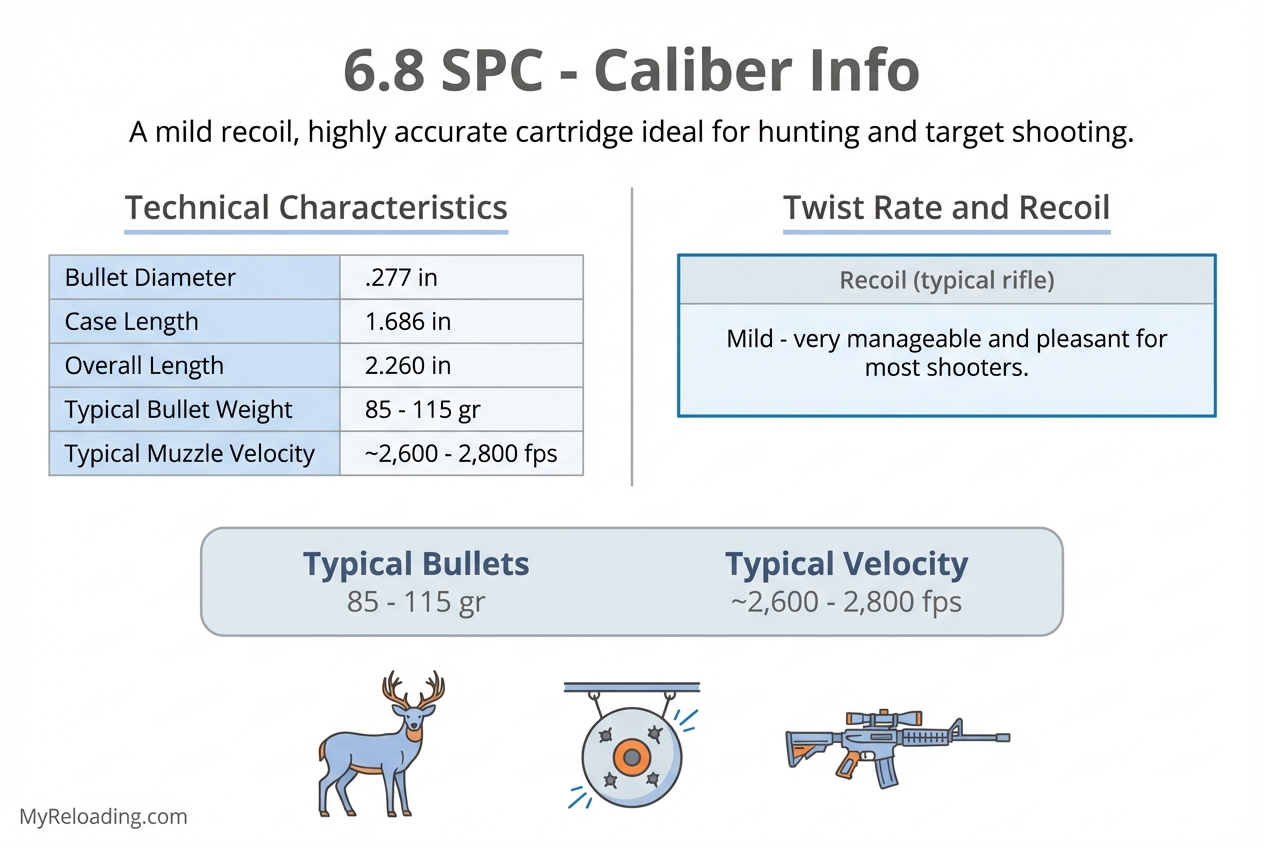
The 6.8 SPC (6.8x43mm Remington SPC), introduced in 2004, is renowned for its superior terminal performance and stopping power compared to the 5.56x45mm NATO while maintaining compatibility with the AR-15 platform. Developed through collaboration between Remington Arms, the U.S. Army Marksmanship Unit, and Special Forces operators, the cartridge was designed to provide significantly improved effectiveness on soft targets at intermediate ranges (0-500 yards) without requiring a larger rifle platform. It excels in hunting medium game such as whitetail deer, hogs, and antelope, as well as tactical and defensive applications where over-penetration concerns of the 5.56 are addressed with heavier bullets and better energy transfer. This comprehensive guide covers its specifications, advantages, recoil, comparisons to similar calibers, practical uses, ballistics, and reloading data for hunters, shooters, and reloaders.
Caliber Description
The 6.8 SPC features a bullet diameter of 0.277 inches and a case length of 1.687 inches. Bullet weights commonly range from 85 to 120 grains, with 90-115 grain projectiles dominating factory loads and handloads for optimal performance.
Full Metal Jacket (FMJ): Used for training, plinking, and general range work with reliable feeding and reduced barrel fouling.
Hunting (Soft Point, Ballistic Tip, Hollow Point): Polymer-tipped or bonded designs provide rapid expansion and weight retention for ethical kills on medium game.
Match-Grade: High-BC boat-tail hollow points or polymer-tipped bullets for precision shooting and competitive applications.
Fast-to-medium burn rate powders such as Accurate 1680, Hodgdon Benchmark, CFE223, and Alliant Reloder 7 deliver muzzle velocities of 2,550-2,800 fps depending on bullet weight and barrel length. Popular rifles include AR-15 variants from Wilson Combat, LWRC, Barrett REC7, Ruger American Ranch, and Remington 700 conversions.
Advantages: Dramatically improved terminal ballistics over 5.56 NATO, minimal modifications required for AR-15 platforms, excellent accuracy potential, effective on medium game out to 400 yards.
Disadvantages: Factory ammunition costs more and availability can be limited compared to 5.56, higher recoil than lighter varmint rounds, reduced magazine capacity in standard AR-15 magazines (typically 25 rounds vs 30).
Comparison: Compared to the 223 Remington, the 6.8 SPC delivers nearly double the muzzle energy and far superior wounding capability. Versus the 300 Blackout, it offers higher velocity and flatter trajectory in supersonic loads.
Technical Characteristics
| Characteristic | Value |
|---|---|
| Bullet Diameter (inches) | 0.277 |
| Case Length (inches) | 1.687 |
| Bullet Weight (grains) | 85-120 |
| Muzzle Velocity (fps) | 2,625 (115-grain example) |
| Muzzle Energy (ft-lbs) | 1,759 (115-grain example) |
Twist Rate Overview
The 6.8 SPC typically uses twist rates from 1:10 to 1:11, with 1:11 being the original specification that stabilizes bullets up to 115 grains exceptionally well. Faster 1:10 twists accommodate heavier 120-grain projectiles for improved long-range stability and terminal performance.
| Twist Rate | Optimal Bullet Weight (grains) | Recommended Barrel Length (inches) |
|---|---|---|
| 1:10 | 110-120 | 18-24 |
| 1:11 | 90-115 | 16-20 |
Recoil
The 6.8 SPC generates approximately 11.8 ft-lbs of free recoil energy in an 8-pound rifle using standard 115-grain factory loads. This is noticeably stouter than 5.56 but remains very manageable for most shooters, especially in well-designed AR-15 platforms with modern stocks and muzzle devices.
Recoil Comparison:
Lower Recoil: The 223 Remington produces about 4.5 ft-lbs under similar conditions.
Higher Recoil: The 308 Winchester generates approximately 17.5 ft-lbs.
The 6.8 SPC achieves an ideal balance for tactical use and hunting, providing substantial downrange authority without excessive muzzle rise or shooter fatigue.
Recoil Comparison Table
| Caliber | Recoil (ft-lbs) | Rifle Weight (pounds) |
|---|---|---|
| 6.8 SPC | 11.8 | 8 |
| 223 Remington | 4.5 | 8 |
| 308 Winchester | 17.5 | 8 |
Caliber Comparison
Compared to the 223 Remington, the 6.8 SPC offers vastly superior energy transfer and terminal performance on medium game while maintaining acceptable recoil. Versus the 300 Blackout in supersonic configuration, it provides higher velocity, flatter trajectory, and better long-range accuracy, though the 300 Blackout excels with subsonic loads and suppressors.
Comparison Table
| Caliber | Bullet Weight (grains) | Muzzle Velocity (fps) | Muzzle Energy (ft-lbs) | Effective Range (yards) |
|---|---|---|---|---|
| 6.8 SPC | 115 | 2,625 | 1,759 | 450 |
| 223 Remington | 77 | 2,750 | 1,293 | 500 |
| 300 Blackout | 125 | 2,215 | 1,362 | 400 |
For more details, see 7.62×39 vs 300 AAC Blackout and 308 Win vs 30-06 Springfield.
Applications and Practical Use
Hunting: Excellent for medium game including whitetail deer, feral hogs, coyotes, and antelope with ethical kills possible to 400 yards using premium controlled-expansion bullets.
Sport Shooting: Popular in 3-gun competition and tactical carbine matches due to reliable feeding, moderate recoil, and superior hit probability over 5.56 NATO.
Military/Self-Defense: Originally developed for special operations use; provides significantly better terminal effect than 5.56 while retaining AR-15 ergonomics and magazine compatibility.
Recommendations:
Hunting: Bonded or polymer-tipped bullets such as Hornady SST, Nosler AccuBond, or Federal Fusion for reliable expansion and penetration.
Sport Shooting: Sierra MatchKing or Hornady V-MAX for precision and consistency in competition.
Training: FMJ or remanufactured loads with 110-115 grain bullets to master recoil control while keeping costs reasonable.
Ballistics and Performance
Using Federal Premium 115-grain Fusion factory load as reference (24-inch barrel approximation):
Muzzle Velocity: 2,770 fps
Energy: 1,960 ft-lbs muzzle, approximately 900 ft-lbs at 400 yards
Trajectory Drop: Moderately flat with modern high-BC bullets
Ballistic Coefficient (BC): 0.350 G1 typical for 115-grain Fusion
The cartridge delivers excellent performance to 500 yards, maintaining lethal energy and accuracy well beyond typical 5.56 capabilities.
Basic Ballistics Table
| Distance (yards) | Velocity (fps) | Energy (ft-lbs) | Drop (inches) |
|---|---|---|---|
| 0 | 2,770 | 1,960 | -1.5 |
| 100 | 2,520 | 1,624 | +2.5 |
| 200 | 2,285 | 1,335 | 0 |
| 300 | 2,065 | 1,090 | -9.8 |
| 400 | 1,860 | 885 | -29.5 |
| 500 | 1,670 | 713 | -62.0 |
Note: Data for standard conditions: 59°F, sea level, sight height 1.5 inches, zeroed at 200 yards, 24-inch barrel, approximate G1 BC 0.350.
Long-Range Performance
At 1000 yards:
Velocity: Approximately 1,200 fps
Energy: Approximately 368 ft-lbs
Drop: Approximately 320 inches (with 200-yard zero)
Wind Drift: Approximately 110 inches in 10 mph crosswind
While not a dedicated long-range cartridge, the 6.8 SPC significantly outperforms the 5.56 NATO at extended distances and remains effective for specialized applications with proper handloads.
Factors Affecting Performance
Multiple variables influence real-world results with the 6.8 SPC.
Atmospheric Conditions: Higher altitudes and warmer temperatures increase velocity; dense cold air requires load adjustments for consistent accuracy.
Powder Type: Temperature-stable powders such as CFE223 or Hodgdon Extreme series maintain velocity extremes.
Barrel Length: Velocity gain of approximately 25-50 fps per inch above 16 inches; 18-20 inch barrels provide optimal balance for most applications.
Trajectory Calculation: Use modern ballistic applications incorporating actual BC, environmental data, and drag functions for precise holdovers.
Reloading
Reloading the 6.8 SPC is highly economical and allows customization far beyond factory offerings. Component availability has improved dramatically since introduction, with excellent brass from Starline, Lapua, and Peterson. Always start with published SAAMI-spec data from reputable sources such as Hodgdon, Alliant, or Accurate, work up loads incrementally while monitoring pressure signs carefully.
Primers and Cases
| Component Type | Common Brands/Markings | Suitable For |
|---|---|---|
| Primer | Large Rifle | CCI 200, Remington 7½ |
| Primer | Large Rifle Magnum | CCI 250, Federal 215 |
| Case | Brass | Starline, Remington, Hornady |
Bullets
| Bullet Brand/Model | Weight (grains) | Type | Best For |
|---|---|---|---|
| Hornady V-MAX | 110 | Polymer tip | Varmint/predator |
| Sierra Pro-Hunter | 115 | Soft point | Medium game hunting |
| Nosler AccuBond | 110 | Bonded polymer tip | All-around hunting |
| Barnes TTSX | 110 | Monolithic copper | Lead-free hunting |
| Speer Gold Dot | 115 | Bonded hollow point | Self-defense/tactical |
Powders
| Powder Brand/Marking | Suitable Bullet Weights (grains) | Best For |
|---|---|---|
| Accurate 1680 | 100-120 | Compact charges |
| Hodgdon Benchmark | 90-110 | Accuracy |
| Alliant Reloder 7 | 85-110 | Velocity |
| Hodgdon H322 | 90-115 | Classic performance |
| Winchester 748 | 100-120 | Consistent metering |
| Accurate 2200 | 85-110 | Reduced loads |
| Hodgdon CFE223 | 90-115 | Copper fouling reduction |
| Alliant Power Pro 2000-MR | 100-120 | Temperature stability |
| Ramshot TAC | 90-115 | Tactical applications |
| Vihtavuori N120 | 85-105 | Light varmint loads |
Practical Considerations
Barrel Wear: Moderate operating pressure (55,000 psi) results in good barrel life; proper cleaning and avoiding over-max loads extends service significantly.
Optics and Setup: Pair with low-power variable optics (1-6x or 1-8x) for tactical use or 3-15x for hunting; quality mounts and lightweight stocks maximize the cartridge’s versatility.
Conclusion
The 6.8 SPC remains one of the most effective intermediate cartridges available nearly two decades after introduction, offering a compelling blend of power, accuracy, and practicality in the AR-15 platform. Its proven terminal performance on game and targets, combined with mature component support and reloading flexibility, ensures continued popularity among hunters, tactical shooters, and enthusiasts seeking more capability than 5.56 without moving to larger rifles. As interest in enhanced AR-performance cartridges grows, the 6.8 SPC continues to deliver outstanding real-world results.


